
JEE Main April 2026 Day 1 Exam Analysis: Students Say Paper Was Easier Than January Session
 aspirantmitraa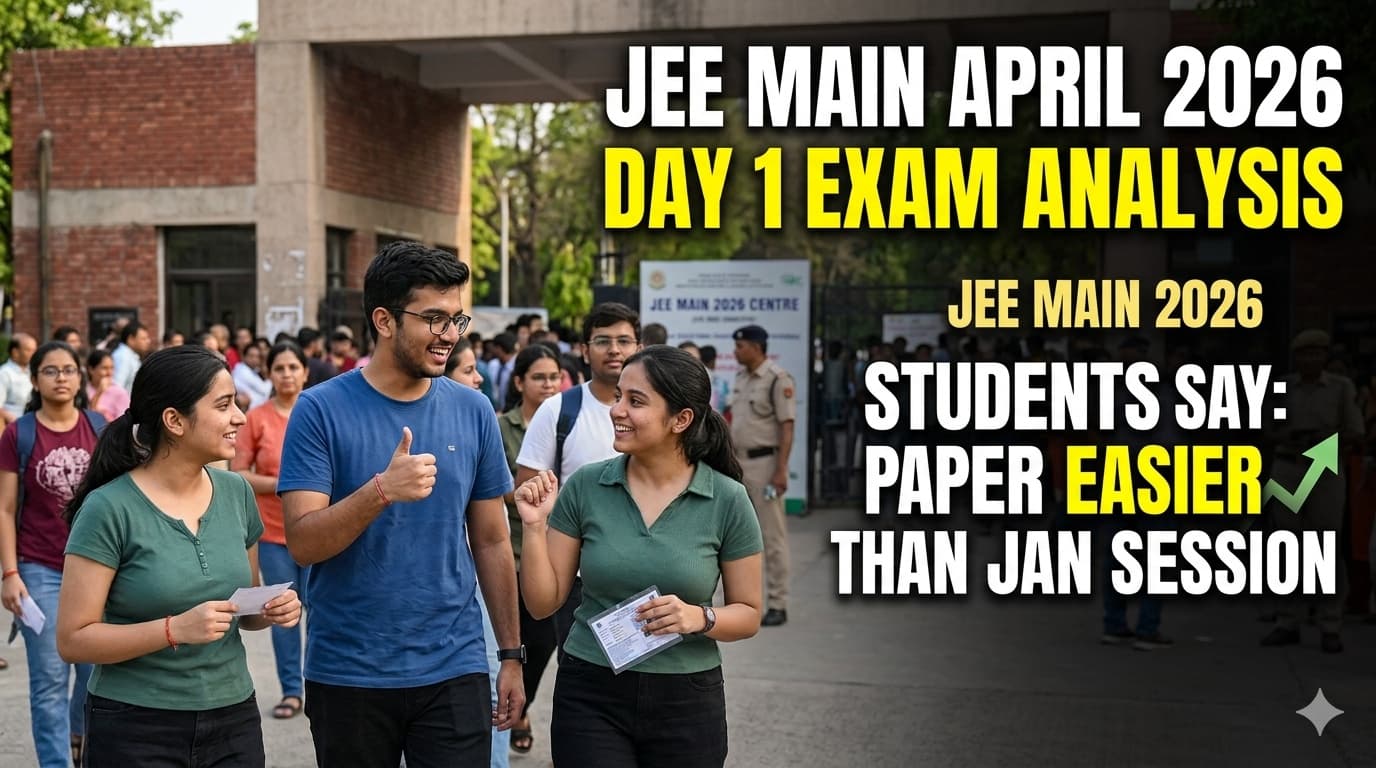
JEE Main 2026 Session 2 finally kicked off on April 2, 2026, and students walked out of examination centres with a collective sigh of relief. Day 1 of the April attempt set a positive tone for the entire session. Based on student reactions, memory‑based question recalls, and expert insights gathered right after both shifts, the overall paper was moderate in difficulty and was widely considered more approachable than the January session.
In this blog, we break down everything about JEE Main April 2 2026 from a student perspective, covering both Shift 1 and Shift 2 in detail, including subject‑wise analysis, important topics, expected good attempts, marks vs percentile estimates, and preparation tips for students yet to appear.
Ready to Ace Your Exam?
Practice with our comprehensive test series designed by experts. Get detailed solutions, performance analytics, and boost your preparation.
Explore Test SeriesQuick Overview: JEE Main April 2, 2026
- Total Questions: 75 (25 each from Physics, Chemistry, and Mathematics)
- Total Marks: 300
- Mode: Computer‑Based Test (CBT)
- Marking Scheme: +4 for correct, -1 for incorrect
- Exam Centres: 566 centres across 304 cities in India and 14 cities abroad
- Approximate Candidates: Around 11.23 lakh candidates registered for Session 2
Overall Difficulty: What Students Said After the Exam
The overall consensus from students after both shifts on April 2 was clear: the paper was moderate and friendlier than January 2026. Here is what came out based on student reactions collected at exam centre gates and online forums:
- Shift 1 was rated easy to moderate by most students
- Shift 2 was rated moderate to slightly difficult
- Chemistry was the easiest section in both shifts
- Mathematics was the most time‑consuming section in both shifts
- Physics sat comfortably in the middle, ranging from easy to moderate
- Many students felt more confident compared to how they felt after the January paper
- The difficulty order across both shifts remained: Mathematics > Physics > Chemistry
One student from Pune said, "The paper was very balanced today. Chemistry was like reading NCERT directly. Maths took the most time but nothing was impossible." Another student from Delhi mentioned, "Physics was cleaner than what I expected. Most questions were formula‑based and direct."
JEE Main April 2, 2026 Shift 1 Analysis (Morning: 9 AM to 12 PM)
Overall Difficulty: Easy to Moderate
Shift 1 set a positive opening for Session 2. The paper had a balanced mix of conceptual and application‑based questions without being excessively tricky. Students with strong fundamentals found the paper very manageable.
Physics Analysis: Shift 1
- Difficulty Level: Easy
- Nature of Questions: Formula‑based and concept‑driven
- Class‑wise Weightage: Higher weightage from Class 11 topics in this shift
- Time Consumption: Low, most students finished Physics without rushing
Important topics asked in Physics Shift 1:
- Electrostatics
- Ray Optics
- Kinematics
- Thermodynamics
- Electromagnetic Induction (EMI)
- Modern Physics
- Semiconductor
- Rotational Motion
- Wave Optics
- Units and Dimensions
- Thermodynamics
- Fluids
- Gravitation
Students described Physics as the most scoring section in Shift 1. Questions did not demand lengthy calculations and were mostly straightforward for those who had revised formulas.
Chemistry Analysis: Shift 1
- Difficulty Level: Very Easy
- Nature of Questions: Mostly NCERT‑based, direct, and concept‑oriented
- Weightage: Inorganic Chemistry > Physical Chemistry > Organic Chemistry
- Special Question Types: A few Assertion and Reason type questions appeared
Important topics asked in Chemistry Shift 1:
- Coordination Compounds
- Chemical Bonding
- Salt Analysis (Salts)
- Periodic Table
- Ionic Equilibrium
- Biomolecules
- Amines
- Chemical Kinetics
- General Organic Chemistry (GOC)
- Inorganic Chemistry concepts
Students unanimously agreed that Chemistry was the easiest and most scoring section. If you had read NCERT thoroughly, most questions could be answered directly without any calculations.
Mathematics Analysis: Shift 1
- Difficulty Level: Moderate
- Nature of Questions: Balanced but required clear concepts and careful calculation
- Time Consumption: Higher than Physics and Chemistry; needed approximately 90 minutes
- Good Attempts: 50 to 60 questions overall is considered a safe attempt for this shift
Important topics asked in Mathematics Shift 1:
- Coordinate Geometry: Straight Lines, Circles
- Conic Sections: Ellipse and Parabola
- Trigonometry
- Integral Calculus
- Vectors and 3D Geometry
- Matrices and Determinants
- Sequences and Series
- Probability
- Relations and Functions
- Quadratic Equations
Mathematics was the only section that tested students on time management. Questions were not impossibly tough but required careful step‑by‑step working. Students who rushed through Maths without checking calculations likely lost marks due to silly errors.
Expected Score vs Percentile (Shift 1 Estimates):
- 220+ marks: 99.99 percentile range
- 180 to 190 marks: 99 percentile range
- 170+ marks: 90 percentile range
- 140 to 160 marks: Around the JEE Advanced cutoff zone
JEE Main April 2, 2026 Shift 2 Analysis (Afternoon: 3 PM to 6 PM)
Overall Difficulty: Moderate to Difficult
Shift 2 was a notch harder than the morning shift. The Mathematics section became the biggest challenge, and Chemistry turned slightly lengthier compared to Shift 1. Students who appeared for the afternoon shift found the paper more demanding in terms of time.
Physics Analysis: Shift 2
- Difficulty Level: Moderate
- Nature of Questions: Conceptual type with some formula application
- Class‑wise Weightage: Higher weightage from Class 12 topics
- Note: Had a good presence of questions from Fluid Mechanics
Important topics asked in Physics Shift 2:
- Electrostatics
- Current Electricity
- Ray Optics
- Fluids
- Modern Physics
- Heat and Thermodynamics
- Kinetic Theory of Gases (KTG)
- Wave Optics
- Units and Dimensions
- Error Analysis
- Magnetism
- Thermodynamics
- Friction
- Gravitation
- Electromagnetic Waves
Chemistry Analysis: Shift 2
- Difficulty Level: Moderate to slightly difficult (felt lengthier than Shift 1)
- Nature of Questions: Some NCERT‑based, but with more application than Shift 1
- Student Feedback: Chemistry was not as straightforward as the morning; some questions felt unexpected
Important topics asked in Chemistry Shift 2:
- Coordination Compounds
- Amines
- Chemical Kinetics
- Ionic Equilibrium
- Chemical Bonding
- Salts
- General Organic Chemistry (GOC)
- Inorganic Chemistry
Mathematics Analysis: Shift 2
- Difficulty Level: Moderate to Difficult
- Nature of Questions: Lengthy, calculation‑intensive, broad chapter coverage
- Student Feedback: Maths was the clear bottleneck; time management was the deciding factor
- Key Observation: Students could not rely on selective preparation because questions came from across the entire syllabus
Important topics asked in Mathematics Shift 2:
- Calculus and Integration
- Straight Lines and Circles
- Conic Sections
- Quadratic Equations
- Sequences and Series
- Probability
- Permutation and Combination
- Binomial Theorem
- Matrices and Determinants
- Vectors and 3D Geometry
Expected Score vs Percentile (Shift 2 Estimates):
- 99 percentile: Expected around 160 to 170 marks range
- The cutoff is slightly lower than Shift 1 because the paper was tougher overall
Shift 1 vs Shift 2: A Quick Comparison
Both shifts maintained a moderate overall difficulty on Day 1. The key differences were:
- Shift 1 was friendlier, especially in Chemistry and Physics
- Shift 2 felt more difficult primarily because of the Mathematics section
- Broad chapter coverage in Shift 2 made selective preparation risky
- Students appearing for later shifts should treat both these papers as a reference
- Chemistry remained the most consistent and scoring section across both shifts
- Normalization by NTA will account for the difference between shifts in the final percentile
What This Paper Tells Students Appearing in Later Shifts
If your JEE Main 2026 exam is on April 4, 5, 6, or 8, here are the most important takeaways from Day 1:
Focus Topics Based on April 2 Trends:
For Mathematics:
- Integral Calculus is a high‑priority topic
- Vectors and 3D Geometry appeared in both shifts
- Coordinate Geometry, especially circles and straight lines, is essential
For Chemistry:
- Coordination Compounds appeared in both shifts, prioritize this
- Ionic Equilibrium and GOC are must‑revise topics
- NCERT reading is non‑negotiable for Chemistry
For Physics:
- Ray Optics appeared prominently
- Thermodynamics is a consistent high‑weightage chapter
- Modern Physics and Electrostatics need solid preparation
General Strategy Tips from Day 1 Observations:
- Attempt Chemistry first to secure easy marks and boost confidence
- Leave at least 90 minutes for Mathematics
- Do not skip NCERT for Chemistry under any circumstances
- Practice formula recall for Physics rather than deriving from scratch in the exam hall
- If a question in Maths is taking more than 4 minutes, move on and return later
JEE Main April 2 2026: Expert Summary
Coaching institutes and subject experts reviewed the Day 1 papers and concluded the following:
- Session 2 maintained a similar pattern to Session 1 with no structural changes
- The overall difficulty was comparable to JEE Main 2025 papers, slightly more balanced
- Mathematics was the one section that created differentiation between students
- Students who skipped selective topics and prepared the full syllabus benefited the most
- The paper favoured students with strong NCERT base and formula clarity
Frequently Asked Questions (FAQs)
Q1. What was the overall difficulty of JEE Main April 2, 2026? The paper was easy to moderate in Shift 1 and moderate in Shift 2. Both shifts were considered easier than the January session overall.
Q2. Which subject was toughest on Day 1? Mathematics was the toughest section in both shifts due to lengthy and calculation‑heavy questions.
Q3. Was Chemistry easy in JEE Main April 2, 2026? Yes, Chemistry was the easiest and most NCERT‑based section in Shift 1. Shift 2 Chemistry was slightly longer but still manageable.
Q4. How many good attempts are expected for a 99 percentile? Based on Day 1 difficulty, a score of around 180 to 190 marks is expected to land around 99 percentile in Shift 1. For Shift 2, the expected range is around 160 to 170 marks.
Q5. Was there any change in exam pattern? No major changes were observed in the exam pattern. The CBT format with 75 questions and 300 marks remained the same.
Q6. When will the official answer key be released? The official answer key for JEE Main Session 2 will be released by NTA after the completion of all shifts, on the official website jeemain.nta.nic.in.
Note: This analysis is based on student feedback, memory‑based question recalls, and expert review collected after the exam. Difficulty levels and percentile estimates are indicative and may vary after NTA's official normalization process.
Ready to Ace Your Exam?
Practice with our comprehensive test series designed by experts. Get detailed solutions, performance analytics, and boost your preparation.
Explore Test Series