
UPSC CSE Syllabus: Complete Prelims and Mains Guide with All Subjects and Topics
 aspirantmitraa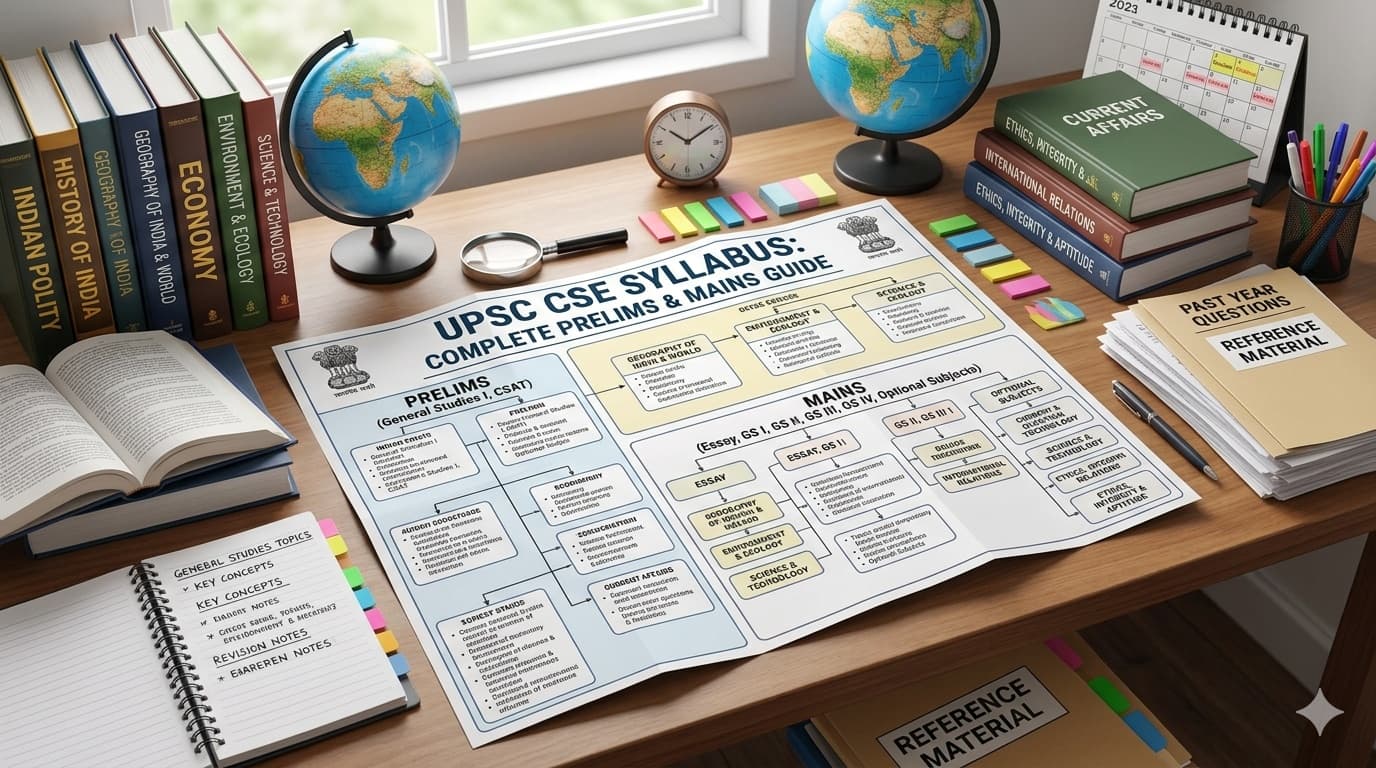
What is UPSC CSE? Everything a Aspirant Needs to Know
The Union Public Service Commission Civil Services Examination, commonly known as UPSC CSE or IAS Exam, is the most prestigious and competitive examination in India. Conducted every year by the Union Public Service Commission, it is the gateway to India's most powerful administrative, diplomatic, and law enforcement services including the Indian Administrative Service (IAS), Indian Police Service (IPS), Indian Foreign Service (IFS), Indian Revenue Service (IRS), and over two dozen other Group A and Group B central services.
This blog covers the complete UPSC CSE syllabus for Prelims, Mains, and the optional subjects, along with exam pattern, important dates, eligibility criteria, preparation strategy, and recommended books. Whether you are a fresh graduate starting your UPSC journey or a repeat aspirant looking for a structured guide, this is the only resource you need.
Ready to Ace Your Exam?
Practice with our comprehensive test series designed by experts. Get detailed solutions, performance analytics, and boost your preparation.
Explore Test SeriesUPSC CSE Exam Structure: Three Stages Explained
The Civil Services Examination is conducted in three successive stages. Clearing one stage is mandatory to appear in the next.
Stage 1: Preliminary Examination (Prelims)
The Prelims is an objective‑type screening exam. It consists of two papers held on the same day. The marks scored in Prelims are not counted in the final merit list; they are only used to shortlist candidates for the Mains examination.
- General Studies Paper I (GS Paper I): 100 questions, 200 marks, 2 hours. Negative marking of 1/3rd for wrong answers.
- General Studies Paper II (CSAT): 80 questions, 200 marks, 2 hours. This is a qualifying paper with a minimum passing threshold of 33 percent (66 marks out of 200).
Stage 2: Main Examination (Mains)
The Mains is a descriptive, written examination consisting of 9 papers spread over 5 days. Out of the 9 papers, 7 papers are merit‑based and 2 are qualifying in nature. The total marks counted for the final merit list from Mains are 1750.
Stage 3: Personality Test (Interview)
Candidates who qualify the Mains examination are called for the Personality Test conducted by a UPSC board. The interview carries 275 marks. The final merit list is prepared based on the combined marks of Mains (1750 marks) and Interview (275 marks), totalling 2025 marks.
UPSC CSE Eligibility Criteria
Before diving into the syllabus, every aspirant must verify their eligibility.
Nationality:
- For IAS and IPS: The candidate must be a citizen of India.
- For other services: Citizens of India, subjects of Nepal or Bhutan, Tibetan refugees who came to India before 1st January 1962, and Persons of Indian Origin (PIO) from specific countries are eligible subject to eligibility certificates.
Educational Qualification:
- The candidate must hold a degree from any university incorporated by an act of the Central or State Legislature, or possess an equivalent qualification.
- Candidates who are in the final year of graduation are also eligible to apply for Prelims.
Age Limit:
- General category: 21 to 32 years
- OBC candidates: 21 to 35 years (3 years relaxation)
- SC and ST candidates: 21 to 37 years (5 years relaxation)
- PwBD (Persons with Benchmark Disability): Additional relaxation of 10 years over the category limit
Number of Attempts:
- General category: 6 attempts
- OBC candidates: 9 attempts
- SC and ST candidates: Unlimited attempts (up to the age limit)
- An attempt is counted only when a candidate actually appears for at least one paper of the Preliminary Examination.
Application Fee:
- General, OBC, and EWS male candidates: Rs. 100
- Female candidates: Exempted
- SC, ST, and PwBD candidates: Exempted
Track Your UPSC CSE Syllabus Topic by Topic
The UPSC CSE syllabus is one of the most vast syllabi of any competitive exam in the world. With topics spanning history, geography, polity, economy, science, environment, ethics, essay writing, and an optional subject of your choice, it is virtually impossible to track your preparation without a structured system.
Aspirant Mitraa has built a completely free and detailed UPSC CSE Syllabus Tracker at https://www.aspirantmitraa.com/syllabus/upsc‑cse‑2027 where you can mark each topic across Prelims GS, Mains GS I to GS IV, Essay, and optional subjects as studied, in progress, or pending. This tracker is built specifically for UPSC aspirants who want to leave nothing to chance.
UPSC CSE Prelims Syllabus: Complete Breakdown
GS Paper I Syllabus (General Studies)
GS Paper I of UPSC Prelims covers six major subject areas. Questions test factual knowledge, analytical ability, and current affairs.
History of India and Indian National Movement
- Prehistoric, Vedic, and Early Historical Period
- Mauryan and Post‑Mauryan Period
- Gupta Period and Post‑Gupta Era
- Medieval India including Delhi Sultanate, Mughal Empire, Bhakti and Sufi Movements
- Advent of Europeans and British colonialism
- Socio‑religious reform movements of the 19th century
- Indian National Movement including Moderate and Extremist phases
- Gandhian era and mass movements: Non‑Cooperation, Civil Disobedience, Quit India
- Revolutionary movements and contributions of key leaders
- Partition, Independence, and Integration of Princely States
Indian and World Geography
- Physical geography: Geomorphology, climatology, oceanography, biogeography
- Indian physical features: Himalayan ranges, river systems, plains, plateaus, coastline
- Indian agriculture, soil types, irrigation systems and cropping patterns
- Minerals and industries in India
- Population distribution, growth, density, migration, and urbanization
- World geography: Major landforms, climate zones, oceans, and natural resources
- Economic geography: Trade routes, global energy resources, major industries worldwide
- Important international borders and geopolitical boundaries
Indian Polity and Governance
- Indian Constitution: Historical background, Preamble, Salient features
- Fundamental Rights, Directive Principles, and Fundamental Duties
- Parliament, President, Prime Minister, Council of Ministers, and Cabinet
- State governments: Governor, Chief Minister, State Legislature
- Judiciary: Supreme Court, High Courts, independence and powers
- Panchayati Raj and Urban Local Bodies
- Elections: Election Commission of India, electoral reforms
- Public Policy, Rights Issues, RTI, Lokpal, CAG
- Constitutional and Statutory Bodies
- Centre‑State relations and Federal structure
Economic and Social Development
- Indian economy: Planning, economic reforms since 1991
- Poverty, inequality, and social exclusion
- Sustainable development and inclusive growth
- Demographics and social sector initiatives
- Money, banking, inflation, and monetary policy
- Union Budget, fiscal policy, government spending
- International organizations: WTO, IMF, World Bank, and India's participation
- Social issues: Education, health, gender, child welfare
General Issues on Environmental Ecology, Biodiversity, and Climate Change
- Ecology: Ecosystems, food chains, energy flow, nutrient cycling
- Biodiversity: Types, importance, threats, conservation strategies
- Protected areas: National parks, wildlife sanctuaries, biosphere reserves
- Climate change: Causes, consequences, international agreements (Paris Agreement, COP)
- Pollution: Air, water, soil, and noise pollution and their impacts
- Environmental legislation in India: Environment Protection Act, Wildlife Protection Act, Forest Rights Act
- Disaster Management: Types of disasters, NDMA, disaster risk reduction
General Science
- Physics: Basic concepts relevant to daily life and technology
- Chemistry: Common chemical reactions, everyday applications
- Biology: Human body, diseases, nutrition, genetics, biotechnology basics
- Science and Technology: Space, defence, IT, nuclear technology, nanotechnology
- Recent developments in science and technology at national and international level
GS Paper II Syllabus (CSAT)
CSAT is a qualifying paper. A minimum of 33 percent (66 marks out of 200) must be scored.
- Comprehension passages in English and Hindi
- Interpersonal skills including communication skills
- Logical reasoning and analytical ability
- Decision making and problem solving
- General mental ability
- Basic numeracy: numbers, relations, orders of magnitude (Class X level)
- Data interpretation: charts, graphs, tables, data sufficiency (Class X level)
UPSC CSE Mains Syllabus: All Papers Explained
The Mains examination consists of 9 papers. Paper A (Indian Language) and Paper B (English) are qualifying papers and their marks are not counted in the merit list. The remaining 7 papers carry marks that determine the final rank.
Overview of Mains Papers:
- Paper A: Indian Language (Qualifying, 300 marks)
- Paper B: English (Qualifying, 300 marks)
- Paper I: Essay (250 marks)
- Paper II: General Studies I (250 marks)
- Paper III: General Studies II (250 marks)
- Paper IV: General Studies III (250 marks)
- Paper V: General Studies IV (250 marks)
- Paper VI: Optional Subject Paper I (250 marks)
- Paper VII: Optional Subject Paper II (250 marks)
Total merit‑based marks: 1750 (Mains) + 275 (Interview) = 2025
Essay Paper (Paper I)
Candidates are required to write essays on two topics (one from each section), typically about 1000 to 1200 words each. Essay topics cover:
- Philosophical and abstract themes
- Socio‑economic issues
- Governance and polity
- Science, technology, and innovation
- Environmental and ethical dimensions
- Women, education, and social change
Good essays demand original thinking, structured argumentation, clarity of expression, and balanced perspectives.
General Studies I (Paper II): Indian Heritage, Culture, History, and Geography
Indian Heritage and Culture
- Salient aspects of art forms, literature, and architecture from ancient to modern times
- Indian sculpture, cave paintings, temple architecture, classical music and dance
- Culture and traditions of different regions of India
- Contributions of Indian thinkers, saints, and reformers
Modern Indian History
- Significant events and personalities from the mid‑18th century onwards
- Freedom struggle: various stages and key contributions
- Post‑independence consolidation and reorganization of India
World History
- Significant events from the 18th century onwards
- World Wars, Cold War, decolonization, and emergence of new nations
- Industrial Revolution and its global impact
- Spread of communism, capitalism, and rise of nationalism
Indian Society
- Salient features of Indian society and its diversity
- Role of women and women's organizations
- Population and associated issues, poverty and developmental issues
- Urbanization and problems, effects of globalization on Indian society
- Social empowerment, communalism, regionalism, secularism
Geography
- Salient features of world's physical geography
- Distribution of key natural resources across the world
- Factors responsible for location of primary, secondary, and tertiary sector industries
- Important geophysical phenomena: earthquakes, tsunamis, volcanic activity, cyclones
- Geographical features and changes and their effect on flora, fauna, and human population
General Studies II (Paper III): Governance, Constitution, Polity, Social Justice, and International Relations
Indian Constitution and Governance
- Indian Constitution: historical underpinnings, evolution, features, amendments, and basic structure
- Functions and responsibilities of the Union and States: federalism, dispute redressal mechanisms
- Separation of powers between various organs, disputes and conflicts
- Parliament and State Legislatures: structure, functioning, conduct of business, privileges
- Executive and Judiciary: structure, organization, powers, and functioning
- Ministries and Departments of the Government of India
- Pressure groups and formal/informal associations and their role in polity
Governance, Transparency, and Accountability
- Important aspects of governance: transparency, accountability, e‑governance initiatives
- Role of civil services in democracy
- Government policies and interventions for development in various sectors
- Development processes and the development industry: role of NGOs, SHGs, and various groups
Social Justice
- Welfare schemes for vulnerable sections by Centre and States
- Issues relating to development and management of Social Sector or Services
- Issues relating to poverty and hunger, health, education, and human resource development
- Issues relating to SC, ST, OBC, minorities, women, children, and differently‑abled persons
International Relations
- India and its neighbourhood: relations with Pakistan, China, Nepal, Bhutan, Bangladesh, Sri Lanka, Afghanistan, and Myanmar
- Bilateral, regional, and global groupings and agreements involving India
- Effect of policies and politics of developed and developing countries on India's interests
- Important international institutions: UN, WHO, WTO, IMF, World Bank, and their functions
- India's foreign policy, soft power, and diaspora
General Studies III (Paper IV): Technology, Economic Development, Biodiversity, Environment, Security, and Disaster Management
Economy and Development
- Indian economy and its planning: growth, development, and employment
- Inclusive growth and issues arising from it
- Government budgeting, fiscal federalism, and taxation reforms
- Major crops and cropping patterns in various parts of India, irrigation
- Food processing industries: scope and significance, supply chain management
- Land reforms in India
- Effects of liberalization, privatization, and globalization
- Infrastructure: energy, ports, roads, airports, railways, and their economic importance
- Investment models and public‑private partnerships
Science and Technology
- Developments and their applications and effects in everyday life
- Achievements of Indians in science and technology
- Awareness in the fields of IT, Space, Computers, Robotics, Nanotechnology, Biotechnology
- Issues relating to intellectual property rights
Environment, Ecology, and Disaster Management
- Conservation and environmental pollution and degradation
- Environmental impact assessment
- Disaster and disaster management: preparedness, mitigation, and reconstruction
- Linkages between development and spread of extremism
Internal Security
- Role of external state and non‑state actors in creating challenges to internal security
- Communication networks, media and social networking in internal security challenges
- Basics of cyber security, money‑laundering, and prevention
- Security challenges and their management in border areas
- Various security forces and agencies and their mandate
- Linkages between organized crime and terrorism
General Studies IV (Paper V): Ethics, Integrity, and Aptitude
This paper tests candidates' understanding of ethical dimensions of governance and their ability to apply ethical principles to real‑life situations. It is the most unique paper in the UPSC CSE Mains.
Ethics and Human Interface
- Essence, determinants, and consequences of ethics in human actions
- Dimensions of ethics, private and public relationships
- Human values: lessons from the lives and teachings of great leaders, reformers, and administrators
- Role of family, society, and educational institutions in inculcating values
Attitude
- Content, structure, function, its influence and relation with thought and behaviour
- Moral and political attitudes, social influence and persuasion
Aptitude and Foundational Values for Civil Services
- Integrity, impartiality, non‑partisanship, objectivity, dedication to public service
- Empathy, tolerance, compassion towards the weaker sections
Emotional Intelligence
- Concepts and their utilities and application in administration and governance
Contributions of Moral Thinkers and Philosophers from India and World
- Key thinkers: Chanakya, Gandhi, Ambedkar, Vivekananda, Aristotle, Kant, Rawls, Bentham, and others
Public or Civil Service Values and Ethics in Public Administration
- Status and problems, ethical concerns and dilemmas in government and private institutions
- Laws, rules, regulations, and conscience as sources of ethical guidance
- Accountability and ethical governance
Probity in Governance
- Concept of public service, philosophical basis of governance
- Information sharing and transparency in government
- Codes of Ethics, Codes of Conduct, Citizen's Charters
- Work culture, quality of service delivery, challenges of corruption
Case Studies on Above Issues
Candidates must practice writing structured, multi‑perspective answers to ethical dilemmas presented as case studies. This section carries significant weightage.
Qualifying Paper A: Indian Language
Candidates must choose one Indian language from the Eighth Schedule of the Indian Constitution. This paper tests reading comprehension, essay writing, translation, and grammar in the chosen language. It is qualifying in nature (minimum 25 percent required) and marks are not counted in the merit list.
Some commonly chosen Indian languages include Hindi, Marathi, Telugu, Tamil, Kannada, Malayalam, Bengali, Punjabi, Gujarati, Odia, and Urdu.
Qualifying Paper B: English
This paper tests the candidate's ability in English language through comprehension, essay, precis writing, translation from the chosen Indian language to English, and grammar. It is qualifying in nature and marks are not counted in the merit list.
UPSC CSE Optional Subject Syllabus
Every candidate must choose one optional subject for the Mains examination. Optional Subject Paper I and Paper II together carry 500 marks (250 marks each) and are counted in the final merit list. Choosing the right optional subject is one of the most important strategic decisions in UPSC CSE preparation.
Complete List of UPSC Optional Subjects:
- Agriculture
- Animal Husbandry and Veterinary Science
- Anthropology
- Botany
- Chemistry
- Civil Engineering
- Commerce and Accountancy
- Economics
- Electrical Engineering
- Geography
- Geology
- History
- Law
- Management
- Mathematics
- Mechanical Engineering
- Medical Science
- Philosophy
- Physics
- Political Science and International Relations
- Psychology
- Public Administration
- Sociology
- Statistics
- Zoology
- Literature of any one of the following languages: Assamese, Bengali, Bodo, Dogri, Gujarati, Hindi, Kannada, Kashmiri, Konkani, Maithili, Malayalam, Manipuri, Marathi, Nepali, Odia, Punjabi, Sanskrit, Santhali, Sindhi, Tamil, Telugu, Urdu, and English
The most popular optional subjects based on number of candidates and success rate include Geography, Anthropology, Public Administration, Sociology, History, Political Science and International Relations, and Psychology.
How to Choose the Right Optional Subject:
- Choose a subject that aligns with your graduation background whenever possible.
- Check the overlap with the GS papers: subjects like Geography, History, Polity, and Sociology have significant overlap with GS I, GS II, and GS IV.
- Assess the availability of quality study material and coaching resources.
- Look at the previous year success rates and topper trends.
- Evaluate the scoring consistency of the subject across years.
Start Tracking Your UPSC CSE Preparation Right Now
UPSC preparation is a multi‑year journey that demands meticulous planning. The biggest mistake most aspirants make is studying without tracking: they repeat topics they have already covered, miss out on low‑priority but high‑yield areas, and go into the exam with uneven preparation.
The Aspirant Mitraa UPSC CSE Syllabus Tracker at https://www.aspirantmitraa.com/syllabus/upsc‑cse‑2027 solves this problem completely. It is a free, topic‑wise syllabus tracker designed specifically for UPSC aspirants. You can track your progress across Prelims GS Paper I, CSAT, all four Mains GS papers, Essay, and your chosen optional subject, all in one place. Mark each subtopic as done, in progress, or pending and always know exactly where you stand.
UPSC CSE Preparation Strategy: A Complete Roadmap
UPSC CSE aspirants who start early and follow a structured strategy have a significantly higher success rate. Here is a month‑by‑month approach based on how toppers have prepared.
Phase 1: Foundation Building (12 to 18 months before Prelims)
- Read all relevant NCERT books from Class VI to Class XII for History, Geography, Polity, Economics, Science, and Environment.
- Start with standard books for each subject in parallel.
- Begin reading a daily newspaper (The Hindu or Indian Express) for current affairs.
- Complete the GS syllabus mapping so every topic is accounted for.
Phase 2: Depth and Optional (9 to 12 months before Prelims)
- Complete your chosen optional subject once with standard books.
- Deepen your understanding of GS subjects with advanced texts.
- Start writing short notes for high‑yield topics.
- Attempt subject‑wise mock tests.
Phase 3: Integration and Mains Preparation (6 to 9 months before Prelims)
- Practice answer writing daily with a 200 to 250 word structure for GS questions.
- Write at least one essay per week.
- Revise optional subject for the second time.
- Follow current affairs rigorously and link them to static syllabus topics.
Phase 4: Prelims Sprint (Last 3 months before Prelims)
- Attempt full‑length Prelims mock tests under timed conditions.
- Target at least 5 to 6 full mock tests per week.
- Focus on revision of high‑yield areas: Polity, Environment, Economy, and Current Affairs.
- Do not start new topics in the last 30 days; only revise.
Phase 5: Mains Focus (Prelims to Mains, approximately 3 months)
- Write full‑length answer practice every day.
- Complete your optional subject for the third time.
- Strengthen essay writing with a variety of topics.
- Practice case studies for GS IV Ethics paper.
UPSC CSE Recommended Books: Subject‑Wise
The following books are used by toppers and recommended by top coaching institutes consistently.
History:
- Ancient and Medieval India by Poonam Dalal Dahiya
- A Brief History of Modern India (Spectrum)
- India's Struggle for Independence by Bipan Chandra
Geography:
- Certificate Physical and Human Geography by G.C. Leong
- Indian and World Geography by Majid Husain
- NCERT Geography books (Class XI and XII)
Indian Polity:
- Indian Polity by M. Laxmikanth (most important book for Polity)
- Introduction to the Constitution of India by D.D. Basu
Economy:
- Indian Economy by Ramesh Singh
- Economic Survey (annual publication by Ministry of Finance)
- India Year Book (annual)
Environment and Ecology:
- Environment by Shankar IAS Academy
- NCERT Biology (Class XII)
Ethics (GS IV):
- Ethics, Integrity and Aptitude by G. Subba Rao and P.N. Roy Chowdhury
- Lexicon for Ethics, Integrity and Aptitude by Niraj Kumar
Science and Technology:
- Vision IAS Science and Technology notes
- The Hindu newspaper science section
Current Affairs:
- The Hindu and Indian Express (daily)
- Vision IAS Monthly Magazine
- Drishti IAS Monthly Magazine
- Government websites: PIB, PRS India, Ministry websites
Personality Test (Interview): UPSC CSE
The Personality Test, often called the UPSC Interview, is the final stage of the Civil Services Examination. It carries 275 marks.
Important points about the UPSC Interview:
- It is not a knowledge test but a test of your personality, suitability for public service, and overall character.
- The interview board assesses mental alertness, critical powers of assimilation, and clear and logical exposition of ideas.
- Balance of judgment, variety and depth of interest, ability for social cohesion, leadership, and intellectual and moral integrity are key attributes evaluated.
- Candidates are called for the interview based on their Mains performance and are expected to have submitted a Detailed Application Form (DAF) with information about their hobbies, interests, graduation subjects, and home state.
- Interview duration is typically 25 to 35 minutes.
- The UPSC board often asks questions related to the candidate's DAF, optional subject, home district, current events, and hypothetical governance scenarios.
Frequently Asked Questions About UPSC CSE
How many total attempts are allowed for UPSC CSE?
General category candidates get 6 attempts. OBC candidates get 9 attempts. SC and ST candidates can attempt until they reach the upper age limit. An attempt is counted only when you appear for at least one paper of the Preliminary Examination.
Can a final year student appear for UPSC CSE ?
Yes. Candidates who are in the final year of their graduation are eligible to appear for the Preliminary Examination. However, they must produce proof of graduation before filling the Mains application.
Is there negative marking in UPSC CSE Prelims?
Yes. In GS Paper I, each wrong answer results in a deduction of 1/3rd of the marks assigned to that question. CSAT (Paper II) also has negative marking of 1/3rd but it is only a qualifying paper.
Can I give both UPSC CSE and UPSC IFoS in the same year?
Yes. UPSC Prelims for CSE and Indian Forest Service (IFoS) are held on the same day using the same papers. If you qualify, you can appear in the Mains of both. However, both examinations have separate Mains syllabi and you must choose accordingly.
What is the UPSC CSE cut‑off for IAS?
The cut‑off for IAS allocation varies every year based on the difficulty of the examination and the number of vacancies. In recent years, the final cut‑off for IAS (General category) in the Final Merit List has been around 950 to 1000 marks out of 2025.
How long does UPSC CSE preparation take?
Most successful candidates take between 1 to 3 years of dedicated preparation. Some candidates who come with strong academic backgrounds or prior competitive exam experience have cleared it in under a year. However, a realistic preparation timeline for most aspirants is 12 to 18 months of structured study.
Is coaching mandatory for UPSC CSE?
No. Many toppers, including several AIR 1 holders in recent years, have prepared through self‑study. Coaching can be helpful for structured guidance, peer learning, and test series. However, self‑study with the right books, daily newspaper reading, and consistent answer writing practice is sufficient.
What is the UPSC CSE syllabus in Hindi?
The UPSC CSE syllabus is officially available in both English and Hindi on the UPSC official website. The syllabus topics remain the same regardless of the medium of examination.
Conclusion: Your UPSC CSE Journey Starts Today
The UPSC Civil Services Examination is not just an exam; it is a transformation. Lakhs of aspirants dream of joining the IAS, IPS, and IFS every year, but only a few hundred make it. The difference between those who succeed and those who do not is rarely talent; it is planning, consistency, and systematic execution.
The UPSC CSE syllabus is vast but it is also well‑defined. Every topic, from Indian Constitution to Ecology, from Modern History to Ethics and Governance, is learnable with the right resources and the right timeline.
Start by mapping every topic in the syllabus. Know what you have covered and what is pending. Use the free UPSC CSE Syllabus Tracker at Aspirant Mitraa (https://www.aspirantmitraa.com/syllabus/upsc‑cse‑2027) to build a clear picture of your preparation status across Prelims GS, CSAT, all four Mains GS papers, and your optional subject. Never let a single topic slip through.
Ready to Ace Your Exam?
Practice with our comprehensive test series designed by experts. Get detailed solutions, performance analytics, and boost your preparation.
Explore Test Series