
GATE CS 2027 Last 6 Month Preparation Plan With Revised Syllabus
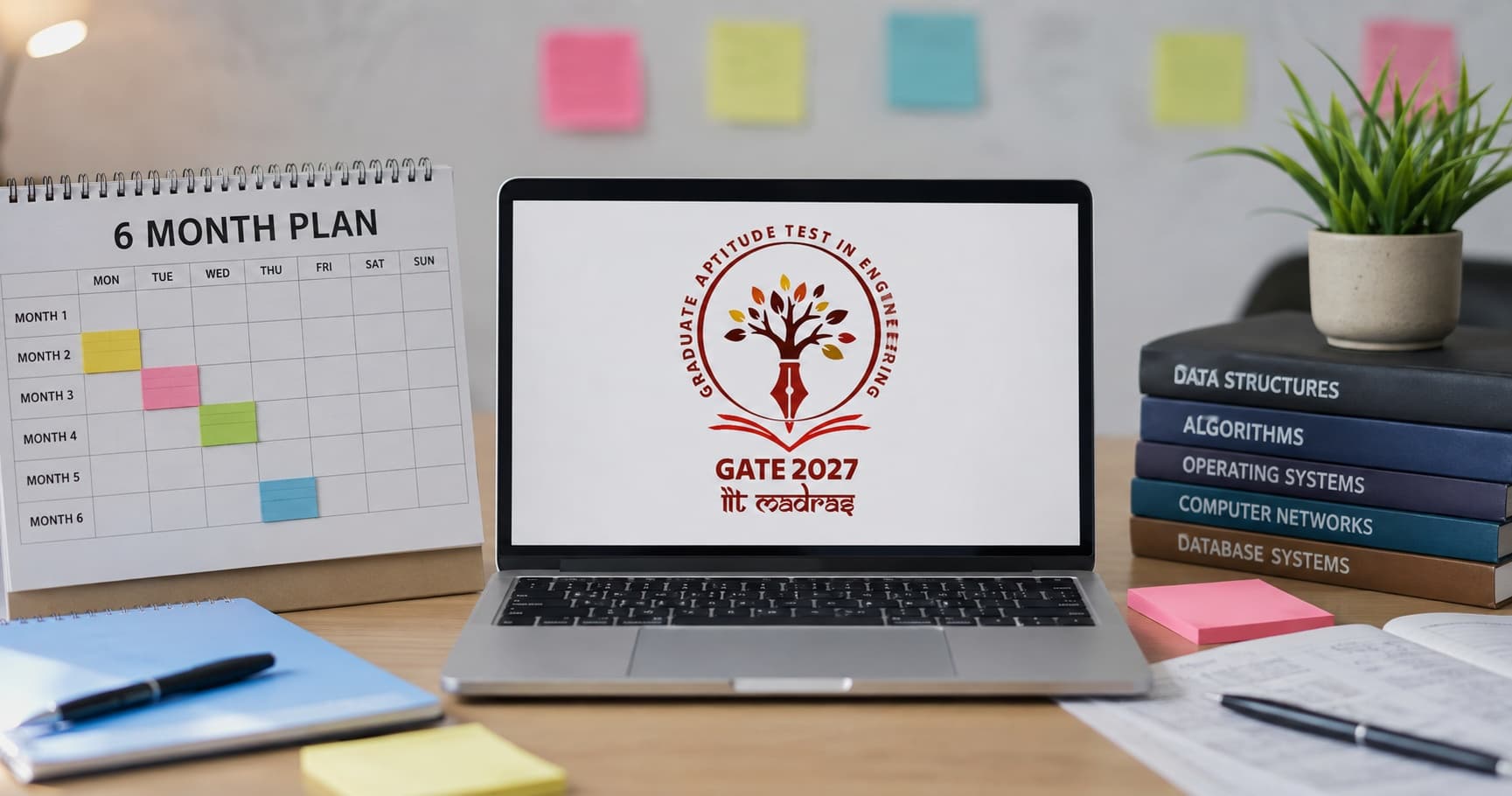
GATE 2027 will be conducted by IIT Madras on February 6, 7, 13, 14, 20 and 21, 2027, in forenoon and afternoon sessions. Registration for GATE 2027 opens on August 14, 2026 and closes on September 21, 2026 without a late fee, with a late window open till September 30, 2026. Admit cards are expected in January 2027.
That leaves candidates roughly six months from now to build a complete GATE Computer Science and Information Technology preparation strategy. This year the task carries an extra layer, because IIT Madras has revised the GATE CS syllabus for the first time in several years. Three core subjects have been restructured, and aspirants who continue studying from outdated notes risk wasting time on topics that are no longer tested.
Ready to Ace Your Exam?
Practice with our comprehensive test series designed by experts. Get detailed solutions, performance analytics, and boost your preparation.
Explore Test SeriesThis guide covers what has changed in the GATE CS 2027 syllabus, a month by month six month study plan, and how to structure test practice so that your preparation is measurable and not just a checklist of chapters read.
What Has Changed in the GATE CS 2027 Syllabus
Out of the ten core technical sections in the GATE CS paper, three have been revised for 2027: Digital Logic, Computer Organization and Architecture (COA), and Computer Networks. The remaining seven sections, including Programming and Data Structures, Algorithms, Operating Systems, Database Management Systems, Theory of Computation, Compiler Design and Engineering Mathematics, remain the same as GATE 2026.
| Subject Nature of change What to focus on | ||
| Digital Logic | Wording refined, circuit minimisation emphasised | Karnaugh maps and tabular minimisation methods |
| Computer Organization and Architecture | Refined and reorganised | Pipelining, cache mapping and control unit design |
| Computer Networks | Scope reduced, several topics removed | TCP flow and congestion control, socket API, DNS, HTTP |
| Programming, DS, Algorithms, OS, DBMS, TOC, Compiler Design | No change | Continue with existing preparation material |
The most significant reduction is in Computer Networks. Topics such as UDP, ARP, DHCP, ICMP, SMTP, FTP, email protocols and flooding based routing have been removed from the syllabus. The transport layer is now limited to TCP flow control, congestion control and the socket API, while the application layer has been narrowed to DNS and HTTP only. The OSI model stack as a standalone topic and basic IP support protocols have also been dropped.
Since even a small syllabus change can shift question weightage, it is worth comparing your current notes against the official syllabus before you begin revision. Aspirant Mitraa maintains a syllabus tracker for GATE CS 2027 that lists every subject, topic and subtopic as per the updated structure, so you can mark what is already covered and what is pending.
Track the complete GATE CS 2027 syllabus here
GATE 2027 Important Dates
| Event Date | |
| Registration opens | August 14, 2026 |
| Registration closes (without late fee) | September 21, 2026 |
| Registration closes (with late fee) | September 30, 2026 |
| Application correction window | October 2026 |
| Admit card release | January 2027 |
| GATE CS exam | February 6, 7, 13, 14, 20, 21, 2027 |
Exam dates are announced by IIT Madras and candidates should keep checking the official website gate2027.iitm.ac.in for any updates, since paper wise slot allotment is confirmed only closer to the admit card release.
GATE CS Exam Pattern Recap
The GATE CS paper carries 100 marks across 65 questions, to be attempted in 3 hours. General Aptitude accounts for 15 marks and Engineering Mathematics contributes around 13 marks, with the remaining marks distributed across the nine core CS subjects. The programming language tested in the exam is C.
Six Month Preparation Plan for GATE CS 2027
With around six months left before the exam, the plan below divides your time into three phases: building the foundation, covering the revised subjects with extra care, and shifting fully to test practice and revision in the final two months.
| Month Focus subjects Test practice | ||
| Month 1 (August) | Discrete Mathematics, Programming and Data Structures, Digital Logic (revised) | Topic wise tests after each chapter |
| Month 2 (September) | Computer Organization and Architecture (revised), Algorithms | Topic wise and subject wise tests |
| Month 3 (October) | Operating Systems, Database Management Systems | Subject wise tests, first mixed test |
| Month 4 (November) | Theory of Computation, Compiler Design, Computer Networks (revised) | Subject wise tests, two mixed tests |
| Month 5 (December) | Full syllabus revision, weak topic clearance, General Aptitude | Mixed tests and full length mocks |
| Month 6 (January to early February) | Previous year questions, formula and shortcut revision, exam strategy | Daily full length mocks, error analysis |
Month 1: Build the Base
Start with Discrete Mathematics, since it overlaps heavily with Algorithms and Theory of Computation later. Cover Programming and Data Structures in parallel, since strong fundamentals here make Algorithms easier to grasp. Take up the revised Digital Logic syllabus early and focus specifically on Karnaugh maps and tabular minimisation techniques, since the section has been reworded for 2027.
Month 2: Cover the Revised COA Syllabus
Computer Organization and Architecture is one of the three revised subjects, so give it dedicated time rather than rushing through it alongside other topics. Focus on pipelining numericals, cache mapping techniques and control unit design, which are the areas most commonly tested. Move to Algorithms once COA is in a stable place, since Algorithms builds directly on Data Structures covered in Month 1.
Month 3: Operating Systems and DBMS
These two subjects are unchanged from 2026 and are considered relatively scoring if practiced through numerical problems such as CPU scheduling, page replacement, and SQL query and normalisation questions. By the end of this month, take your first mixed subject test covering everything studied so far.
Month 4: Theory of Computation, Compiler Design and the Revised CN Syllabus
Theory of Computation is conceptually demanding, so allow extra days for regular languages, context free languages and decidability. Compiler Design usually needs fewer hours if TOC concepts are clear. For Computer Networks, study only the reduced 2027 syllabus. Do not spend time on UDP, ARP, DHCP, ICMP or email protocols since these are no longer part of the exam. Focus on TCP congestion control, IPv4 with CIDR notation, and the DNS and HTTP application layer topics.
Month 5: Full Revision and Weak Area Clearance
By this stage, the entire syllabus should be covered at least once. Use this month to revise every subject through short notes, attempt subject wise and mixed tests regularly, and identify topics where your accuracy is consistently low. General Aptitude should not be ignored here, since 15 marks can meaningfully affect your final rank.
Month 6: Full Length Mocks and Exam Temperament
In the final month before the exam, shift almost entirely to previous year questions and full length mock tests taken under timed conditions. Aim for at least 15 to 20 full length mocks before the actual exam. Use the analysis report after every test to identify which subjects, sections or difficulty levels are pulling your score down, and revise only those areas rather than restarting the full syllabus.
Structured Test Practice With Aspirant Mitraa
Reading the syllabus is only the first step. Marks in GATE come from converting concepts into speed and accuracy under exam conditions, which is why structured, analysed test practice matters as much as syllabus coverage.
The GATE CS 2027 Test Series by Aspirant Mitraa is built on the revised GATE CS 2027 syllabus and includes 150 tests, structured as topic wise tests, subject wise tests, mixed subject tests and full length mock tests. Every question is based on standard reference books, and each test comes with a detailed solution report once submitted.
What makes the test series useful for tracking progress is the analysis layer built into every attempt:
- Topic wise, section wise and subject wise breakup of your performance
- Difficulty wise analysis, so you know how you perform on easy, moderate and hard questions separately
- Time taken per question, to identify where you are losing time unnecessarily
- Attempt comparison, so you can measure improvement from one test to the next rather than looking at isolated scores
This turns every test into a diagnostic tool instead of just a score, which is particularly useful in the last two to three months when revision time needs to be spent efficiently.
Short on Time? Try the Full Length Mock Series
Not every aspirant has six full months available for topic wise and subject wise practice. For candidates who are starting late, working alongside a job, or simply want focused exam simulation without going through every topic separately, Aspirant Mitraa also offers a dedicated GATE CSE 2027 Full Length Mock Test Series built on the new syllabus.
This series includes 10 plus full length mock tests that mirror the actual exam pattern, along with the same detailed solution report, subject and difficulty wise analysis, and time per question tracking available in the full test series. It works well as a standalone option in the final stretch before the exam, or as a supplement to your own topic wise revision.
Frequently Asked Questions
Is six months enough to prepare for GATE CS 2027? A six month plan can work well if you follow a structured subject wise schedule and start test practice early rather than only in the last month. Students with a strong base in core CS subjects generally find six months sufficient.
Which GATE CS subjects have changed for 2027? Digital Logic, Computer Organization and Architecture, and Computer Networks have been revised. All other subjects, including Algorithms, Programming and Data Structures, Operating Systems, DBMS, Theory of Computation and Compiler Design, remain unchanged.
How many mock tests should I attempt before the exam? Most successful candidates attempt at least 15 to 20 full length mock tests, along with regular topic wise and subject wise tests through the preparation period.
Where can I check the updated GATE CS 2027 syllabus? The complete subject and topic wise syllabus, including all 2027 revisions, is available on the Aspirant Mitraa syllabus tracker.
The GATE CS 2027 syllabus revision is limited to three subjects, so most of your existing preparation material remains valid. What matters over the next six months is sequencing your study around subject dependencies, giving the revised sections dedicated attention, and shifting to disciplined, analysed test practice well before the exam rather than only in the final weeks. Tracking the syllabus accurately and reviewing test analysis after every attempt are the two habits that separate a good GATE score from an average one.
Ready to Ace Your Exam?
Practice with our comprehensive test series designed by experts. Get detailed solutions, performance analytics, and boost your preparation.
Explore Test Series