JEE Advanced 2026 Paper Analysis: Complete Paper 1 and Paper 2 Review, Difficulty Level, Subject‑Wise Breakdown, Student Reactions, Expected Cutoff and Marks vs Rank
 aspirantmitraa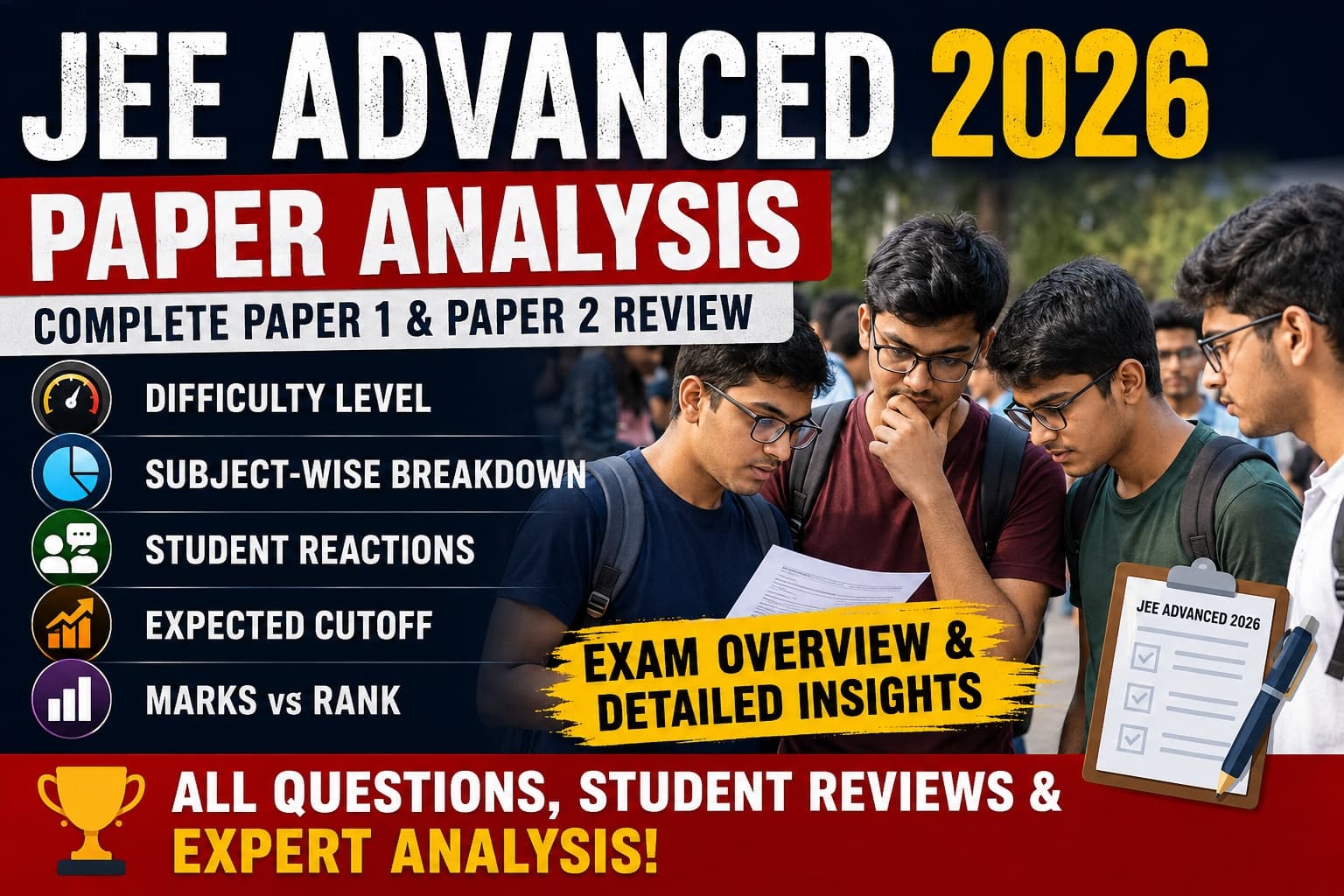
The JEE Advanced 2026 examination has been conducted today, May 17, 2026, by IIT Roorkee across 221 cities in India and 2 international centres in computer‑based test mode. Paper 1 was held from 9:00 AM to 12:00 Noon and Paper 2 from 2:30 PM to 5:30 PM. Both papers have concluded successfully and a complete analysis is now available based on student feedback, coaching institute expert reviews, and memory‑based question data from students who appeared across the country.
This is the definitive JEE Advanced 2026 paper analysis covering every detail that matters for results, cutoff calculation, rank estimation, and counselling planning. Every JEE aspirant, whether they appeared today or is preparing for a future attempt, will benefit from this in‑depth breakdown.
Ready to Ace Your Exam?
Practice with our comprehensive test series designed by experts. Get detailed solutions, performance analytics, and boost your preparation.
Explore Test SeriesJEE Advanced 2026 Exam at a Glance
| Detail Information | |
| Exam Date | May 17, 2026 |
| Conducting IIT | IIT Roorkee |
| Paper 1 Timing | 9:00 AM to 12:00 Noon |
| Paper 2 Timing | 2:30 PM to 5:30 PM |
| Total Duration per Paper | 3 hours |
| Questions per Paper | 48 (16 each from Physics, Chemistry, Maths) |
| Total Marks per Paper | 180 |
| Combined Total Marks | 360 |
| Exam Mode | Computer‑Based Test (CBT) |
| Exam Centres | 221 cities in India, 2 international centres |
| Candidates Appeared | Approximately 1.9 lakh |
| Official Website | jeeadv.ac.in |
| Provisional Answer Key Date | May 25, 2026 |
| Result Date | June 1, 2026 |
JEE Advanced 2026 Paper 1 Analysis: Complete Review
Overall Difficulty Level of Paper 1
The JEE Advanced 2026 Paper 1 exam was overall difficult with Mathematics being the toughest of all three subjects. There were a total of 48 questions in Paper 1, with 16 questions each from Physics, Chemistry, and Mathematics.
According to initial feedback after the morning shift, JEE Advanced 2026 Paper 1 was rated moderately to highly challenging. Mathematics was reportedly the lengthiest and toughest section, while Physics required strong conceptual understanding and analytical ability. Chemistry was described as tricky, particularly the organic chemistry section, where several questions were said to be directly linked to NCERT concepts and lines. Keshav Agarwal, Vice President of the Coaching Federation of India, said the overall structure and difficulty level reflected the IIT stamp and standard typically associated with JEE Advanced papers.
JEE Advanced 2026 Paper 1 Subject‑Wise Difficulty
| Subject Difficulty Level Key Observation | ||
| Mathematics | Toughest | Lengthy, indefinite integrals, functions — most time‑consuming |
| Physics | Moderate to Difficult | Conceptual and numerical mix, required deep understanding |
| Chemistry | Easiest | NCERT‑linked, direct questions in Organic and Inorganic |
Difficulty Order in Paper 1: Mathematics ≥ Physics > Chemistry
JEE Advanced 2026 Paper 1 Mathematics Analysis
A few questions in Maths were from Functions, Indefinite integral and Applications of Integrals. The difficulty order across three subjects was Mathematics ≥ Physics > Chemistry.
As per initial feedback from students, the Paper 1 difficulty level was on the tougher side. Mathematics was toughest with a few questions from Indefinite Integral. The question paper had a total 54 questions, 18 each from Physics, Chemistry and Mathematics. There were around 7 to 8 MCQs, and other questions were Matching type and Numerical Value Answer (NAV) type questions.
Key Mathematics topics asked in JEE Advanced 2026 Paper 1:
- Functions (domain, range, composite functions — rated very difficult by students)
- Indefinite Integration and Applications of Integrals
- Definite Integrals
- Matrices and Determinants
- 3D Geometry and Vectors
- Probability and Permutation and Combination
- Complex Numbers
- Conic Sections
- Trigonometric Equations
Students noted that even familiar topics required multi‑step problem solving. Many students ran out of time on the Mathematics section and had to leave questions unattempted. The Indefinite Integral questions were particularly noted for their non‑standard approaches.
JEE Advanced 2026 Paper 1 Physics Analysis
Physics proved more challenging compared to Chemistry and Mathematics in terms of clarity and time management. Physics clearly stood out as the most demanding section in the paper in terms of lengthy numerical and conceptual questions, increasing difficulty. Students reported that even familiar topics required deeper thinking, reflecting the evolving pattern of IIT‑level competitive exams.
Key Physics topics asked in JEE Advanced 2026 Paper 1:
- Mechanics: Kinematics, Rotational Motion, Newton's Laws
- Electrostatics and Capacitors
- Current Electricity and Kirchhoff's Laws
- Magnetic Effects of Current
- Modern Physics: Photoelectric Effect, Atomic Structure, Radioactivity
- Optics: Ray Optics, Wave Optics
- Thermodynamics and Kinetic Theory
Physics questions in Paper 1 required applying multiple concepts in a single problem. Direct formula substitution was minimal. Students with strong conceptual clarity performed better than those who had only practiced formula‑based problem solving.
JEE Advanced 2026 Paper 1 Chemistry Analysis
Chemistry in Paper 2 was widely regarded as the easiest section among the three. The questions were direct, concept‑based, and mostly derived from well‑known NCERT content and standard JEE topics. Organic Chemistry featured mechanisms and reaction‑based questions that required basic recall and understanding rather than in‑depth analysis. Physical Chemistry questions were formula‑driven and straightforward, while Inorganic Chemistry leaned on memory‑based facts. There was a good balance between theory and application, and students who had revised NCERT thoroughly were able to solve this section quickly and accurately.
Key Chemistry topics asked in JEE Advanced 2026 Paper 1:
- Organic Chemistry: Reaction mechanisms, Amines, Polymers, Biomolecules, Oxygen‑containing compounds, Named reactions (Aldol, Cannizzaro)
- Inorganic Chemistry: p‑block elements, Coordination Compounds, NCERT‑based qualitative analysis
- Physical Chemistry: Chemical Kinetics, Electrochemistry, Thermodynamics, Chemical Equilibrium, Atomic Structure
JEE Advanced 2026 Paper 1 Question Type Distribution
| Question Type Marks per Correct Answer Negative Marking | ||
| Single Correct MCQ | +3 | -1 |
| Multiple Correct MCQ | +4/+3/+2/+1 (partial) | -2 for incorrect |
| Numerical Value Answer | +4 | None |
| Matching Type | +3 or partial | Varies |
JEE Advanced 2026 Paper 2 Analysis: Complete Review
Overall Difficulty Level of Paper 2
JEE Advanced 2026 Paper 2 exam had 48 questions. As per Paper 2 review, difficulty level and paper analysis, the exam was moderate in difficulty. Physics was toughest among all three subjects followed by Mathematics and Chemistry. Among the three subjects, Mathematics was comparatively the most difficult in Paper 1. Physics ranged from moderate to difficult, while Chemistry was easy to moderate. Overall, the paper was well balanced in terms of question distribution and chapter coverage.
JEE Advanced 2026 Paper 2 Subject‑Wise Difficulty
| Subject Difficulty Level Key Observation | ||
| Physics | Toughest in Paper 2 | Multi‑conceptual, calculation‑heavy, time‑consuming |
| Mathematics | Moderate to Difficult | Lengthy but slightly easier than Paper 1 |
| Chemistry | Easiest | Direct NCERT‑based, quickly solvable |
Difficulty Order in Paper 2: Physics > Mathematics > Chemistry
JEE Advanced 2026 Paper 2 Mathematics Analysis
Paper 2 Mathematics was rated moderate in difficulty compared to Paper 1. The questions were lengthy but slightly more direct. Topics that appeared prominently in Paper 2 Mathematics include:
- Calculus: Differential Equations, Definite Integrals
- Algebra: Probability, Permutation and Combination, Complex Numbers
- Coordinate Geometry: Parabola, Ellipse, Hyperbola, Circles
- Vectors and 3D Geometry
- Matrices
Students who had struggled significantly with Paper 1 Mathematics found Paper 2 slightly more accessible.
JEE Advanced 2026 Paper 2 Physics Analysis
Physics emerged as the most challenging subject in Paper 2, reversing the Paper 1 pattern where Mathematics was toughest. Key observations from Physics in Paper 2:
- Waves and Sound: Doppler Effect, Standing Waves, Resonance
- Thermodynamics: Heat engines, Carnot cycle, Gas Laws
- Modern Physics: Nuclear Physics, Semiconductor Devices
- Optics: Interference, Diffraction, Polarization
- Fluids and Surface Tension
Physics questions in Paper 2 required multi‑step solutions combining concepts from two or more chapters simultaneously. This is a classic JEE Advanced approach that separates candidates with deep conceptual clarity from those who have surface‑level knowledge.
JEE Advanced 2026 Paper 2 Chemistry Analysis
Organic Chemistry featured mechanisms and reaction‑based questions. Physical Chemistry questions were formula‑driven and straightforward. Inorganic Chemistry leaned on memory‑based facts. Students who had revised NCERT thoroughly were able to solve this section quickly and accurately.
Paper 2 Chemistry mirrored the Paper 1 approach in terms of accessibility. NCERT was the backbone of the Chemistry section in both papers. Candidates who had done a thorough reading of NCERT Chemistry (both Class 11 and Class 12) with all examples and exercises found Chemistry to be the most reliable score‑building section across both papers.
JEE Advanced 2026 vs JEE Advanced 2025: Comparison
Over the years, the JEE Advanced difficulty level has stayed between moderate to difficult. Usually, the toughness level alternates between moderate‑to‑tough and very tough, depending on the year. In 2023, the exam was described as lengthy and tricky in Physics and Mathematics. In 2024, candidates rated Chemistry easier, but Mathematics remained a nightmare and consumed most time. In 2025, the exam was rated as one of the toughest in recent times, especially in Physics.
| Year Paper 1 Difficulty Paper 2 Difficulty Toughest Subject | |||
| 2026 | Moderate to Difficult | Moderate | Maths (P1), Physics (P2) |
| 2025 | Difficult | Difficult | Physics (both papers) |
| 2024 | Moderate to Difficult | Difficult | Mathematics |
| 2023 | Moderate | Moderate to Difficult | Mathematics |
| 2022 | Moderate to Difficult | Difficult | Mathematics |
JEE Advanced 2026 continues the tradition of Mathematics being the most feared subject in Paper 1, while Physics takes over in Paper 2. Chemistry remains consistently the most scoring subject across both papers every year.
JEE Advanced 2026 Expected Cutoff for Inclusion in Rank List
The JEE Advanced qualifying cutoff determines whether a candidate is included in the rank list. This is different from the admission cutoff, which determines actual IIT seat allocation.
The JEE Advanced 2026 expected cutoff is 93 to 96 marks out of 360 for the General category or the CRL rank list. The official JEE Advanced 2026 cutoff will be released by IIT Roorkee on June 1, 2026 at jeeadv.ac.in along with the result and rank list. The expected qualifying cutoff is to score at least 20.56% in aggregate for the General category. For OBC‑NCL, the expected cutoff is 84 to 87 marks. For SC, ST, and PwD, it is in the 23 to 49 marks range depending on the category.
Expected JEE Advanced 2026 Qualifying Cutoff (Subject + Aggregate)
| Category Expected Min Marks per Subject Expected Min Aggregate (out of 360) Expected Percentage | |||
| General (CRL) | ~10% per subject (~18 marks) | 93–96 marks | 25.8% to 26.7% |
| GEN‑EWS | ~9% per subject | 84–87 marks | 23.3% to 24.2% |
| OBC‑NCL | ~9% per subject | 84–87 marks | 23.3% to 24.2% |
| SC | ~5% per subject | 45–50 marks | 12.5% to 13.9% |
| ST | ~5% per subject | 45–50 marks | 12.5% to 13.9% |
| PwD | ~5% per subject | 45–50 marks | 12.5% to 13.9% |
| Preparatory Course | ~2.5% per subject | 23–26 marks | 6.4% to 7.2% |
In 2025, the JEE Advanced cutoff marks for inclusion in the rank list were 20.56% for the Common Rank List; 18.50% for the GEN‑EWS rank list and OBC‑NCL rank list; 10.28% for SC, ST, and PwD rank lists across all categories; and 5.14% for Preparatory course rank lists.
Around 40,000 to 50,000 candidates usually qualify for the JEE Advanced rank list. In 2025, 54,378 candidates qualified for the JEE Advanced rank list as per official data.
JEE Advanced 2026 Marks vs Rank: What to Expect
Based on historical JEE Advanced data and today's paper difficulty (moderate to difficult across both papers), here is the expected marks vs rank mapping for General category candidates:
| Score (out of 360) Expected AIR Range IIT Admission Possibility | ||
| 310 to 360 | AIR 1 to AIR 50 | Any IIT, any branch including IIT Bombay CSE |
| 270 to 310 | AIR 50 to AIR 300 | Top IITs (Bombay, Delhi, Madras) core branches |
| 240 to 270 | AIR 300 to AIR 700 | IIT Bombay, Delhi, Madras — various branches |
| 210 to 240 | AIR 700 to AIR 1,500 | IIT Kharagpur, Kanpur, Roorkee — top branches |
| 185 to 210 | AIR 1,500 to AIR 3,000 | IIT Hyderabad, Guwahati, BHU, ISM Dhanbad |
| 160 to 185 | AIR 3,000 to AIR 5,500 | NITs or newer IITs for core branches |
| 130 to 160 | AIR 5,500 to AIR 9,000 | Newer IITs with good branches |
| 100 to 130 | AIR 9,000 to AIR 16,000 | IITs with limited seat availability |
| 93 to 100 | AIR 16,000 to AIR 25,000 | Rank list inclusion; limited IIT options |
A safe score of 220 to 280+ will likely be required for a top 1,000 rank in JEE Advanced 2026. In a tough paper year, the safe score can be lower to around 180 to 190. For easier papers, the safe score can increase to around 230 to 250.
JEE Advanced 2026 IIT Admission Cutoff: Top Branches and Closing Ranks
The admission cutoff for IITs is released as opening and closing ranks during JoSAA counselling, not as marks. Based on JEE Advanced 2025 counselling data, here are the approximate closing ranks for the most sought‑after IIT branches:
| IIT and Branch General Category Closing Rank (Approx 2025) | |
| IIT Bombay CSE | AIR 63 to 67 |
| IIT Delhi CSE | AIR 97 to 112 |
| IIT Madras CSE | AIR 134 to 145 |
| IIT Kharagpur CSE | AIR 248 to 265 |
| IIT Kanpur CSE | AIR 220 to 245 |
| IIT Roorkee CSE | AIR 373 to 401 |
| IIT Bombay Electrical | AIR 280 to 340 |
| IIT Delhi Electrical | AIR 420 to 480 |
| IIT Bombay Mechanical | AIR 600 to 750 |
| IIT Hyderabad CSE | AIR 2,100 to 2,400 |
| IIT Guwahati CSE | AIR 2,500 to 2,800 |
| IIT BHU CSE | AIR 1,800 to 2,100 |
| IIT ISM Dhanbad Mining | AIR 10,000 to 13,000 |
These are approximate 2025 figures and will vary slightly in 2026 based on total qualified candidates, seat availability, and candidate preferences.
JEE Advanced 2026 Student Reactions: What Students Said After the Exam
Across cities including Delhi, Mumbai, Chennai, Hyderabad, Kolkata, Bengaluru, Jaipur, Patna, and Pune, students shared their immediate reactions after both papers concluded:
After Paper 1 (9 AM to 12 Noon):
- "Mathematics was a nightmare. I spent 70 minutes on Maths and still couldn't finish all questions." — Student from Delhi
- "Chemistry was manageable. I solved it in 35 minutes and used the rest for Maths and Physics." — Student from Hyderabad
- "Physics was tough but doable with good preparation. Functions in Maths was the hardest part." — Student from Chennai
- "Overall the paper was harder than what mock tests prepared us for." — Student from Jaipur
After Paper 2 (2:30 PM to 5:30 PM):
- "Paper 2 Physics was shockingly tough. I wasn't expecting multi‑concept questions at that difficulty level." — Student from Mumbai
- "Chemistry saved me in both papers. If you've done NCERT well, Chemistry is your biggest score booster." — Student from Pune
- "Paper 2 was moderate overall. The difficulty distribution between subjects was different from Paper 1." — Student from Bengaluru
- Many students reported that the JEE Advanced 2026 Paper 2 was similar to the difficulty level of the previous year exam.
JEE Advanced 2026 Good Attempts: What Is a Safe Score?
Based on today's difficulty analysis across both papers, here is what coaching institute experts consider a safe number of good attempts and score:
| Score Range Category Expected Rank Admission Possibility | |||
| 280 marks and above | General | Top 200 | Top IIT top branch |
| 240 to 280 marks | General | Top 700 | Top IIT good branch |
| 200 to 240 marks | General | Top 2,000 | Older IIT various branches |
| 160 to 200 marks | General | Top 6,000 | Good IIT |
| 93 to 100 marks | General | ~25,000 | Rank list inclusion, limited IIT |
| Below 93 marks | General | Not in rank list | No IIT |
For OBC‑NCL candidates, the expected minimum is around 84 to 87 marks. For SC and ST candidates, around 45 to 50 marks secures rank list inclusion.
JEE Advanced 2026 Marking Scheme: Every Question Type Explained
JEE Advanced uses a complex marking scheme with partial marking and negative marking. Understanding this is critical for score calculation before the official answer key:
Paper 1 (Based on 2025‑2026 pattern with 48 questions, 16 per subject):
| Question Type Correct Answer Wrong/Incorrect Partial Marks | |||
| Single Correct Option | +3 | -1 | None |
| Multiple Correct Options (all correct) | +4 | -2 | +3, +2, +1 for partial |
| Numerical Value Type | +4 | 0 (no negative) | None |
| Matching List Type | +3 | -1 | Varies |
Critical rule for Multiple Correct Questions: If a question has 4 correct options and you mark only 3, you get partial marks (+3). If you mark any wrong option in addition, you get -2. This makes Multiple Correct questions the most strategically complex type in JEE Advanced.
Previous Year JEE Advanced Qualifying Cutoff Trend (2019 to 2025)
| Year CRL (General) % OBC/EWS % SC/ST/PwD % Total Qualified | ||||
| 2025 | 20.56% (~74 marks) | 18.50% (~67 marks) | 10.28% (~37 marks) | 54,378 |
| 2024 | 24.23% (~87 marks) | 21.81% (~79 marks) | 12.11% (~44 marks) | 48,248 |
| 2023 | 33.33% (~120 marks) | 29.99% (~108 marks) | 16.67% (~60 marks) | 43,773 |
| 2022 | 24.69% (~89 marks) | 22.22% (~80 marks) | 12.34% (~44 marks) | 40,712 |
| 2021 | 37.50% (~90 marks) | 33.75% (~81 marks) | 18.75% (~45 marks) | 41,862 |
| 2020 | 37.50% (~90 marks) | 33.75% (~81 marks) | 18.75% (~45 marks) | 43,204 |
| 2019 | 35.0% (~126 marks) | 31.5% (~113 marks) | 17.5% (~63 marks) | 38,705 |
Note: The percentage‑based cutoff stays constant but the corresponding marks change every year based on total marks in the paper, which has varied from 360 to 372 in recent years.
JEE Advanced 2026 Answer Key and Result Timeline
| Event Expected Date | |
| JEE Advanced 2026 Exam | May 17, 2026 |
| Unofficial Answer Keys (Coaching Institutes) | May 17, 2026 (same day) |
| Official Question Paper PDF Released | May 17 to 18, 2026 |
| Provisional Answer Key Released | May 25, 2026 |
| Objection Submission Window | May 25 to May 27, 2026 |
| Final Answer Key + JEE Advanced Result | June 1, 2026 |
| JoSAA 2026 Counselling Begins | June 2, 2026 |
What to Do Right Now After JEE Advanced 2026
If you think you have done well (expected 180+ marks):
- Check unofficial answer keys from Allen, Aakash, FIITJEE, Physics Wallah, Narayana, and Resonance released today to estimate your raw score
- Register immediately for JoSAA 2026 when it opens on June 2, 2026
- Prepare your preference list of IITs and branches based on your estimated rank
- Wait for the official provisional answer key on May 25 and challenge any questions you find incorrect by paying Rs. 200 per question
If you are unsure about your performance:
- Do not estimate your score without a proper answer key comparison
- Coaching institute keys may differ slightly from the official key
- Use the JEE Advanced Rank Predictor 2026 by Aspirant Mitraa to estimate your rank once the answer key is out
- Wait for the official result on June 1 before making any conclusions about your IIT prospects
For next year JEE Advanced 2027 aspirants:
- Today's paper confirms that Mathematics and Physics demand deep conceptual understanding, not formula memorisation
- Chemistry is consistently the most scoring and accessible subject — prioritise NCERT mastery
- Paper 2 Physics is historically as tough or tougher than Paper 1 Mathematics — prepare accordingly
- Time management is critical: most students struggle not because of knowledge gaps but because of poor time allocation strategy
Frequently Asked Questions on JEE Advanced 2026 Paper Analysis
Q. What was the overall difficulty level of JEE Advanced 2026? The overall paper was moderate to difficult. Paper 1 was rated more difficult than Paper 2. Mathematics was the toughest in Paper 1, and Physics was the toughest in Paper 2.
Q. Which was the easiest subject in JEE Advanced 2026? Chemistry was the easiest and most scoring subject in both Paper 1 and Paper 2, with most questions directly NCERT‑based.
Q. How many questions were there in JEE Advanced 2026? Each paper had 48 questions: 16 each from Physics, Chemistry, and Mathematics. Total across both papers: 96 questions for 360 marks combined.
Q. What is the expected JEE Advanced 2026 cutoff for General category? The expected qualifying cutoff for General (CRL) is 93 to 96 marks out of 360, corresponding to approximately 25.8% to 26.7% aggregate. The official cutoff will be released with the result on June 1, 2026.
Q. When will the JEE Advanced 2026 provisional answer key be released? The provisional answer key will be released on May 25, 2026 at jeeadv.ac.in.
Q. When will the JEE Advanced 2026 result be declared? The result will be declared on June 1, 2026 at jeeadv.ac.in.
Q. Was JEE Advanced 2026 tougher than JEE Advanced 2025? Both years had difficult papers. JEE Advanced 2025 was rated one of the toughest in recent memory, especially in Physics. JEE Advanced 2026 was moderate to difficult, with Mathematics taking the toughest crown in Paper 1 and Physics in Paper 2.
Q. What marks are needed for top 1,000 rank in JEE Advanced 2026? Based on today's paper difficulty (moderate to difficult), a score of approximately 220 to 250 marks out of 360 is expected to yield a rank within the top 1,000 for General category candidates.
Q. How many candidates qualified for JEE Advanced 2026? A total of 2,50,182 candidates were eligible to appear for JEE Advanced 2026 based on the JEE Main 2026 qualifying cutoff.
For the official provisional answer key on May 25, result on June 1, and JoSAA counselling updates, keep visiting jeeadv.ac.in. Predict your rank now using the JEE Advanced Rank Predictor 2026 by Aspirant Mitraa.
Ready to Ace Your Exam?
Practice with our comprehensive test series designed by experts. Get detailed solutions, performance analytics, and boost your preparation.
Explore Test Series