NEET 2026 Paper Analysis (May 3): ‑ Complete Subject‑Wise Difficulty Level, Chapter‑Wise Weightage, Student Reactions and Expected Cutoff
 aspirantmitraa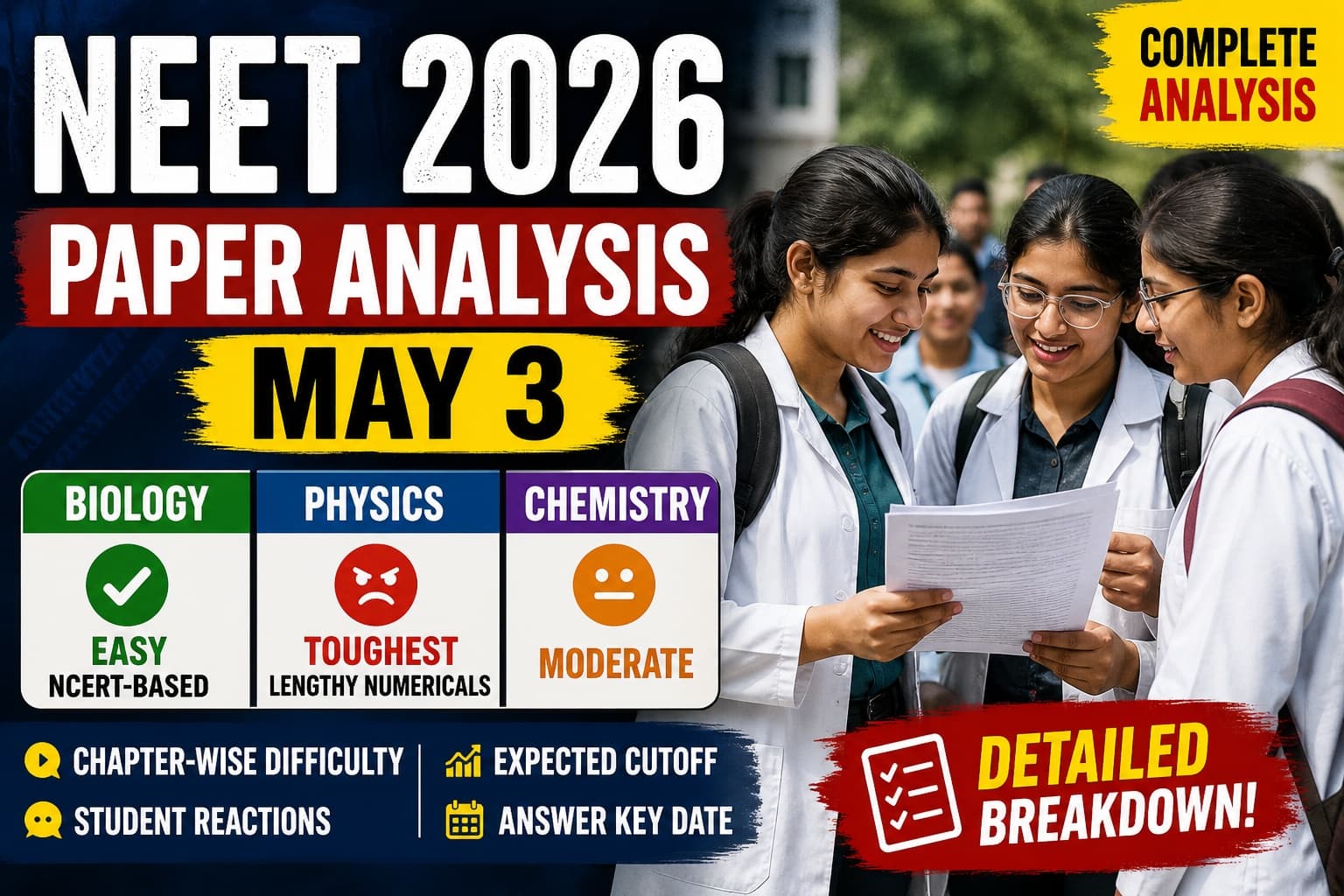
The NEET UG 2026 examination has officially concluded today, May 3, 2026, from 2:00 PM to 5:00 PM IST in offline pen‑and‑paper mode. Conducted by the National Testing Agency (NTA) across 552 exam centres in India and 14 international centres, the exam saw approximately 22.79 lakh registered candidates sitting for one of the most competitive medical entrance examinations in the world. As students exit centres across the country, their initial reactions, combined with expert analysis from leading coaching institutions, are forming the first clear picture of how the NEET 2026 question paper actually turned out. Based on all available feedback and expert assessment as of this evening, the NEET 2026 paper difficulty level is moderate overall, with Biology emerging as the most scoring section, Chemistry as balanced and manageable, and Physics once again proving to be the most time‑consuming and challenging section of the paper.
This article provides a complete NEET 2026 paper analysis covering the overall difficulty level, subject‑wise review for Biology, Physics and Chemistry, chapter‑wise weightage breakdown, student and expert reactions, comparison with NEET 2025, and expected cutoff marks for the General, OBC, SC, ST, and EWS categories.
Ready to Ace Your Exam?
Practice with our comprehensive test series designed by experts. Get detailed solutions, performance analytics, and boost your preparation.
Explore Test SeriesNEET 2026 Paper Analysis: Overall Difficulty Level
The NEET UG 2026 question paper on May 3 has been rated as moderate in difficulty, which is consistent with NEET 2025 trends. The paper was neither extremely easy nor brutally difficult, with the overall level falling slightly easier than NEET 2025 primarily because Biology was heavily NCERT‑based and Chemistry remained manageable.
Key overall observations from the NEET 2026 paper analysis today:
- The overall paper was moderate in difficulty across all three subjects combined
- Biology was the easiest and most scoring section with direct NCERT‑based questions
- Chemistry was balanced and moderate with a good mix of organic, inorganic, and physical questions
- Physics was the most time‑consuming and toughest section with numerical‑heavy and concept‑based questions
- No out‑of‑syllabus questions were asked in any subject
- Students who revised NCERT thoroughly and solved five or more years of NEET PYQs reported a manageable paper
- The paper was reportedly slightly easier than NEET 2025, which was considered moderately hard
- Most students followed the Biology‑first strategy in the exam hall, attempting Biology, then Chemistry, then Physics last
NEET 2026 Exam Pattern: Structure and Marking Scheme
Before going into subject‑wise analysis, here is a quick recap of the NEET UG 2026 exam structure:
- Total Questions: 180 MCQs
- Total Marks: 720
- Duration: 3 hours (180 minutes) from 2:00 PM to 5:00 PM
- Marking Scheme: +4 for each correct answer, -1 for each incorrect answer, 0 for unattempted
- Subject Distribution:Physics: Section A (35 questions, compulsory) + Section B (15 questions, attempt any 10) = 45 questions, 180 marks
- Chemistry: Section A (35 questions, compulsory) + Section B (15 questions, attempt any 10) = 45 questions, 180 marks
- Biology (Botany + Zoology): Section A (70 questions, compulsory) + Section B (30 questions, attempt any 20) = 90 questions, 360 marks
- Languages: 13 languages including English, Hindi, Assamese, Bengali, Gujarati, Kannada, Malayalam, Marathi, Odia, Punjabi, Tamil, Telugu, and Urdu
A critical change in NEET 2026 is the restoration of the 3‑hour exam duration. NTA removed the extra 20 minutes that had been granted during the COVID‑19 pandemic in the previous three years. This meant students had only 180 minutes for 180 questions, making time management even more critical, especially given a lengthy Physics section.
NEET 2026 Biology Paper Analysis: Difficulty Level, Chapter‑Wise Breakdown and Key Observations
Overall Biology Difficulty: Easy to Moderate
Biology in NEET 2026 has been confirmed as the easiest and most scoring section of the paper, continuing a consistent trend from previous years. According to expert analysis and direct student feedback, most Biology questions were directly lifted from NCERT textbook lines, diagrams, examples, and in‑text boxes. Students who had revised their NCERT Biology thoroughly across Class 11 and Class 12 chapters found this section highly manageable and high‑scoring.
The Biology section comprised 90 questions carrying 360 marks, which is 50% of the total NEET paper. This makes Biology the single most important subject in terms of marks and rank determination in NEET. Experts confirmed that Botany was slightly easier than Zoology, though both sections maintained a balanced and NCERT‑focused pattern overall.
NEET 2026 Biology Chapter‑Wise Weightage and Topics Asked
Based on analysis of the NEET 2026 question paper and post‑exam expert review, here is the chapter‑wise breakdown of high‑weightage topics that appeared in the Biology section today:
Botany (Plant Biology) Chapters with High Weightage in NEET 2026:
- Genetics and Molecular Biology: This was the highest‑weightage area in Botany with multiple questions from Principles of Inheritance and Variation and Molecular Basis of Inheritance. Questions covered Mendelian genetics, pedigree analysis, codominance, sex‑linked traits, DNA replication, transcription, translation, and genetic code. Genetics alone contributed nearly 25% of the Botany section, making it the most critical chapter for NEET Biology 2026.
- Plant Physiology: Questions from Photosynthesis, Respiration in Plants, Plant Growth and Development, and Mineral Nutrition featured prominently. C3 and C4 pathways, light reactions vs Calvin cycle, respiratory quotient, and plant hormones were recurring themes.
- Cell Biology and Biomolecules: Cell the Unit of Life, Biomolecules, and Cell Cycle and Division generated multiple questions. Structure of DNA, RNA types, enzymes, carbohydrates, lipids, and protein structures were asked.
- Ecology and Environment: Ecosystem structure, food webs, energy flow, biogeochemical cycles, ecological succession, population interactions, and biodiversity with conservation generated conceptual questions. Ecology is memory‑based and students well‑versed with NCERT examples found these questions straightforward.
- Biotechnology: Biotechnology: Principles and Processes and Biotechnology and its Applications combined contributed significantly. Questions on recombinant DNA technology, PCR, gel electrophoresis, Bt cotton, gene therapy, and insulin production were asked.
- Plant Reproduction: Reproduction in Flowering Plants including double fertilization, embryo development, and pollination mechanisms also featured.
- Biological Classification and Plant Diversity: Some questions from Diversity in the Living World covered algae, bryophytes, pteridophytes, gymnosperms, and angiosperms.
Zoology (Animal Biology) Chapters with High Weightage in NEET 2026:
- Human Physiology: This was the single largest contributor in Zoology, carrying approximately 20% of the Biology section. Questions came from Digestion and Absorption (enzymes, GI hormones, peristalsis), Breathing and Exchange of Gases (lung volumes, respiratory disorders), Body Fluids and Circulation (cardiac cycle, ECG, blood groups, lymph), Excretory Products and their Elimination (nephron structure, countercurrent mechanism, JGA, dialysis), Locomotion and Movement (muscle contraction, sliding filament theory, disorders), Neural Control and Coordination (neuron structure, synaptic transmission, sensory organs), and Chemical Coordination and Integration (endocrine glands, hormones and their functions). Students who had revised the NCERT Human Physiology chapters with diagrams and tables found these questions direct and scoring.
- Genetics (Zoology Component): Questions on inheritance patterns in humans, genetic disorders such as haemophilia, colour blindness, sickle cell anaemia, Down syndrome, Turner's syndrome, and Klinefelter's syndrome appeared consistently.
- Reproduction: Human Reproduction and Reproductive Health including gametogenesis, fertilization, embryonic development, contraceptive methods, STDs, and infertility generated multiple questions.
- Animal Kingdom: Classification of animals, distinguishing characteristics of different phyla, coelom types, symmetry, and notable examples were tested.
- Biotechnology: Applications in Zoology including transgenic animals, cloning, genetic fingerprinting, and bioreactors appeared in this section.
- Evolution: Darwin's theory, natural selection, Hardy‑Weinberg principle, human evolution, and molecular evidence of evolution were tested through both conceptual and statement‑based questions.
- Human Health and Disease: Immunity (innate vs acquired, active vs passive, types of vaccines), common infectious diseases, cancer biology, AIDS, and addiction featured in this section.
NEET 2026 Biology Paper: Student Reactions
Direct student feedback from exam centres across major cities including Delhi, Mumbai, Bengaluru, Chennai, Hyderabad, Kolkata, and Pune reveals the following about Biology in NEET 2026:
- The majority of students described Biology as the easiest section of the three subjects
- Questions were described as direct and to the point with most answers traceable to specific NCERT lines or diagrams
- Genetics was considered slightly tricky in places due to application‑style pedigree and cross problems
- Human Physiology questions were generally straightforward for well‑prepared candidates
- Ecology questions were memory‑based and students who had memorized NCERT examples did well
- Botany was described as slightly easier than Zoology overall
- Students followed the Biology‑first strategy inside the hall, completing it quickly and banking marks early
- A few statement‑based questions in Genetics and Biotechnology required careful reading and elimination
NEET 2026 Physics Paper Analysis: Difficulty Level, Chapter‑Wise Breakdown and Student Reactions
Overall Physics Difficulty: Moderate to Tough
Physics in NEET 2026 lived up to its reputation as the toughest and most time‑consuming section. Students and experts have unanimously rated Physics as the most challenging subject of the May 3 paper. The primary complaint from students across centres is that Physics questions were lengthy, required multi‑step numerical calculations, and consumed significantly more time than expected.
Many students reported that even though they could solve most Physics questions correctly, the sheer length and calculation density meant they ran out of time. Those who had not timed themselves during mock tests regretted the time lost the most.
NEET 2026 Physics Chapter‑Wise Topics Asked
Based on post‑exam review and memory‑based question data, the following Physics chapters appeared in the NEET 2026 question paper:
- Center of Mass and System of Particles: Multiple numerical questions on center of mass calculation, conservation of linear momentum, and collision problems appeared
- Rotational Motion: Moment of inertia, torque, angular momentum conservation, and rolling motion questions were present
- Electric Charges and Fields: Coulomb's law, electric field intensity, field lines, and Gauss's law applications generated multiple questions
- Electrostatic Potential and Capacitance: Potential difference, capacitor combinations, energy stored in capacitors, and dielectric medium questions appeared
- Current Electricity: Ohm's law, Kirchhoff's laws, Wheatstone bridge, potentiometer, and meter bridge problems were asked
- Ray Optics and Optical Instruments: Mirror formula, lens formula, magnification, refraction through prisms, and optical instrument (microscope and telescope) questions featured prominently
- Modern Physics: Photoelectric effect, de Broglie wavelength, nuclear reactions, radioactivity, half‑life calculations, and atomic spectra appeared
- Magnetic Effects of Current: Moving charges in magnetic fields, Lorentz force, Ampere's law, and solenoid problems were asked
- Waves and Sound: Standing waves, Doppler effect, and resonance questions appeared in fewer numbers
NEET 2026 Physics Paper: Student Reactions
- Physics was unanimously rated the toughest section across all student groups today
- Time pressure in Physics was severe, with many students unable to attempt all questions in the first pass
- Formula‑based questions were fewer than expected; conceptual application dominated
- Questions were described as twisted and indirect, not straight‑forward formula substitutions
- Many students saved Physics for last and ran out of time, leaving several questions unattempted
- Students who had strong mock test experience managed Physics better than average
NEET 2026 Chemistry Paper Analysis: Difficulty Level, Chapter‑Wise Breakdown and Student Reactions
Overall Chemistry Difficulty: Balanced and Moderate
Chemistry in NEET 2026 was rated as balanced and moderate by both students and experts. It served as the middle ground between the easy Biology section and the tough Physics section. Students who had revised NCERT Chemistry thoroughly for both Organic, Inorganic, and Physical components found Chemistry manageable and scoring.
NEET 2026 Chemistry Chapter‑Wise Topics Asked
- Organic Chemistry: Reaction mechanisms, functional group identification, name reactions (Aldol condensation, Cannizzaro, Diels‑Alder), stereochemistry, and biomolecules appeared with moderate difficulty
- Inorganic Chemistry: Coordination compounds (Werner's theory, IUPAC naming, isomerism, VBT, CFT), p‑block elements, d and f‑block transition metals, metallurgy, and qualitative analysis questions were direct NCERT‑based
- Physical Chemistry: Thermodynamics (Hess's law, Gibbs free energy, entropy), Electrochemistry (Nernst equation, Faraday's laws), Chemical Kinetics (rate laws, order of reaction), and Equilibrium (Kp, Kc, Le Chatelier's principle) carried moderate numerical difficulty
NEET 2026 Chemistry Paper: Student Reactions
- Chemistry was described as doable and NCERT‑focused by most students
- Multiple Organic and Inorganic questions were described as directly answerable using NCERT
- Physical Chemistry numerical questions were moderate in difficulty, not as lengthy as Physics
- Inorganic Chemistry was noted as largely direct and fact‑based from NCERT
- Students who struggled with Chemistry were those who had neglected Physical Chemistry numericals
NEET 2026 vs NEET 2025: Comparison of Difficulty Level
Based on the first comprehensive paper analysis of NEET UG 2026 conducted today, here is how it compares with NEET 2025:
- Overall Difficulty: NEET 2026 is slightly easier than NEET 2025, which was rated Moderate‑Hard. NEET 2026 falls in the Moderate range.
- Biology: Both NEET 2025 and NEET 2026 had NCERT‑heavy Biology with a few tricky statement‑based questions. NEET 2026 Biology was slightly more direct than NEET 2025.
- Physics: NEET 2025 had a particularly tough Physics section. NEET 2026 Physics is comparably tough, with students reporting similar or slightly less difficulty than NEET 2025 in Physics.
- Chemistry: NEET 2026 Chemistry was comparable to NEET 2025, with both being moderate and NCERT‑balanced.
- NEET 2025 Physics Section: In 2025, Biology had 19 easy, 16 medium, and 14 hard questions in Botany. NEET 2026 follows a similar distribution.
NEET 2026 Expected Cutoff Marks (Category‑Wise)
The NEET UG 2026 expected cutoff for the 50th percentile qualifying marks, as well as for admission to top government medical colleges, is based on today's paper difficulty analysis combined with historical cutoff trends:
NEET 2026 Qualifying Cutoff (50th Percentile for Counselling Eligibility)
- General (UR) Category: 140 to 150 marks (approximately 50th percentile)
- OBC‑NCL: 113 to 120 marks
- SC: 113 to 120 marks
- ST: 113 to 120 marks
- General PwBD: 113 to 120 marks
NEET 2026 Cutoff for Top Government Medical College Admission (MBBS)
- AIIMS New Delhi: 700 marks and above (AIR top 50 range)
- Top Government MBBS Colleges: 640 to 680 marks (AIR 100 to 2000 range)
- Good Government Medical College MBBS: 580 to 640 marks (AIR 2000 to 10000 range)
- Government MBBS Seat Anywhere in India: 530 to 580 marks (AIR 10000 to 40000 range)
- Private MBBS Colleges: 480 to 540 marks may be sufficient for admission to private medical colleges in most states
These are estimated ranges based on historical data and today's paper difficulty. The official NEET 2026 cutoff will be released with the result in June 2026.
NEET 2026 Safe Score: How Many Marks Are Enough?
Based on today's paper analysis and historical cutoff trends:
- 680 and above: Exceptionally safe. Top government MBBS anywhere in India including AIIMS
- 620 to 680: Very safe. Government MBBS in top states; good chance at AIIMS Tier 2
- 550 to 620: Safe for government MBBS in most states depending on category and state quota
- 500 to 550: Borderline for government MBBS in some states; safe for private MBBS
- 450 to 500: Safe for private MBBS in most states; BDS admission at government colleges possible
- Below 450: AYUSH courses (BAMS, BHMS, BUMS, BSMS) and private BDS admissible
NEET 2026 Answer Key: When Will NTA Release It?
Following the completion of the NEET UG 2026 examination today, here is the expected timeline for the answer key and result:
- Unofficial Answer Key by Coaching Institutes: Released within hours of exam conclusion today, May 3, 2026 (Allen, Aakash, PW, NTA Abhyas, Narayana, and others)
- NTA Official Provisional Answer Key: Expected to be released in the last week of May 2026, typically within 10 to 15 days of the exam
- Objection Window: Candidates can challenge the provisional answer key by paying Rs. 200 per question within the announced window
- NTA Final Answer Key: Expected in the second or third week of June 2026, after incorporating reviewed objections
- NEET UG 2026 Result: Expected in the third week of June 2026 on neet.nta.nic.in
How to Calculate Your NEET 2026 Score Using Unofficial Answer Key
Students can calculate their estimated NEET 2026 score right now using any coaching institute's unofficial answer key:
- Match every attempted answer in your question booklet with the unofficial answer key for your paper code (Code 12, 13, 14, etc.)
- Award +4 marks for every match (correct answer)
- Deduct -1 mark for every mismatch (wrong answer)
- Do not count unattempted questions (they carry 0 marks and no penalty)
- The formula is: Total Score = (Correct Answers × 4) minus (Wrong Answers × 1)
- A raw score between 550 and 650 is considered safe for government MBBS admission in most states
Note that scoring in Section B matters specifically only for questions you chose to attempt. You must attempt only 10 out of 15 questions in Section B for each subject. If you attempted more than 10, only the first 10 answers as per your OMR will be evaluated.
NEET 2026 Paper Analysis: Key Takeaways for Next Year Aspirants
For students who will appear in NEET 2027, here are the most important takeaways from the NEET 2026 paper:
- NCERT is non‑negotiable for Biology and Chemistry. Students who revise NCERT line by line outperform those who rely only on coaching notes
- Physics requires timed practice under exam conditions. Solving 45 Physics questions in 60 minutes with calculations is only possible through consistent timed mock tests
- The Biology‑first strategy saves time and locks in marks early. Most successful students start with Zoology or Botany, complete it within 60 to 65 minutes, and use the remaining time for Chemistry and Physics
- Statement‑based questions in Genetics, Biotechnology, and Ecology require careful reading and elimination rather than direct recall
- Skipping calculation‑heavy Physics questions in the first pass and returning to them saves 10 to 15 minutes that often determine the final score
- Class 12 Biology contributes 55 to 60% of Biology questions while Class 11 contributes 40 to 45%. Both must be covered without exception
- Genetics alone accounts for nearly 25% of the Botany section. Ignoring it is a serious mistake
- Human Physiology accounts for approximately 20% of the Zoology section. Every diagram and table in NCERT Human Physiology must be memorized
NEET UG 2026 What Comes Next After the Exam
With the NEET 2026 examination over, here is what students should do and expect in the coming weeks:
- Check unofficial answer keys from Allen, Aakash, Physics Wallah, Narayana, and other coaching institutes released today to estimate your score
- The official NTA provisional answer key will be available on neet.nta.nic.in within 10 to 15 days
- The NTA will release the OMR sheet scan and recorded responses for download alongside the provisional answer key
- Candidates can raise objections by paying Rs. 200 per question during the objection window
- The NEET 2026 result will be declared on neet.nta.nic.in in June 2026
- Medical counselling through MCC (Medical Counselling Committee) will begin after the result for AIIMS, JIPMER, and 15% All India Quota seats at government medical colleges
- State counselling for 85% state quota seats will follow separately through respective state medical counselling authorities
Frequently Asked Questions on NEET 2026 Paper Analysis
Q. What was the overall difficulty level of NEET 2026 paper on May 3? The NEET 2026 paper was moderate in overall difficulty, slightly easier than NEET 2025. Biology was easy, Chemistry was balanced, and Physics was tough.
Q. Was Biology easy in NEET 2026? Yes. Biology was the easiest and most scoring section in NEET 2026, with most questions directly from NCERT textbook lines, diagrams, and examples.
Q. Which was the toughest section in NEET 2026? Physics was unanimously rated the toughest and most time‑consuming section, with lengthy numerical and concept‑based questions.
Q. What topics were asked in NEET 2026 Biology paper? High‑weightage topics included Genetics and Molecular Biology, Human Physiology, Biotechnology, Ecology, Plant Physiology, and Reproduction.
Q. What is the expected NEET 2026 cutoff for General category? The expected qualifying cutoff for General category is 140 to 150 marks. For top government MBBS colleges, a safe score is 580 to 640 marks and above.
Q. When will the official NEET 2026 answer key be released by NTA? The NTA official provisional answer key is expected in the last week of May 2026, approximately 10 to 15 days after the exam.
Q. When will the NEET 2026 result be declared? The NEET UG 2026 result is expected in the third week of June 2026 at neet.nta.nic.in.
Q. Was NEET 2026 tougher than NEET 2025? No. NEET 2026 was slightly easier than NEET 2025 overall, primarily because of NCERT‑heavy Biology and manageable Chemistry. Physics maintained similar toughness.
Q. How many questions were there in NEET 2026 Biology? There were 90 Biology questions in total: 45 from Botany and 45 from Zoology, carrying 360 marks which is 50% of the total NEET paper.
For official NEET 2026 answer key, OMR sheet download, objection window, result date, and MCC counselling schedule, keep checking the official NTA NEET portal at neet.nta.nic.in.
Ready to Ace Your Exam?
Practice with our comprehensive test series designed by experts. Get detailed solutions, performance analytics, and boost your preparation.
Explore Test Series