
SSC CGL Exam Pattern and Syllabus 2026: Complete Guide
 aspirantmitraa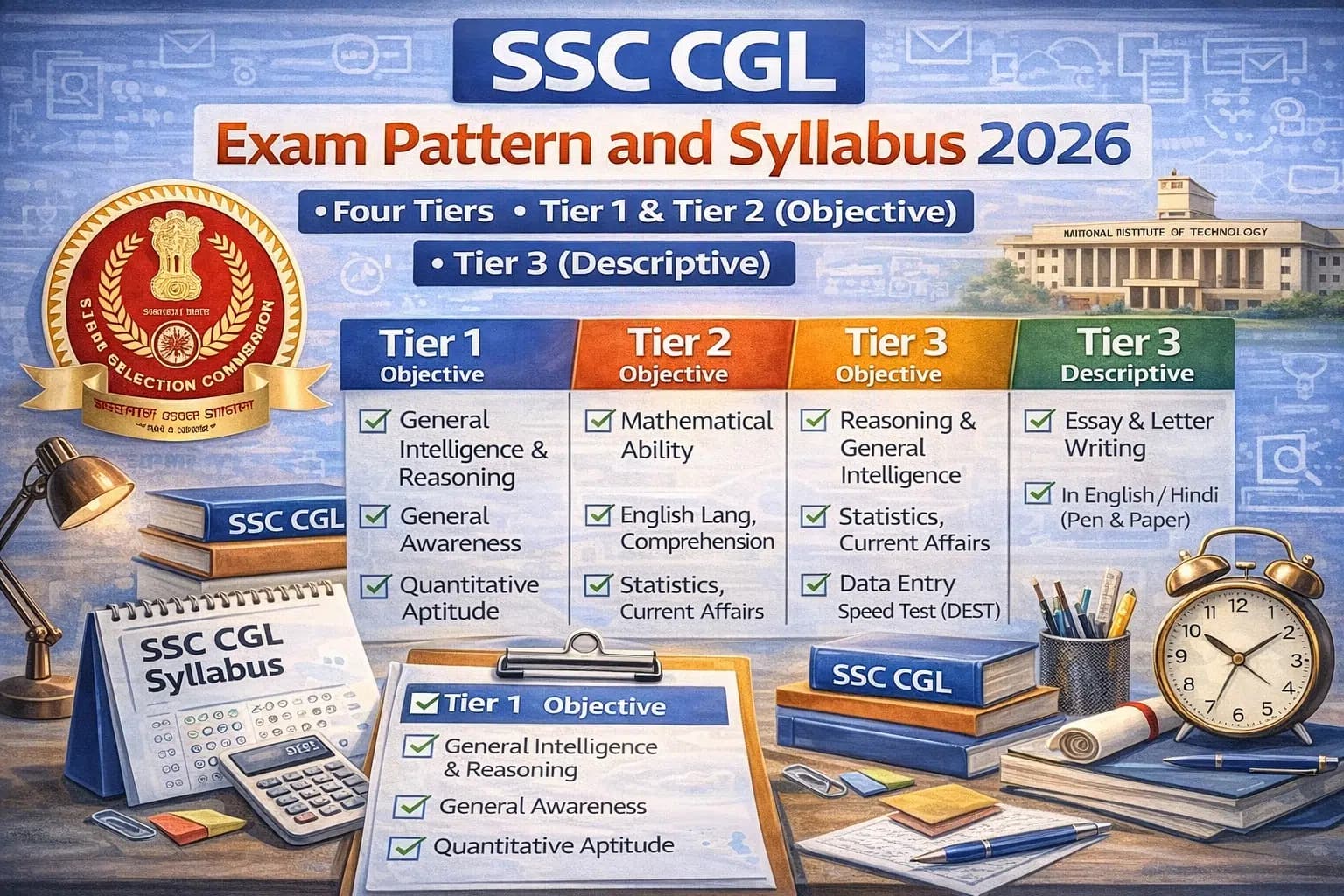
Understanding the SSC CGL exam pattern and syllabus is fundamental to developing an effective preparation strategy for this highly competitive examination. The Staff Selection Commission has designed a comprehensive two‑tier examination system to assess candidates' aptitude, knowledge, and suitability for various government positions. With the SSC CGL Notification 2026 expected in March, aspirants must familiarize themselves with the complete examination structure and curriculum to plan their preparation efficiently.
Ready to Ace Your Exam?
Practice with our comprehensive test series designed by experts. Get detailed solutions, performance analytics, and boost your preparation.
Explore Test SeriesSSC CGL Exam Structure Overview
The Combined Graduate Level Examination follows a multi‑stage selection process designed to evaluate different skill sets of candidates. The examination has undergone several revisions over the years, with the current pattern being more streamlined and focused.
Examination Stages:
Stage 1 involves Tier 1 Computer Based Examination which serves as a screening test for all candidates. This is qualifying in nature.
Stage 2 comprises Tier 2 Computer Based Examination with multiple papers. Marks obtained here determine the final merit list.
Stage 3 includes Document Verification where candidates' certificates and credentials are verified.
Stage 4 consists of Skill Tests or Computer Proficiency Tests depending on the post applied for.
The entire selection process spans approximately 6 to 8 months from the Tier 1 exam to final result declaration.
SSC CGL Tier 1 Exam Pattern 2026
The first tier acts as a preliminary examination to shortlist candidates for the main examination. Understanding this pattern helps in strategic preparation and time management.
Examination Mode and Duration
The Tier 1 exam is conducted entirely in Computer Based Test (CBT) mode at designated examination centers across India. Candidates appear for the exam in shifts allocated to them through the admit card.
Total Duration: 60 minutes for general candidates
Duration for PwBD Candidates: 80 minutes for visually handicapped and cerebral palsy candidates who are eligible for scribe
The exam is conducted simultaneously in English and Hindi languages. Candidates can toggle between languages during the exam except for the English Comprehension section which is available only in English.
Question Pattern and Marking Scheme
Total Questions: 100 Multiple Choice Questions
Total Marks: 200 marks with each question carrying 2 marks
Type of Questions: Objective type with four options and one correct answer
Negative Marking: Yes, 0.50 marks (one‑fourth of the marks assigned to the question) is deducted for each wrong answer
Normalization: Since the exam is conducted in multiple shifts across different days, normalization of marks is done to ensure fairness.
The normalization process accounts for difficulty level variations across different shifts. Candidates' final scores are calculated after normalization, which may differ from raw scores.
Section‑wise Distribution
The Tier 1 examination is divided into four sections testing different abilities.
Section 1: General Intelligence and Reasoning
This section evaluates logical thinking, analytical reasoning, and problem‑solving capabilities.
Number of Questions: 25 questions
Maximum Marks: 50 marks (2 marks each)
Time Allocation: Approximately 15 minutes
Topics Covered: Analogies test relationship between different items or concepts. Classifications involve grouping similar elements together. Series questions include number series, letter series, and mixed series patterns.
Coding‑Decoding assesses ability to understand coded language and decode messages. Blood Relations questions test understanding of family relationships. Direction and Distance problems evaluate spatial reasoning.
Logical Reasoning includes statement and conclusion, statement and assumptions, and syllogism. Venn Diagrams test set theory and logical grouping. Non‑Verbal Reasoning covers pattern completion, figure classification, and embedded figures.
Section 2: General Awareness
This section tests knowledge of current events, static GK, and awareness about the world.
Number of Questions: 25 questions
Maximum Marks: 50 marks (2 marks each)
Time Allocation: Approximately 12‑15 minutes
Topics Covered: Current Affairs include recent national and international events, government schemes, appointments, awards, and important dates. Questions from the last 6 months before the exam are most relevant.
History covers ancient Indian history, medieval period, modern India, and the freedom struggle. Important events, personalities, movements, and their significance are tested.
Geography includes Indian and world geography, physical features, climate, natural resources, and economic geography. Environmental studies and biodiversity are also part of this.
Polity questions come from the Indian Constitution, political system, governance, public policy, and rights issues. Understanding constitutional articles and amendments is crucial.
Economy covers basic economic concepts, Indian economy, budget, banking, economic indicators, and current economic developments.
Science topics include physics, chemistry, biology fundamentals, and recent scientific developments and discoveries.
Culture questions test knowledge of Indian art, literature, festivals, and cultural heritage.
Section 3: Quantitative Aptitude
This section assesses numerical ability and mathematical skills.
Number of Questions: 25 questions
Maximum Marks: 50 marks (2 marks each)
Time Allocation: Approximately 18‑20 minutes
Topics Covered: Number System includes basics, HCF and LCM, divisibility rules, and prime numbers. Simplification and approximation questions test calculation speed and accuracy.
Percentage, Profit and Loss, Simple and Compound Interest are commercial mathematics topics frequently asked. Ratio and Proportion along with Time and Work problems are regular features.
Speed, Distance, and Time questions test understanding of motion concepts. Averages, Mixtures, and Alligations are calculation‑based topics.
Geometry covers basic geometrical figures, properties, area, and perimeter. Mensuration includes 2D and 3D shapes volume and surface area.
Trigonometry basics like ratios, identities, and simple applications appear occasionally. Data Interpretation from charts, graphs, and tables tests analytical ability.
Algebra includes linear equations, quadratic equations, and basic algebraic expressions.
Section 4: English Comprehension
This section evaluates language proficiency, grammar, and comprehension skills.
Number of Questions: 25 questions
Maximum Marks: 50 marks (2 marks each)
Time Allocation: Approximately 12‑15 minutes
Topics Covered: Reading Comprehension passages test understanding of written text, ability to draw inferences, and identify main ideas. Usually 1‑2 passages with 5‑7 questions each.
Grammar includes parts of speech, tenses, voice (active and passive), narration (direct and indirect), subject‑verb agreement, and article usage.
Vocabulary questions test synonyms, antonyms, one‑word substitution, and idioms and phrases. Spellings may also be tested.
Sentence Improvement identifies errors or suggests better phrasing. Error Spotting locates grammatical mistakes in sentences.
Fill in the Blanks assess vocabulary and contextual word usage. Sentence Rearrangement tests logical sequencing ability.
Cloze Test involves filling multiple blanks in a passage using appropriate words.
For detailed syllabus using gamidied tracking mode use our SSC CGL Syllabus 2026.
For detailed preparation strategies for each section, refer to our guide on SSC CGL Preparation Strategy 2026.
SSC CGL Tier 2 Exam Pattern 2026
Tier 2 is the main examination where performance determines final merit ranking and post allocation. This tier consists of multiple papers with different purposes.
Paper 1: Quantitative Abilities
This is a compulsory paper for all posts and tests advanced mathematical and numerical ability.
Number of Questions: 90 Multiple Choice Questions
Maximum Marks: 180 marks (2 marks per question)
Duration: 120 minutes (160 minutes for PwBD candidates with scribe)
Negative Marking: 0.50 marks for each wrong answer
Difficulty Level: Higher than Tier 1 Quantitative Aptitude
Syllabus for this paper covers all topics from Tier 1 Quantitative Aptitude but with increased complexity and depth. Advanced problems on Number System, Algebra, Geometry, Trigonometry, and Mensuration are asked.
Data Interpretation gets more weightage with complex charts, graphs, and case studies. Speed and accuracy in calculations are crucial as the paper is lengthy and time‑bound.
Paper 2: English Language and Comprehension
This is also compulsory for all posts and assesses comprehensive language skills.
Number of Questions: 90 Multiple Choice Questions
Maximum Marks: 180 marks (2 marks per question)
Duration: 120 minutes (160 minutes for PwBD candidates with scribe)
Negative Marking: 0.50 marks for each wrong answer
Language: Questions are in English only
Syllabus includes all topics from Tier 1 English Comprehension but with greater depth. Multiple reading comprehension passages with more complex vocabulary and ideas are given.
Advanced grammar rules, error detection, sentence correction, and paragraph completion questions appear. Vocabulary questions test less common synonyms, antonyms, and phrases.
Essay writing or precis writing may be included in some formats. Overall language proficiency at a higher level is evaluated.
Paper 3: Statistics
This paper is only for candidates who have applied for the post of Junior Statistical Officer (JSO) in the Ministry of Statistics and Programme Implementation.
Number of Questions: 100 Multiple Choice Questions
Maximum Marks: 200 marks (2 marks per question)
Duration: 120 minutes (160 minutes for PwBD candidates with scribe)
Negative Marking: 0.50 marks for each wrong answer
Eligibility: Only those who have selected JSO post preference
Syllabus covers both theoretical and applied statistics. Collection, Classification and Presentation of Statistical Data including primary and secondary data, sampling methods, and data presentation through diagrams and graphs.
Measures of Central Tendency include mean, median, mode, and their properties. Measures of Dispersion cover range, quartile deviation, mean deviation, and standard deviation.
Moments, Skewness and Kurtosis test distribution characteristics. Correlation and Regression analyze relationships between variables.
Probability Theory includes basic probability, conditional probability, and Bayes' theorem. Random Variables and Probability Distributions cover binomial, Poisson, and normal distributions.
Sampling Theory deals with sampling distributions, estimation, and hypothesis testing. Index Numbers and Time Series analyze economic data patterns.
This paper requires strong mathematical and statistical background, typically from candidates with Statistics or Mathematics degrees.
SSC CGL Tier 2 Marking and Merit
The final merit list for SSC CGL is prepared based on performance in Tier 2 examination only. Tier 1 is purely qualifying.
Merit Calculation:
For most posts, marks in Paper 1 (Quantitative Abilities) and Paper 2 (English Language) are combined to determine merit.
For JSO posts, marks from all three papers (Paper 1, Paper 2, and Paper 3) are considered.
Candidates are ranked based on total marks obtained in relevant papers. In case of tie, age‑based tie‑breaking rules apply with older candidates getting preference.
Post allocation depends on merit rank, post preferences submitted by candidates, vacancies available, category‑wise reservation, and medical fitness for specific posts.
Skill Tests and Computer Proficiency Test
After Tier 2, candidates are called for skill tests or computer proficiency tests depending on the posts they have applied for.
Typing Test
Certain posts require typing skills which are tested through a typing speed test.
For Data Entry Operator Posts:
Typing speed of 8,000 key depressions per hour on computer is required. This translates to approximately 40 words per minute.
Duration of test is 15 minutes. Medium can be either English or Hindi as per candidate's preference.
This is a qualifying test. Candidates must achieve minimum speed to qualify, but marks are not added to total score.
Computer Proficiency Test (CPT)
Some posts require computer knowledge which is tested through practical examination.
Components of CPT:
Word Processing tests ability to create, format, and edit documents using word processing software like MS Word.
Spreadsheet work evaluates skills in creating spreadsheets, using formulas, and data manipulation using MS Excel.
Generation of Slides tests presentation creation using software like MS PowerPoint.
Each component has specific tasks to be completed within the given time limit. This is also qualifying in nature.
Document Verification Process
Candidates who qualify in Tier 2 and skill tests (if applicable) are called for document verification. This is a crucial stage where all claims made in the application are verified.
Documents Required:
Educational certificates proving qualification as mentioned in application. Mark sheets of all years and semesters from 10th standard onwards.
Age proof certificate like 10th standard certificate, birth certificate, or matriculation certificate.
Category certificate for SC, ST, OBC (Non‑Creamy Layer), or EWS candidates issued by competent authority in prescribed format.
Disability certificate for PwBD candidates showing percentage and type of disability.
Experience certificate if claiming any experience‑based relaxation or benefit.
Photo identity proof like Aadhaar card, PAN card, driving license, or passport.
Recent passport‑size photographs matching the one uploaded in application.
Any other documents as specified in the admit card for document verification.
All certificates must be original with self‑attested photocopies. Mismatch between declared and actual information leads to disqualification even at this late stage.
Medical Examination
After successful document verification, candidates undergo medical examination to assess fitness for the allocated post.
Different posts have different medical standards. Visual acuity, color vision (for certain posts), hearing capacity, and general physical fitness are assessed.
Posts involving fieldwork or specific physical requirements have stricter medical standards. Candidates must be free from any disease or disability that may interfere with efficient discharge of duties.
Medical unfitness at this stage can result in non‑selection even after clearing all written stages. Therefore, maintaining good health throughout the selection process is important.
Subject‑wise Preparation Strategy
Understanding what to study is as important as understanding the exam pattern.
For General Intelligence and Reasoning
Practice is key for this section. Solve different types of questions from various sources. Learn shortcuts and tricks for quick solving.
For non‑verbal reasoning, regular practice of figure‑based questions improves pattern recognition. Time yourself while practicing to improve speed.
Understanding basic concepts and then applying them to different question types helps. Don't just memorize solutions; understand the logic behind them.
For General Awareness
This is primarily memory‑based and requires consistent reading. Daily newspaper reading for current affairs is mandatory.
For static GK, prepare subject‑wise notes covering history, geography, polity, economy, and science. Regular revision prevents forgetting.
Monthly magazines and current affairs compilations help consolidate information. Making your own notes aids better retention than just reading.
For Quantitative Aptitude
Master basic mathematical concepts first before moving to advanced problems. Understand formulas and their derivations rather than just memorizing them.
Practice mental mathematics and shortcut techniques for faster calculation. Time management is crucial as many questions need to be solved quickly.
Solve previous year papers to identify important topics and question patterns. Regular practice improves both speed and accuracy.
For English Comprehension
Build vocabulary by learning new words daily. Reading newspapers, novels, and quality English content improves comprehension naturally.
Grammar rules should be understood with examples. Practice error detection and sentence improvement regularly.
For reading comprehension, practice reading diverse topics and answering questions within time limits.
Detailed topic‑wise syllabus breakdown and preparation resources are available in our article on
SSC CGL Syllabus 2026 Complete Breakdown.
Changes from Previous Years
SSC periodically revises the exam pattern to improve the selection process. Staying updated with changes is important.
Recent Modifications:
The examination has been reduced from four tiers to two tiers, simplifying the process. This change was implemented from SSC CGL 2020 onwards.
Tier 3 (Descriptive Paper) and Tier 4 (Skill Tests) have been removed as separate stages. Skill tests are now conducted for specific posts only after Tier 2.
Normalization of marks across different shifts has been introduced to ensure fairness when exams are conducted on multiple days.
The pattern and syllabus remain largely stable, but minor modifications in question distribution or difficulty level may occur. Always refer to the official notification for current year specifics.
Mock Tests and Their Importance
Taking regular mock tests is crucial for exam success. They serve multiple purposes in preparation.
Mock tests familiarize you with the actual exam interface and environment. They help develop time management skills and improve speed.
Regular testing identifies weak areas that need more attention. Analyzing mistakes in mock tests prevents repeating them in the actual exam.
Mock tests build exam temperament and reduce anxiety. They simulate pressure conditions helping you stay calm during the real exam.
Use our premium mock test to prepare
Recommended Approach:
Start taking mock tests after completing at least 60‑70% of syllabus. Initially take section‑wise tests to strengthen individual areas.
Progress to full‑length tests replicating actual exam conditions. Take tests in computer‑based mode matching the real exam format.
Analyze each test thoroughly spending 2‑3 hours on review. Track your progress through successive tests to monitor improvement.
Time Management During Exam
Effective time utilization can significantly impact your score. Planning your approach beforehand helps.
For Tier 1:
With 60 minutes for 100 questions, you have approximately 36 seconds per question. However, distribution should be strategic.
Attempt questions you know first from all sections. Don't get stuck on difficult questions; mark them for review and move ahead.
Easier sections like General Awareness and Reasoning should be attempted quickly. Save more time for Quantitative Aptitude which requires calculations.
Keep 3‑5 minutes at the end for final review and attempting marked questions.
For Tier 2:
Each paper has 120 minutes which seems sufficient but becomes tight with complex questions.
In Quantitative Abilities paper, solve easier questions first building momentum. Attempt Data Interpretation sets strategically based on difficulty.
In English paper, reading comprehension passages take time. Skim the questions first, then read the passage keeping those questions in mind.
Negative marking makes accuracy important. Don't attempt questions you're completely unsure about.
Common Mistakes to Avoid
Learning from others' mistakes helps avoid similar pitfalls.
Pattern‑Related Mistakes:
Not being clear about exam pattern and syllabus leads to unfocused preparation. Some candidates prepare topics not even in the syllabus.
Ignoring negative marking and attempting all questions randomly reduces overall score significantly.
Preparation Mistakes:
Starting preparation too late doesn't leave enough time for complete syllabus coverage and revision.
Relying only on shortcuts without understanding basic concepts creates problems when questions are twisted.
Not practicing enough mock tests leaves candidates unprepared for time pressure and exam conditions.
Exam Day Mistakes:
Not reading questions carefully leads to silly errors even in known questions.
Poor time management resulting in attempting too few questions or rushing through and making mistakes.
Getting nervous and losing composure affects performance negatively.
For comprehensive guidance on avoiding mistakes and maximizing scores, check How to Prepare for SSC CGL 2026 Effectively.
Frequently Asked Questions
Q: Is SSC CGL Tier 1 marks considered for final selection?
No, Tier 1 is only qualifying. Final merit is based on Tier 2 marks only.
Q: Can I skip Tier 1 and directly appear for Tier 2?
No, all candidates must qualify Tier 1 to be eligible for Tier 2.
Q: What is the qualifying cutoff for Tier 1?
Cutoffs vary each year depending on difficulty and number of candidates. Generally, scoring 120‑130 marks ensures qualification.
Q: Is there sectional cutoff in SSC CGL?
No, there is no sectional cutoff. Only overall cutoff matters.
Q: Which paper in Tier 2 is most important?
Both Paper 1 (Quantitative Abilities) and Paper 2 (English) are equally important as both are compulsory and combined for merit.
Q: Do I need to appear for Paper 3 if I haven't applied for JSO?
No, Paper 3 is only for JSO aspirants. Other candidates only attempt Paper 1 and Paper 2.
Q: Is calculator allowed in SSC CGL exam?
No, calculators are not allowed.
Q: Can I change answers after submission?
Once you submit the exam, you cannot change any answers. However, before final submission, you can navigate back and modify.
Understanding the SSC CGL exam pattern and syllabus is the foundation of successful preparation. The two‑tier examination system tests diverse skills from logical reasoning to numerical ability, general awareness to language proficiency.
With Tier 1 acting as a screening test and Tier 2 determining final merit, both stages require focused preparation though with different strategies. While Tier 1 demands speed and accuracy across multiple subjects, Tier 2 requires depth and mastery in specific areas.
The Computer Based Test format, normalization process, and negative marking scheme make it essential to practice extensively in similar conditions. Mock tests and previous year papers are invaluable resources for pattern familiarity.
With the SSC CGL notification expected in March 2026 and exams in May‑June, candidates have a clear timeline to structure their preparation. Start with building strong fundamentals, progress to advanced topics, practice regularly through mock tests, and stay consistent with current affairs.
Understanding eligibility requirements covered in SSC CGL Eligibility Criteria 2026 and following a systematic preparation strategy aligned with the exam pattern will significantly enhance your chances of success.
Remember, SSC CGL is not just about knowing more, but about scoring more within the given time and conditions. Strategic preparation focused on the exam pattern makes the crucial difference between selection and disappointment.
Start your preparation today with complete pattern understanding, and success in SSC CGL 2026 will be yours!
Note: The exam pattern details are based on the current SSC CGL format. Always verify from the official notification for any changes.
Ready to Ace Your Exam?
Practice with our comprehensive test series designed by experts. Get detailed solutions, performance analytics, and boost your preparation.
Explore Test Series