
SSC CGL Preparation Strategy 2026
 aspirantmitraa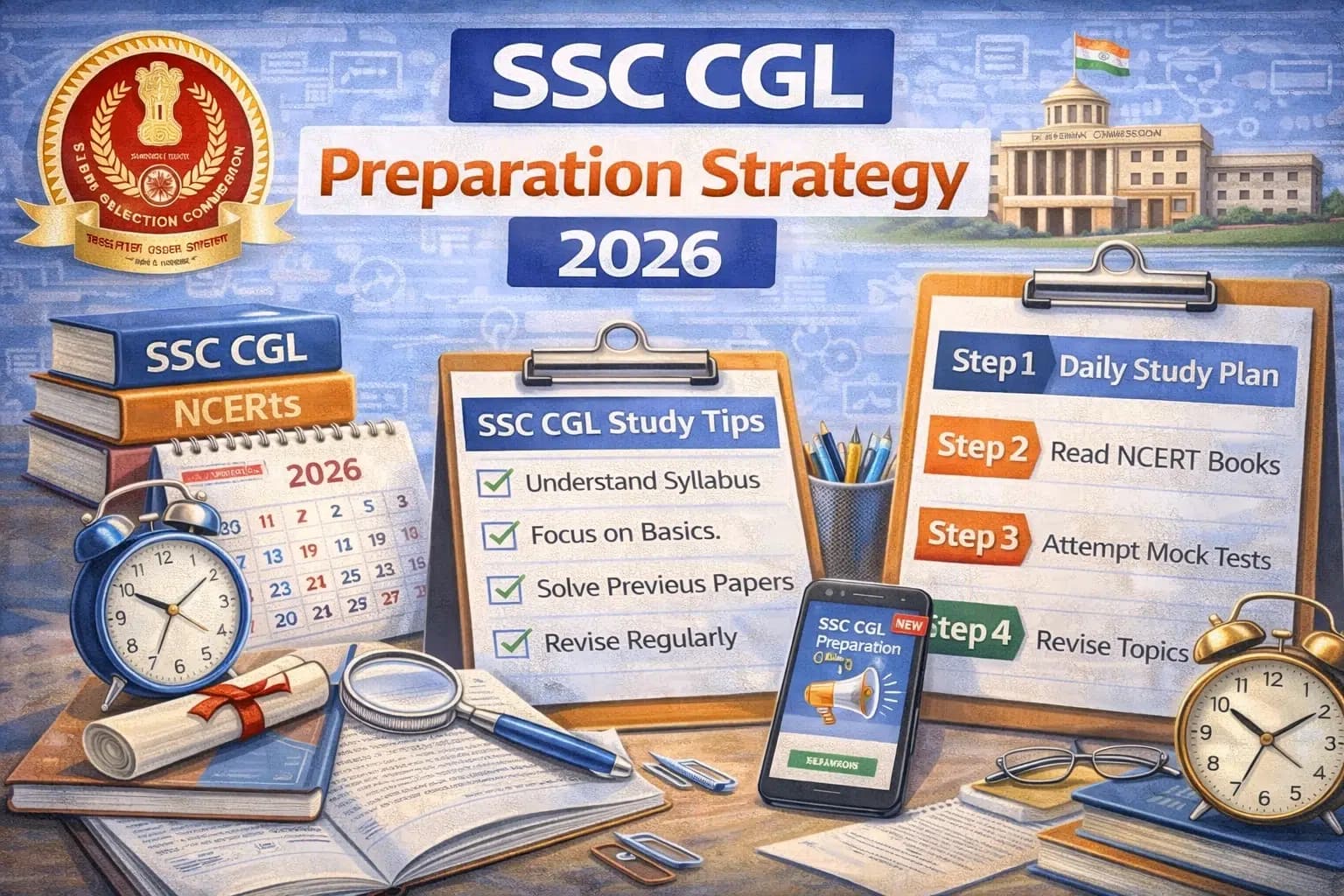
Cracking the SSC Combined Graduate Level Examination requires more than just hard work. It demands smart preparation, strategic planning, consistent effort, and the right approach to tackle this highly competitive exam. With the SSC CGL Notification 2026 expected in March and Tier 1 exam scheduled for May‑June 2026, aspirants have a limited but sufficient window to prepare effectively. This comprehensive guide provides a proven preparation strategy to help you maximize your score and secure your dream government job.
Ready to Ace Your Exam?
Practice with our comprehensive test series designed by experts. Get detailed solutions, performance analytics, and boost your preparation.
Explore Test SeriesUnderstanding SSC CGL Before You Start
Before diving into preparation, understand what you are preparing for. The Staff Selection Commission CGL exam is a two‑tier examination testing your aptitude across General Intelligence, General Awareness, Quantitative Aptitude, and English Comprehension. Understanding the complete SSC CGL Exam Pattern and Syllabus 2026 is the first step toward strategic preparation.
Reality Check for Aspirants:
SSC CGL typically sees 20‑30 lakh applicants competing for approximately 15,000‑20,000 vacancies. The success rate is less than 1%, making it one of India's most competitive exams. However, with focused preparation and the right strategy, success is achievable.
Most successful candidates take 6‑12 months of dedicated preparation. Starting early gives you a significant advantage over last‑minute preparers. Consistency matters more than intensity. Studying 6‑8 hours daily with regularity beats irregular 12‑hour marathons.
Phase 1: Foundation Building (Months 1‑3)
The initial phase focuses on building strong fundamentals across all four sections of SSC CGL.
Step 1: Verify Your Eligibility
Before investing time and effort, confirm you meet the SSC CGL Eligibility Criteria 2026 including educational qualification, age limit, and category requirements. This prevents disappointment later in the selection process.
Step 2: Understand Complete Syllabus
Download the official SSC CGL syllabus and exam pattern from ssc.gov.in. Create a checklist of all topics to track your progress systematically for this you can use AspirantMitraa's Gamified syllabus mode. Understanding what to study prevents wasted effort on irrelevant topics.
The syllabus is vast but not infinite. Breaking it into manageable chunks makes preparation less overwhelming. Categorize topics as easy, moderate, and difficult based on your comfort level.
Step 3: Gather Study Resources
Selecting the right study material is crucial for effective preparation. Too many books create confusion while too few leave gaps in knowledge.
For Quantitative Aptitude:
RS Aggarwal Quantitative Aptitude book covers all mathematical topics tested in SSC CGL. The book provides theory, solved examples, and practice questions for each topic.
Rakesh Yadav Class Notes provide shortcuts and tricks for quick problem‑solving. These are particularly useful for competitive exam preparation where speed matters.
Fast Track Arithmetic by Rajesh Verma offers concise formulas and quick methods for calculation‑intensive topics.
For English Comprehension:
Wren and Martin High School English Grammar is the bible for grammar rules. Understanding grammar fundamentals is essential for error detection and sentence improvement questions.
Word Power Made Easy by Norman Lewis helps build vocabulary systematically. A strong vocabulary is necessary for synonyms, antonyms, and comprehension passages.
Previous year SSC CGL English papers provide insight into question patterns and frequently tested topics.
For General Intelligence and Reasoning:
RS Aggarwal Verbal and Non‑Verbal Reasoning covers all reasoning topics comprehensively. The book includes various question types with detailed solutions.
Arun Sharma Logical Reasoning provides advanced level reasoning questions for competitive exams.
Rakesh Yadav Reasoning Class Notes offer shortcuts and pattern recognition techniques useful for quick solving.
For General Awareness:
Lucent General Knowledge book covers static GK topics like History, Geography, Polity, Economy, and Science comprehensively.
Manorama Yearbook provides current affairs and general knowledge in one comprehensive volume updated annually.
Daily newspapers like The Hindu, Indian Express, or Dainik Jagran keep you updated with current events.
Monthly current affairs magazines like Pratiyogita Darpan or Competition Success Review consolidate important monthly events.
Step 4: Create a Study Timetable
A realistic, sustainable study schedule is more effective than an overly ambitious plan you cannot follow.
Daily Study Hours:
For working professionals preparing alongside jobs, 4‑5 hours daily focused study is sufficient if done consistently.
For full‑time aspirants dedicating themselves entirely to preparation, 8‑10 hours daily study with proper breaks maximizes productivity.
Students preparing while completing graduation can allocate 6‑7 hours daily balancing college and preparation.
Subject‑wise Time Allocation:
Quantitative Aptitude requires the most time, approximately 35‑40% of daily study hours. Mathematics needs conceptual understanding and extensive practice.
English Comprehension deserves 20‑25% of study time. Regular practice improves grammar, vocabulary, and reading speed.
General Intelligence and Reasoning gets 25‑30% allocation. This section rewards practice more than theory.
General Awareness needs 15‑20% daily time plus continuous current affairs reading. This section combines static GK and current events.
Weekly Schedule:
Dedicate specific days to specific subjects for deeper focus. For example, Monday and Thursday for Quantitative Aptitude, Tuesday and Friday for Reasoning, Wednesday for English, and Saturday for General Awareness.
Sunday can be reserved for weekly revision and full‑length mock tests. Taking one day off or lighter study prevents burnout.
Step 5: Build Strong Fundamentals
For Quantitative Aptitude:
Start with basic number system, percentages, averages, ratio and proportion. These fundamentals apply to many other topics.
Master arithmetic topics like profit and loss, simple and compound interest, time and work, time speed and distance. These carry significant weightage.
Learn algebraic basics, linear equations, quadratic equations, and basic formulas. Understanding concepts prevents dependence on only shortcuts.
Geometry and mensuration require formula memorization and spatial visualization. Practice diagram‑based questions regularly.
Data Interpretation needs chart reading, approximation, and quick calculation skills. Practice various types of DI sets.
For English Comprehension:
Learn all grammar rules systematically starting with parts of speech, tenses, voice, narration, and articles.
Practice error detection daily to internalize grammar rules. Identifying errors sharpens your understanding.
Build vocabulary through word lists, reading quality English content, and learning word roots and prefixes.
Reading comprehension improves with practice. Read diverse passages and answer questions within time limits.
For General Intelligence and Reasoning:
Analogies, classifications, and series questions test pattern recognition. Practice different types extensively.
Coding‑decoding questions need systematic approach. Learn different coding patterns.
Blood relations, direction, and seating arrangement require logical thinking and sometimes diagram making.
Syllogism and statement‑conclusion questions test deductive reasoning. Learn Venn diagram method for quick solving.
Non‑verbal reasoning needs regular practice of figure‑based questions. Pattern recognition improves with practice.
For General Awareness:
History preparation should cover ancient India, medieval India, modern India, and world history focusing on important events and personalities.
Geography includes physical geography, Indian geography, world geography, and environmental studies. Map‑based preparation helps.
Polity covers Indian Constitution, political system, governance, and important articles and amendments.
Economy basics include economic concepts, Indian economy, budget terms, banking, and financial institutions.
Science topics include physics, chemistry, biology fundamentals, and recent scientific developments.
Current affairs require daily newspaper reading and monthly consolidation of important events, government schemes, appointments, awards, and sports.
Phase 2: Advanced Preparation (Months 4‑6)
After building fundamentals, the focus shifts to advanced topics, speed building, and extensive practice.
Step 6: Advanced Topic Coverage
Mathematics:
Move to advanced topics like trigonometry, advanced geometry, coordinate geometry, and complex data interpretation.
Learn shortcut methods and quick calculation techniques. Speed matters significantly in SSC CGL where time is limited.
Practice mental mathematics for quick calculations. This saves precious seconds during examination.
English:
Advanced grammar includes phrasal verbs, idioms, one‑word substitution, and sentence improvement at higher difficulty.
Vocabulary building should be continuous. Learn 10‑15 new words daily with their usage in sentences.
Reading comprehension passages become longer and more complex. Practice reading and understanding quickly.
Reasoning:
Tackle complex reasoning questions involving multiple conditions and variables.
Practice input‑output, coding‑decoding advanced patterns, and statement‑assumption questions.
Non‑verbal reasoning should include mirror images, water images, paper cutting, and embedded figures.
General Awareness:
Current affairs from the last 6 months before exam carry maximum weightage. Focus on recent events.
Static GK should be revised regularly to prevent forgetting. Create subject‑wise notes for quick revision.
Link current affairs with static GK. For example, when reading about a scheme, also note the ministry and relevant static facts.
Step 7: Practice Previous Year Papers
Solving previous year question papers is the most important aspect of SSC CGL preparation. Papers from the last 10‑15 years provide invaluable insights.
Benefits of Previous Year Papers:
Understanding question patterns and types helps you know what to expect in the actual exam.
Identifying important topics and frequently asked concepts allows focused preparation on high‑yield areas.
Getting familiar with difficulty level sets realistic expectations and reduces exam day surprises.
Practicing time management under exam conditions improves speed and accuracy.
How to Use Previous Year Papers:
Solve papers in exam conditions with strict timing. Simulate the actual test environment.
Initially solve year‑wise to see evolution of pattern and difficulty over years.
Later solve topic‑wise to strengthen weak areas through targeted practice.
Analyze each paper thoroughly. Understand why you got questions wrong. Learn from mistakes.
Maintain a wrong question journal. Revisit difficult questions periodically until you master them.
Step 8: Join Test Series
Mock tests are crucial for exam readiness. They simulate actual exam pressure and help build temperament.
When to Start:
Begin taking mock tests after completing at least 60‑70% of syllabus. Taking tests too early without preparation is counterproductive.
In the last 2‑3 months before exam, increase test frequency to 2‑3 full‑length tests weekly.
How to Take Mock Tests:
Always take tests in computer‑based mode matching actual SSC exam interface. Practice on screen, not on paper.
Set strict time limits matching actual exam duration. Do not extend time even if questions remain.
Take tests at the same time as your actual exam slot to condition your mind for peak performance at that hour.
Avoid interruptions during tests. Treat each mock test as the real exam.
Analyzing Mock Tests:
Spend 2‑3 hours analyzing each mock test. Analysis is more important than just taking tests.
Identify your weak areas and topics where you make frequent mistakes. Work on these specifically.
Track your progress through successive tests. Monitor improvement in speed, accuracy, and overall score.
Learn from mistakes. Understand why you selected wrong options and what the correct approach should be.
Don't get demotivated by low scores initially. Mock tests are for learning, not for proving yourself.
Phase 3: Intensive Preparation (Months 7‑9)
The final months before the exam require intensive practice, rapid revision, and fine‑tuning your strategy.
Step 9: Speed and Accuracy Building
SSC CGL tests not just knowledge but also how quickly and accurately you can apply it.
For Quantitative Aptitude:
Practice mental math and approximation techniques. Quick calculation is essential.
Learn multiplication tricks, square and cube shortcuts, percentage conversions, and fraction to decimal conversions by heart.
Solve questions using shortcut methods rather than long conventional approaches.
Practice Data Interpretation sets with time limits. DI questions are time‑consuming but scoring if practiced well.
For English:
Improve reading speed through regular practice. You should be able to read and comprehend passages quickly.
Grammar rules should be at your fingertips. Instant recognition of errors comes with extensive practice.
Vocabulary recall improves with regular revision. Use flashcards for quick daily vocabulary revision.
For Reasoning:
Pattern recognition in reasoning improves dramatically with practice. Solve diverse question types.
Learn to eliminate obviously wrong options quickly in reasoning questions.
For diagram‑based questions, practice making quick rough diagrams for better visualization.
For General Awareness:
Quick recall of facts, dates, names, and events comes from regular revision.
Create mnemonics for difficult‑to‑remember information like constitutional articles, important dates, or lists.
Step 10: Revision Strategy
Revision is as important as initial learning. Without proper revision, you forget what you learned.
Multiple Revision Cycles:
First revision should be detailed, going through notes and reference books. Allocate 50‑60% of initial learning time.
Second revision focuses on notes and important formulas. This takes 30‑40% of first revision time.
Third and subsequent revisions are quick glances at notes, formulas, and important points taking progressively less time.
Revision Techniques:
Create one‑page summaries for each topic condensing key points, formulas, and important facts.
Use mind maps for complex topics showing relationships between different concepts.
Flashcards work excellently for vocabulary, formulas, static GK facts, and quick points.
Group study sessions help in discussing difficult topics and learning from peers.
Subject‑wise Revision:
Mathematics requires formula revision and solving mixed practice questions from all topics.
English needs grammar rules revision, vocabulary revision, and reading practice.
Reasoning requires pattern practice and solving questions from all types.
General Awareness needs both static GK revision and current affairs consolidation.
Step 11: Current Affairs Preparation
Current affairs carry significant weightage in SSC CGL General Awareness section.
Daily Current Affairs:
Read newspaper daily without fail. Focus on national news, international events, government schemes, appointments, awards, sports, and important deaths.
Make concise notes while reading. Writing helps retention better than just reading.
Use different colored pens for different categories making revision visually easier.
Monthly Consolidation:
At month end, consolidate all important events from the month in one place.
Use reliable monthly current affairs compilations or magazines to ensure you don't miss important events.
Create category‑wise notes like important appointments, new schemes launched, international summits, awards and honors, books and authors, sports events and winners.
Last 6 Months Focus:
In the final months before exam, focus intensively on current affairs from the last 6 months as these carry maximum weightage.
Revise monthly current affairs multiple times. Repetition ensures retention.
Link current affairs with static GK wherever possible for comprehensive understanding.
Final Month Strategy
The last month before SSC CGL Tier 1 exam is crucial for final preparation and mental readiness.
Rapid Revision
Focus on quick revision rather than learning new topics. New topics this late create confusion.
Use your condensed notes, formula sheets, and flashcards for rapid multiple revisions.
Revise previous year questions and your wrong question journal thoroughly.
Mock Test Frequency
Take one full‑length mock test every alternate day in the last month.
Analyze each test but don't spend too much time. Quick analysis and moving forward is better.
Track your scores and ensure they are consistently improving or stabilizing at good levels.
Avoid Common Mistakes
Don't panic in the last month. Stay calm and confident in your preparation.
Don't start new books or topics. Stick to what you have already prepared.
Don't overstudy causing exhaustion. Take adequate rest and maintain physical health.
Don't discuss preparation levels with peers creating unnecessary anxiety.
Exam Day Preparation
Visit exam center location beforehand to know the route and travel time.
Arrange necessary documents like admit card, photo ID, and photographs well in advance.
Ensure technical readiness if appearing from home for online proctored exam.
Sleep well the night before exam. Last‑minute cramming affects performance negatively.
Subject‑wise Preparation Tips
Quantitative Aptitude Success Tips
Master basic arithmetic thoroughly as it forms the foundation for many other topics.
Learn at least 2‑3 methods for each question type. If one method is lengthy, another shortcut might work.
Practice mental calculations daily. Speed in calculation directly impacts your score.
Don't ignore any topic completely. Even difficult topics may have easy questions.
Data Interpretation needs consistent practice. Start with easier sets and gradually move to complex ones.
English Comprehension Success Tips
Read quality English content daily. Good reading habit improves comprehension naturally.
Don't just memorize grammar rules. Understand them with examples and practice extensively.
Vocabulary building is a continuous process. Learn words in context, not in isolation.
For reading comprehension, read questions first, then the passage. This helps you know what to look for.
Practice writing and speaking in English improves overall language command.
Reasoning Success Tips
Understand the logic behind solutions rather than just memorizing patterns.
For series questions, look for multiple patterns like difference, ratio, square, cube combinations.
Diagram making helps in blood relations, seating arrangements, and direction questions.
Verbal reasoning needs logical thinking. Practice statement‑conclusion and syllogism thoroughly.
Non‑verbal reasoning improves with regular practice. Spend 15‑20 minutes daily on figure‑based questions.
General Awareness Success Tips
Create separate notebooks for static GK and current affairs for organized study.
Make connections between different facts. Linking helps remember better than isolated facts.
Current affairs should be read daily. Monthly cramming doesn't work as well as daily reading.
Government websites like PIB are excellent sources for authentic current information.
Static GK needs regular revision. Forgetting is natural, so periodic revision is essential.
Time Management During Exam
Effective time utilization can significantly improve your score in SSC CGL.
For Tier 1 Exam:
With 60 minutes for 100 questions, you have only 36 seconds per question on average.
Attempt sections in order of your strength. Starting with your strong section builds confidence.
Don't get stuck on difficult questions. Mark for review and move ahead quickly.
Aim to complete first round in 50 minutes attempting questions you know well.
Use remaining 10 minutes for marked questions and final review.
General Awareness questions take least time. Answer these quickly saving time for Maths.
Quantitative Aptitude needs maximum time. Allocate 20‑25 minutes for this section.
Negative marking makes accuracy important. Avoid random guessing unless you can eliminate at least two options.
Common Mistakes to Avoid
Learning from others' mistakes helps you avoid similar pitfalls in your preparation and exam.
Preparation Phase Mistakes:
Starting too late doesn't leave enough time for complete syllabus coverage and revision.
Studying without planning wastes time and effort without achieving desired results.
Ignoring any section completely creates dangerous gaps in knowledge.
Not making notes forces you to re‑read entire books during revision wasting precious time.
Over‑reliance on shortcuts without understanding basics leads to mistakes when questions are twisted.
Not taking mock tests regularly leaves you unprepared for time pressure and exam environment.
Exam Day Mistakes:
Not reading questions carefully leads to silly mistakes even in questions you know.
Spending too much time on difficult questions reduces time for easier questions later.
Random guessing without eliminating options increases negative marking significantly.
Letting difficult questions or bad sections affect confidence for remaining sections.
Not managing time properly resulting in leaving many questions unattempted despite knowing answers.
Maintaining Motivation and Health
Long preparation journey requires sustained motivation and good health.
Stay Motivated:
Remember why you started this journey. Your goal of government job should drive you daily.
Celebrate small victories like completing topics, improving mock test scores, or mastering difficult concepts.
Read success stories of previous toppers for inspiration during low phases.
Visualize yourself succeeding and joining your dream department. Positive visualization boosts confidence.
Maintain Physical Health:
Sleep 7‑8 hours daily. Adequate sleep is essential for memory consolidation and mental alertness.
Exercise regularly even if just 30 minutes of walking, jogging, or yoga. Physical fitness boosts mental performance.
Eat nutritious meals avoiding excessive junk food. Brain needs proper nutrition to function optimally.
Take regular breaks during study to prevent mental fatigue and maintain concentration.
Mental Well‑being:
Don't compare your preparation with others. Everyone has different pace and circumstances.
Take one day off weekly to relax and pursue hobbies. Complete rest prevents burnout.
Meditation or relaxation techniques help manage stress and anxiety effectively.
Talk to family or friends when feeling overwhelmed. Support system is crucial during preparation.
For understanding what happens after exam, familiarize yourself with how to apply for SSC CGL 2026 online well in advance.
Frequently Asked Questions
Q: How many hours should I study daily for SSC CGL?
6‑8 hours of focused daily study is sufficient for most aspirants. Quality matters more than quantity.
Q: Is coaching necessary for SSC CGL preparation?
No, many candidates clear SSC CGL through self‑study using standard books and online resources. Coaching is helpful but not mandatory.
Q: How important are mock tests?
Extremely important. Mock tests build exam temperament, improve time management, and identify weak areas. Take at least 20‑30 full‑length mocks.
Q: Can I prepare for SSC CGL in 3 months?
Possible if you have strong basics and can dedicate 10‑12 hours daily. However, 6‑8 months preparation is ideal.
Q: Which section should I focus on most?
All sections are important. However, Quantitative Aptitude typically needs maximum time and practice.
Q: How to improve speed in Quantitative Aptitude?
Regular practice, learning shortcuts, mental math practice, and solving previous year papers improve speed significantly.
Q: Should I learn all topics or focus on important ones?
Cover all topics at basic level, then focus more on high‑weightage and frequently asked topics.
Q: How to balance current affairs and static GK?
Read newspaper daily for current affairs and dedicate specific time weekly for static GK revision.
Conclusion
Cracking SSC CGL 2026 requires strategic preparation combining conceptual clarity, extensive practice, smart revision, and effective time management. Success comes not from studying everything but from studying the right things in the right manner.
With the notification expected in March 2026 and Tier 1 exam in May‑June 2026, aspirants have a clear timeline to structure their preparation. Understanding the complete exam pattern and syllabus and taking premium test series and meeting eligibility requirements are prerequisites before implementing this strategy.
Focus on building strong fundamentals initially, then move to advanced topics and extensive practice. Regular mock tests and thorough analysis are non‑negotiable for success. Multiple revision cycles ensure retention of vast syllabus.
Maintain consistency throughout your preparation journey. Daily disciplined study beats irregular intensive bursts. Take care of your physical and mental health as they directly impact your performance.
Remember, thousands of candidates crack SSC CGL every year. With proper strategy, dedication, and smart work, you can be one of them. Stay focused, stay consistent, and your dream government job through SSC CGL 2026 will become reality.
Start your preparation today with this proven strategy, and success will be yours!
Disclaimer: This strategy is recommended based on successful candidates' experiences. Adapt it according to your individual strengths, weaknesses, and circumstances.
Ready to Ace Your Exam?
Practice with our comprehensive test series designed by experts. Get detailed solutions, performance analytics, and boost your preparation.
Explore Test Series