
UPSC Preparation Strategy for Beginners 2026: Complete Guide
 aspirantmitraa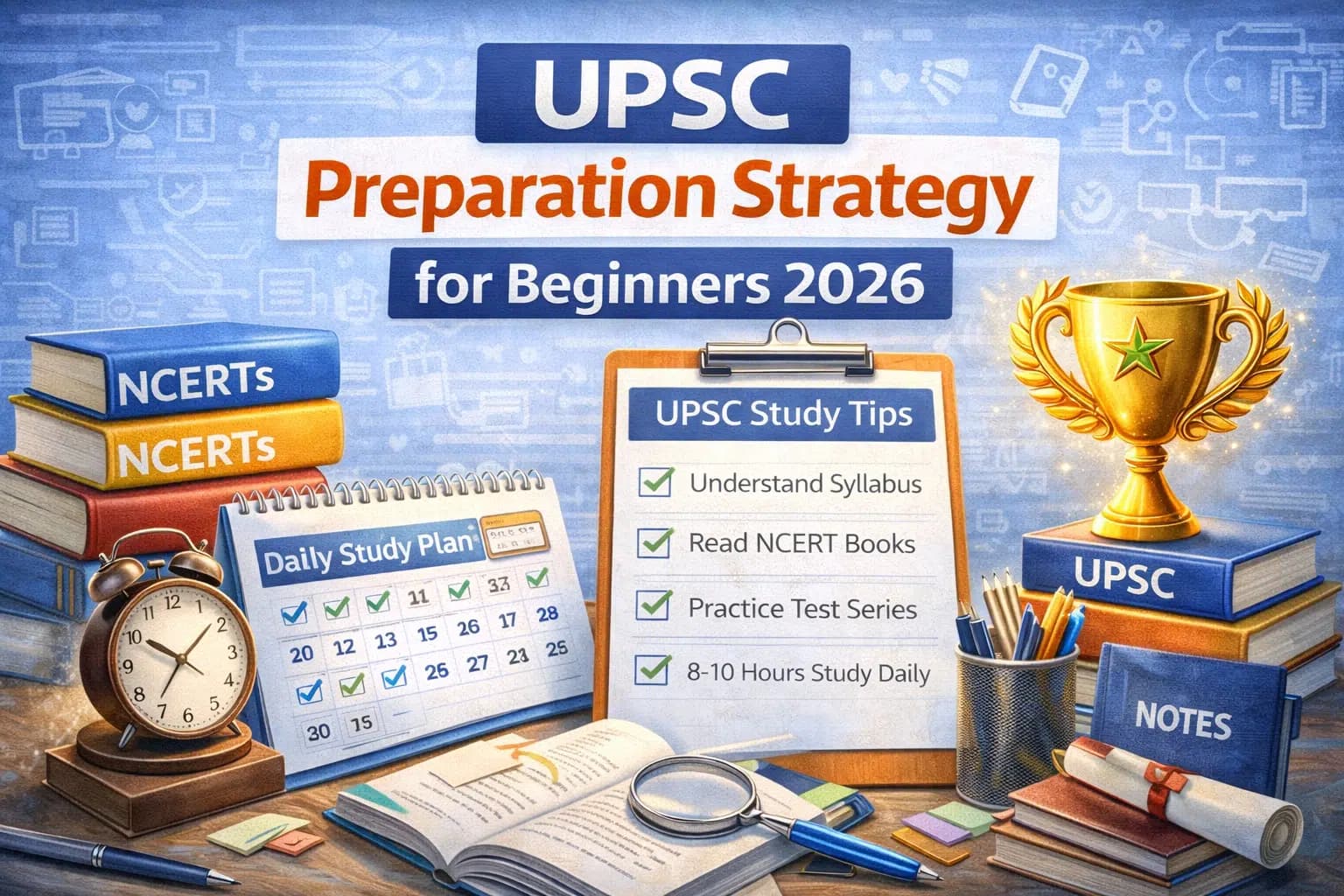
Starting UPSC Civil Services preparation can be overwhelming for beginners. With vast syllabus, multiple subjects, three‑stage examination, and intense competition, knowing where to begin becomes the biggest challenge. This comprehensive guide provides a structured, step‑by‑step preparation strategy specifically designed for first‑time aspirants targeting UPSC CSE 2026.
Ready to Ace Your Exam?
Practice with our comprehensive test series designed by experts. Get detailed solutions, performance analytics, and boost your preparation.
Explore Test SeriesUnderstanding UPSC: Before You Begin
Before diving into preparation, understand what you're preparing for. The UPSC CSE exam pattern consists of three stages Prelims, Mains, and Interview each testing different skills. Success requires not just knowledge accumulation but strategic preparation, consistent effort, and the right approach.
Reality Check for Beginners:
- Preparation typically requires 12‑18 months of dedicated study
- Success rate is approximately 0.1‑0.2% (around 1,000 selections from 10+ lakh applicants)
- Multiple attempts are common even for successful candidates
- Self‑discipline and consistency matter more than intelligence
With the UPSC Notification 2026 expected soon and Prelims scheduled for May 24, 2026, beginners should start immediately with structured preparation.
Phase 1: Foundation Building (Months 1‑4)
Step 1: Verify Your Eligibility
Before investing time and effort, confirm you meet the UPSC eligibility criteria for 2026:
Quick Eligibility Check:
- ✓ Bachelor's degree completed or final year appearing
- ✓ Age between 21‑32 years (General category) as on August 1, 2026
- ✓ Indian citizenship (or eligible nationality status)
- ✓ Within permissible number of attempts
Step 2: Understand the Complete Syllabus
Download and thoroughly read the official UPSC syllabus from upsc.gov.in. Understanding the syllabus scope prevents wasted effort on irrelevant topics.
Syllabus Breakdown:
- Prelims: Current affairs, History, Geography, Polity, Economy, Environment, Science
- Mains: 9 papers covering GS, Optional subject, Essay, Languages
- Interview: Personality assessment based on DAF, current affairs, general awareness
Create a syllabus checklist marking topics as "covered," "in progress," or "pending" to track progress.
Step 3: Start with NCERT Foundation
Why NCERTs First?
- Builds strong conceptual foundation
- Simple language suitable for beginners
- Covers basic concepts tested in UPSC
- Helps understand advanced topics later
NCERT Reading Strategy:
History:
- Class 6: Our Pasts I (Ancient India)
- Class 7: Our Pasts II (Medieval India)
- Class 8: Our Pasts III (Modern India basics)
- Class 11: Themes in Indian History (Ancient and Medieval detailed)
- Class 12: Themes in Indian History (Modern India detailed)
Geography:
- Class 6‑8: Geography textbooks (basic concepts)
- Class 9: Contemporary India I
- Class 10: Contemporary India II
- Class 11: Fundamentals of Physical Geography
- Class 11: India Physical Environment
- Class 12: Fundamentals of Human Geography
- Class 12: India People and Economy
Polity:
- Class 9: Democratic Politics I
- Class 10: Democratic Politics II
- Class 11: Indian Constitution at Work
- Class 12: Contemporary World Politics
Economics:
- Class 9: Economics
- Class 10: Economic Development
- Class 11: Indian Economic Development
- Class 12: Introductory Microeconomics
- Class 12: Introductory Macroeconomics
Science:
- Class 6‑10: Science textbooks (for Science & Technology section)
- Class 11‑12: Biology (for Environment and Ecology)
Environment:
- Class 12: Biology (Chapters on Biodiversity, Ecology, Environment)
Study Approach:
- Read actively, not passively
- Make notes of important points
- Underline/highlight key concepts
- Create mind maps for complex topics
- Revise each subject after completion
Timeline: Dedicate 3‑4 months for thorough NCERT reading with note‑making.
Step 4: Start Reading Newspaper Daily
Newspaper Reading is Non‑Negotiable: From day one of preparation, start reading a quality newspaper. The Hindu is most recommended for UPSC preparation.
How to Read Newspaper Effectively:
For Beginners (First 2 months):
- Read main news items to understand current happenings
- Read editorial page (one editorial daily)
- Don't worry if you don't understand everything initially
- Focus on building reading habit first
After 2 months:
- Read 2‑3 editorials daily
- Analyze government schemes and policies
- Track important issues across multiple days
- Make notes of important news and editorials
- Link current affairs with static syllabus
What to Focus On:
- National news and developments
- International relations and geopolitics
- Economic news (budget, policies, indicators)
- Social issues (education, health, poverty)
- Environment and climate change
- Science and technology developments
- Government schemes and initiatives
Digital Alternative: If newspaper isn't accessible, use The Hindu website or app. Consistency matters more than medium.
Step 5: Complete Standard Reference Books
After NCERT foundation, move to standard reference books for deeper understanding:
Polity:
- M. Laxmikanth: Indian Polity (THE MUST‑READ)
- Reading time: 2‑3 months
- Most important book for UPSC
- Read cover to cover, make detailed notes
- Cross‑reference with current constitutional amendments
Modern History:
- Spectrum: A Brief History of Modern India (Recommended for beginners)
- OR Bipan Chandra: India's Struggle for Independence
- Focus on Freedom Movement, British policies, Social reforms
Geography:
- Certificate Physical and Human Geography by G.C. Leong
- Geography of India by Majid Husain
- World Geography basics from standard books
Economy:
- Ramesh Singh: Indian Economy (for basics)
- Economic Survey (released every January before budget)
- Union Budget (for current economic policies)
Environment:
- Shankar IAS Environment (comprehensive coverage)
- NIOS material on Environment
Science & Technology:
- NCERT Class 11‑12 Science books
- Science & Technology monthly updates
- Space, defense, IT developments from current affairs
Study Schedule for This Phase:
Daily Routine (8‑10 hours):
- Morning (3 hours): NCERT/Standard book reading
- Mid‑day (2 hours): Newspaper + Current affairs notes
- Evening (3 hours): Continuation of morning reading
- Night (1‑2 hours): Revision of previous day's topics
Weekly Target:
- Complete one subject from NCERT per week
- Read newspaper daily without fail
- Make comprehensive notes
- One full day for weekly revision
Phase 2: Advanced Preparation (Months 5‑8)
Step 6: Subject‑wise Deep Dive
After foundation building, go deeper into each subject:
History:
- Ancient India: Art, culture, architecture, empires
- Medieval India: Delhi Sultanate, Mughal Empire, Bhakti movement
- Modern India: 1857 revolt, Congress formation, Freedom struggle, Post‑independence
Geography:
- Physical: Geomorphology, climatology, oceanography
- Indian Geography: Resources, agriculture, industries, transport
- Map‑based preparation (important for Prelims and Mains)
Polity & Governance:
- Constitutional provisions in depth
- Parliament, Executive, Judiciary functioning
- Local governance, Panchayati Raj
- Important amendments and judgments
Economy:
- Economic indicators and concepts
- Government budgeting and fiscal policy
- Banking, monetary policy, inflation
- Agriculture, industry, services sectors
- Economic reforms and liberalization
International Relations:
- India's neighbors and bilateral relations
- International organizations (UN, WTO, IMF, World Bank)
- Regional groupings (SAARC, ASEAN, BRICS)
- Contemporary global issues
Internal Security:
- Left‑wing extremism, terrorism, insurgency
- Border management, coastal security
- Cyber security, money laundering
- Role of security agencies
Environment & Ecology:
- Biodiversity, ecosystems, conservation
- Climate change, global warming
- Environmental pollution and degradation
- Government initiatives and international agreements
Science & Technology:
- Recent developments in S&T
- Space program, defense technology
- Biotechnology, nanotechnology
- IT and digital India initiatives
Step 7: Choose and Start Optional Subject
Selection Criteria:
- Academic background and interest
- Availability of quality study material
- Overlap with GS papers
- Scoring potential
- Availability of coaching/guidance
Popular Optionals for Beginners:
Public Administration:
- Good overlap with GS Paper‑II (Governance)
- Relatively easier to understand
- Plenty of study material available
Sociology:
- Interesting and relatable subject
- Good scoring potential
- Useful for Essay and GS Paper‑I
Geography:
- Excellent overlap with GS (Physical and Human Geography)
- Map‑based, factual subject
- Suitable for science students too
History:
- For those with genuine interest in history
- Requires extensive reading
- Can be very scoring if well‑prepared
Political Science and International Relations (PSIR):
- Overlap with GS Paper‑II
- Contemporary relevance
- Good for students with political science background
Literature (Any language):
- For those passionate about literature
- Relatively limited syllabus
- Requires deep understanding of literary works
Optional Preparation Timeline:
- Start reading optional from Month 5‑6
- Complete first reading by Month 8‑9
- Second revision by Month 10‑11
- Answer writing practice in Month 11‑12
Step 8: Start Answer Writing Practice
Why Answer Writing Matters:
- Mains is entirely writing‑based (1,750 marks)
- Most aspirants lose marks due to poor writing
- Cannot be learned overnight; requires consistent practice
How to Start:
Month 5‑6 (Initial Practice):
- Write 150‑word answers (basic questions)
- Focus on structure: Introduction‑Body‑Conclusion
- Practice keyword‑based writing
- Time yourself: 10 minutes for 150 words
Month 7‑8 (Regular Practice):
- Write 2‑3 answers daily (250 words)
- Mix easy and moderate difficulty questions
- Incorporate diagrams, flowcharts, examples
- Get feedback from mentors or seniors
Answer Writing Format:
Introduction (2‑3 lines):
- Define key terms or provide context
- Mention significance of the issue
Body (Main content):
- Use headings and subheadings
- Present arguments, facts, examples
- Use bullet points for clarity
- Include diagrams if relevant
Conclusion (2‑3 lines):
- Summarize main points
- Provide way forward or balanced perspective
Quality Markers:
- Keyword‑rich content
- Substantiated with facts/data
- Multidimensional approach
- Balanced perspective
- Crisp and clear language
- Within word limit
Step 9: Join Test Series
Importance of Test Series:
- Simulates exam environment
- Identifies weak areas
- Improves time management
- Builds exam temperament
- Tracks progress
When to Join:
- Prelims Test Series: 4‑5 months before exam (January 2026)
- Mains Test Series: After Prelims (June‑July 2026)
How to Use Test Series Effectively:
- Take tests seriously, in exam conditions
- Analyze each test thoroughly
- Don't get demotivated by low scores initially
- Focus on learning from mistakes
- Track improvement over time
Features to Look For:
- Quality questions matching UPSC level
- Detailed explanations
- Performance analysis
- All‑India ranking (for comparison)
- Subject‑wise tests plus full‑length tests
Phase 3: Intensive Preparation (Months 9‑12)
Step 10: Current Affairs Integration
Current Affairs Components:
- Daily news from newspaper
- Monthly current affairs magazines
- Government reports (Economic Survey, Budget, Annual Reports)
- International developments
- Scheme implementations and outcomes
How to Prepare Current Affairs:
Monthly Compilation:
- Consolidate monthly current affairs from reliable sources
- Categorize: National, International, Economy, Environment, S&T, etc.
- Link with static syllabus topics
- Make concise notes for revision
Important Reports and Documents:
- Economic Survey (January release)
- Union Budget (February release)
- India Year Book (comprehensive reference)
- Yojana Magazine (government publication)
- Kurukshetra Magazine (rural development focus)
Issue‑based Tracking:
- Follow important issues across months
- Understand government's approach and opposition views
- Know international implications
- Be aware of committee recommendations
Step 11: Prelims‑Specific Preparation (Last 4 Months)
Prelims Strategy:
CSAT Preparation:
- Don't neglect CSAT despite it being qualifying
- Practice comprehension passages daily
- Solve mathematics and reasoning questions
- Take CSAT mock tests
MCQ Practice:
- Solve previous 10‑15 years' Prelims papers
- Subject‑wise MCQ books
- Daily MCQ practice (50‑100 questions)
- Analyze why wrong answers are wrong
Elimination Technique:
- Learn to eliminate obviously wrong options
- Narrow down to 2 options before guessing
- Understand negative marking impact
Guesswork Strategy:
- Don't attempt if completely clueless (negative marking)
- If can eliminate 2 options, educated guess is worth it
- Leave very difficult questions
Step 12: Revision Strategy
Revision is Key to Retention:
Multiple Revision Cycles:
First Revision (Detailed):
- After completing each subject
- Go through notes and reference books
- 70‑80% time of initial reading
Second Revision (Moderate):
- 2‑3 months before exam
- Focus on notes and important topics
- 40‑50% time of first revision
Third Revision (Quick):
- 1 month before exam
- Only notes and formula sheets
- 20‑30% time of first revision
Final Revision (Last week):
- Quick glance at important formulas, facts
- Confidence building
- Avoid new topics
Revision Techniques:
- Create one‑page summaries per topic
- Mind maps for complex subjects
- Flashcards for facts, dates, names
- Mnemonics for difficult‑to‑remember information
- Group study for discussion‑based learning
Phase 4: Final Sprint (Last 3 Months Before Prelims)
Month -3 (February 2026)
Focus Areas:
- Complete syllabus revision (if anything pending)
- Intensive MCQ practice
- Weekly full‑length mock tests
- Current affairs consolidation
- CSAT practice daily
Daily Routine:
- Morning: Mock test or MCQ practice (3 hours)
- Mid‑day: Test analysis and note‑making (2 hours)
- Afternoon: Current affairs and newspaper (2 hours)
- Evening: Subject revision (3 hours)
- Night: CSAT practice (1 hour)
Month -2 (March 2026)
Focus:
- Two full‑length mock tests weekly
- Quick revision of all subjects
- Weak area strengthening
- Map‑based preparation
- Previous year papers
Avoid:
- Starting new topics or books
- Over‑studying causing burnout
- Neglecting health and sleep
Month -1 (April 2026)
Focus:
- One full‑length mock test every alternate day
- Rapid revision using notes only
- Current affairs final consolidation
- Maintain calm and confidence
Last Week:
- Light revision only
- No new topics or intensive study
- Physical and mental relaxation
- Exam center visit
- Arrange admit card and ID proof
Common Mistakes Beginners Should Avoid
Mistake 1: Reading Too Many Books
- Stick to standard books only
- Multiple books create confusion
- Quality over quantity
Mistake 2: Not Making Notes
- Notes are essential for revision
- Reading without noting leads to forgetting
- Make concise, scannable notes
Mistake 3: Ignoring Newspaper
- Current affairs carry 40‑50% weightage
- Daily reading habit is crucial
- Cannot be compensated later
Mistake 4: Delaying Answer Writing
- Writing cannot be learned without practice
- Start early to develop skills
- Don't wait for "complete preparation"
Mistake 5: Comparing with Others
- Everyone's journey is different
- Focus on your own progress
- Avoid coaching center peer pressure
Mistake 6: Neglecting Health
- Long preparation requires fitness
- Sleep 7‑8 hours daily
- Exercise regularly
- Eat healthy food
Mistake 7: Over‑dependency on Coaching
- Coaching is supplementary, not primary
- Self‑study is most important
- Don't attend all optional classes
Mistake 8: Not Taking Mock Tests
- Practice is essential for exam readiness
- Mock tests build temperament
- Identify and fix weaknesses
Resources for UPSC Preparation
Essential Books:
- Laxmikanth: Indian Polity
- Spectrum: Modern India
- NCERT: All subjects Classes 6‑12
- Shankar IAS: Environment
- Economic Survey
- Optional subject standard books
Newspapers:
- The Hindu (primary)
- Indian Express (alternative/additional)
- PIB releases
Magazines:
- Yojana
- Kurukshetra
- Frontline (optional)
Online Resources:
- UPSC official website
- PIB website
- Ministry websites for schemes
- Rajya Sabha TV discussions
- Vision IAS monthly compilations (paid)
Apps:
- The Hindu app
- UPSC official app
- Various current affairs apps
- Test series apps
Maintaining Motivation Throughout
Stay Motivated:
- Remember your purpose for choosing civil services
- Visualize yourself as an IAS/IPS officer
- Read inspirational stories of toppers
- Take regular breaks to avoid burnout
Handle Setbacks:
- Bad mock test scores are learning opportunities
- Every topper has faced failures
- Consistency matters more than perfection
- Don't quit after one attempt
Support System:
- Family support is crucial
- Join study groups for discussion
- Find a mentor for guidance
- Connect with fellow aspirants
Final Tips for Beginners
1. Start Early: Don't wait for the perfect time. Start today.
2. Be Consistent: Daily 6‑8 hours is better than irregular 12‑hour marathons.
3. Stay Updated: Follow UPSC website for notifications and updates.
4. Be Flexible: Adapt your strategy based on what works for you.
5. Stay Healthy: Physical and mental fitness are non‑negotiable.
6. Practice Writing: Cannot be emphasized enough for Mains success.
7. Manage Time: Both in preparation and during exam.
8. Stay Positive: Believe in yourself and your preparation.
9. Don't Overtrain: Avoid excessive mock tests causing anxiety.
10. Enjoy the Journey: UPSC preparation is also a learning experience.
UPSC Civil Services preparation for beginners requires structured planning, consistent execution, and the right mindset. The journey is long and challenging, but with proper strategy and dedication, success is achievable.
Start with NCERT foundation, build systematically with standard reference books, integrate current affairs daily, practice answer writing regularly, and take mock tests for assessment. Remember that understanding the complete UPSC exam pattern and meeting eligibility requirements are prerequisites before diving deep into preparation.
With the Prelims scheduled for May 24, 2026, you have adequate time if you start now and follow this comprehensive strategy. Stay focused, stay consistent, and remember that every successful civil servant started exactly where you are today at the beginning.
For latest updates on application process and important dates, keep checking the UPSC Notification 2026 updates.
Your civil services journey begins now. Start strong, stay committed, and success will follow!
Disclaimer: This strategy is recommended for beginners. Adapt it based on your individual strengths, weaknesses, and circumstances.
Ready to Ace Your Exam?
Practice with our comprehensive test series designed by experts. Get detailed solutions, performance analytics, and boost your preparation.
Explore Test Series