UPSC CSE Exam Pattern and Syllabus 2026: Complete Guide
 aspirantmitraa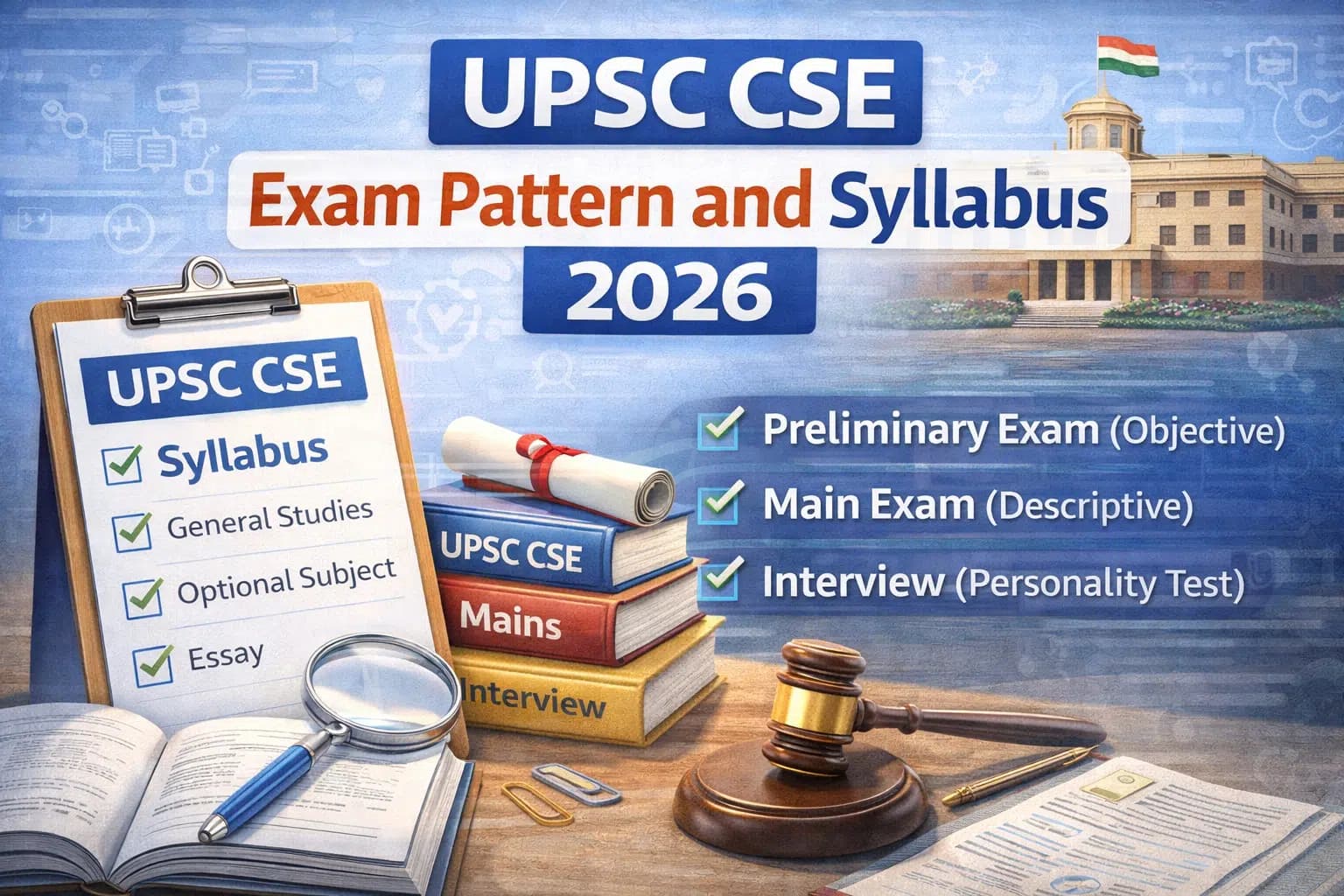
The Union Public Service Commission Civil Services Examination is India's most prestigious competitive exam for recruiting officers to the Indian Administrative Service (IAS), Indian Police Service (IPS), Indian Foreign Service (IFS), and other elite Central services. Understanding the UPSC exam pattern and syllabus is fundamental to developing an effective preparation strategy. This comprehensive guide covers everything you need to know about the UPSC CSE 2026 examination structure and curriculum.
Ready to Ace Your Exam?
Practice with our comprehensive test series designed by experts. Get detailed solutions, performance analytics, and boost your preparation.
Explore Test SeriesUPSC CSE 2026: Overview
With the UPSC Notification 2026 expected to release soon, candidates should familiarize themselves with the complete examination framework. The Civil Services Examination follows a rigorous three‑stage selection process designed to identify candidates with the right combination of knowledge, analytical ability, decision‑making skills, and personality traits required for civil services.
Examination Stages:
- Preliminary Examination (Screening Test)
- Main Examination (Written Test)
- Personality Test (Interview)
Total Selection Process Duration: Approximately 12‑14 months from Prelims to final result declaration
Stage 1: UPSC Prelims Exam Pattern 2026
The Preliminary Examination serves as the screening test, qualifying candidates for the Main Examination. It consists of two objective‑type papers conducted on the same day.
UPSC Prelims Paper‑I: General Studies
Paper Name General Studies Paper‑I
Type Objective (Multiple Choice Questions)
Total Questions 100 MCQs
Maximum Marks 200 marks
Duration 2 hours (120 minutes)
Negative Marking 1/3 mark (0.33) for each wrong answer
Time per Question Approximately 1.2 minutes
Subject‑wise Distribution (Approximate):
Current Events (15‑20 questions):
- National and international importance
- Recent developments in various fields
- Government schemes and initiatives
History of India and Indian National Movement (15‑20 questions):
- Ancient India: Indus Valley Civilization, Vedic period, Mauryan Empire
- Medieval India: Delhi Sultanate, Mughal Empire, Regional kingdoms
- Modern India: British rule, Freedom struggle, Post‑independence
Indian and World Geography (15‑20 questions):
- Physical geography: Climate, drainage, soil, natural vegetation
- Indian geography: Resources, industries, agriculture
- World geography: Major physical features, economic geography
Indian Polity and Governance (15‑20 questions):
- Constitutional framework and amendments
- Panchayati Raj and local governance
- Public policy and governance issues
- Rights issues and transparency
Economic and Social Development (15‑20 questions):
- Sustainable development and economic issues
- Poverty, unemployment, and social sector initiatives
- Inclusive growth and demographic issues
Environmental Ecology, Biodiversity and Climate Change (10‑12 questions):
- Environmental ecology and conservation
- Climate change and its impacts
- Biodiversity and ecosystem
General Science (8‑10 questions):
- Physics, Chemistry, Biology basics
- Science and technology developments
- Space technology and IT developments
UPSC Prelims Paper‑II: CSAT (Civil Services Aptitude Test)
Paper Name General Studies Paper‑II (CSAT)
Type Objective (Multiple Choice Questions)
Total Questions 80 MCQs
Maximum Marks 200 marks (Qualifying only)
Duration 2 hours (120 minutes)
Qualifying Marks 33% (66 marks out of 200)
Negative Marking 1/3 mark for each wrong answer
Important Note: CSAT is a qualifying paper only. Marks obtained in Paper‑II are not counted for ranking; candidates just need to score 33% to qualify. However, both papers must be attempted.
CSAT Syllabus Components:
Comprehension (Major portion):
- Reading passages with questions testing understanding
- Drawing inferences and conclusions
- Analyzing arguments
Interpersonal Skills and Communication:
- Understanding human behavior
- Social interactions
- Communication effectiveness
Logical Reasoning and Analytical Ability:
- Pattern recognition
- Logical deduction
- Analytical thinking
- Problem‑solving
Decision Making and Problem Solving:
- Situation analysis
- Critical thinking
- Judgment and decision making
General Mental Ability:
- Numerical ability
- Data interpretation
- Charts and graphs analysis
Basic Numeracy:
- Number systems and arithmetic
- Percentages, ratios, averages
- Basic mathematics (Class X level)
- Data sufficiency
Prelims Qualifying Strategy
Cutoff Trends: The Prelims cutoff varies each year based on difficulty level, number of vacancies, and candidate performance.
Recent Prelims Cutoffs (General Category):
- 2024: ~98‑102 marks (out of 200)
- 2023: ~88‑92 marks
- 2022: ~95‑99 marks
Target Score Recommendations:
- General Category: 105‑115 marks for comfortable qualification
- OBC Category: 95‑105 marks
- SC/ST Category: 80‑90 marks
For detailed preparation strategies aligned with the exam pattern, check our guide on UPSC Preparation Strategy for Beginners 2026.
Stage 2: UPSC Mains Exam Pattern 2026
The Main Examination is a written examination consisting of 9 papers designed to assess the academic talent and analytical ability of candidates. This is where serious preparation differentiates successful candidates from others.
Papers Overview
Paper‑A Indian Language 300 Qualifying
Paper‑B English 300 Qualifying
Paper‑I Essay 250 Merit
Paper‑II General Studies‑I 250 Merit
Paper‑III General Studies‑II 250 Merit
Paper‑IV General Studies‑III 250 Merit
Paper‑V General Studies‑IV 250 Merit
Paper‑VI Optional Subject Paper‑I 250 Merit
Paper‑VII Optional Subject Paper‑II 250 Merit
Total 1,750 For Merit Duration: Each paper is of 3 hours duration
Qualifying Papers: Papers A and B are qualifying in nature with minimum 25% marks (75 out of 300) required in each. Marks not counted in final merit.
Merit Papers: Papers I to VII contribute to the final ranking with a total of 1,750 marks.
Detailed Mains Syllabus
Paper‑A: Indian Language (Qualifying)
Marks: 300 | Qualifying: 25% (75 marks)
Candidates can choose any Indian language from the Eighth Schedule of the Constitution (22 languages available). The paper tests comprehension, précis writing, grammar, and communication skills in the chosen language.
Paper‑B: English (Qualifying)
Marks: 300 | Qualifying: 25% (75 marks)
Syllabus Components:
- Comprehension of given passages
- Précis writing
- Usage and vocabulary
- Short essays
- Translation from Indian language to English and vice‑versa
Strategy: Don't neglect qualifying papers. While they don't count for merit, failure to secure 25% leads to disqualification regardless of performance in other papers.
Paper‑I: Essay (250 marks)
Duration: 3 hours
Pattern:
- Choice of 8 essay topics (4 in Section A, 4 in Section B)
- Write one essay from each section
- Each essay: approximately 1,000‑1,200 words
Themes:
- Philosophical and abstract topics
- Social and political issues
- Economic and developmental themes
- Environmental and ethical topics
- Science, technology, and innovation
- Cultural and historical subjects
Evaluation Criteria:
- Content depth and relevance
- Logical presentation and coherence
- Effective expression and creativity
- Balanced perspective
- Examples and substantiation
Paper‑II: General Studies‑I (250 marks)
Theme: Indian Heritage, History, Society and Geography
Detailed Syllabus:
Indian Culture:
- Ancient to modern times covering art forms, literature, architecture
- Salient features of Indian society and diversity
- Role of women and women's organizations
- Social empowerment and communalism
- Regionalism and secularism
Indian History:
- Modern Indian history from mid‑18th century
- Freedom struggle and various stages
- Post‑independence consolidation
- History of world events including Industrial Revolution, World Wars, colonization
Geography:
- Physical geography: Geomorphology, climatology, oceanography
- Indian geography: Physical features, resources, agriculture, industries
- World geography: Physical features, demographic aspects
- Disaster management and vulnerability
Society:
- Indian society characteristics and dynamics
- Poverty and developmental issues
- Urbanization and migration
- Social movements in India
Paper‑III: General Studies‑II (250 marks)
Theme: Governance, Constitution, Polity, Social Justice and International Relations
Detailed Syllabus:
Indian Constitution:
- Historical underpinnings and evolution
- Salient features and amendments
- Comparison with other countries' constitutions
- Functions and responsibilities of Union and States
Governance:
- Structure, organization, and functioning of Executive, Legislature, and Judiciary
- Issues and challenges of Indian federalism
- Separation of powers and dispute resolution
- Alternative mechanisms for dispute resolution
Public Policy:
- Development processes and development industry
- Role of NGOs and civil society
- Government policies and interventions
- Welfare schemes and their performance
- Transparency and accountability mechanisms
Social Justice:
- Rights issues: SC, ST, women, children, disabled, aged
- Mechanisms, laws, and institutions for protection
- Issues relating to poverty and hunger
International Relations:
- India and its neighborhood relations
- Bilateral, regional, and global groupings
- Effect of developed and developing countries on India
- Diaspora and its role
- Important international institutions
Paper‑IV: General Studies‑III (250 marks)
Theme: Technology, Economic Development, Biodiversity, Environment, Security and Disaster Management
Detailed Syllabus:
Indian Economy:
- Economic development indicators and mobilization of resources
- Planning, budgeting, and land reforms
- Infrastructure: Energy, ports, roads, airports, railways
- Investment models including PPP
- Government budgeting and fiscal policy
Science and Technology:
- Achievements of Indians in S&T
- Indigenization of technology and new technology development
- IT, space, computers, robotics, nanotechnology, biotechnology
- Intellectual property rights
- Awareness in fields of science and technology
Environment:
- Environmental pollution and degradation
- Conservation efforts
- Climate change impacts and mitigation
Disaster Management:
- Disaster types and vulnerability
- Management strategies and preparedness
Internal Security:
- Development and extremism linkages
- Role of external forces in internal security
- Challenges to internal security through communication networks
- Money laundering and its prevention
- Security challenges and their management
- Border management and cyber security
Paper‑V: General Studies‑IV (250 marks)
Theme: Ethics, Integrity and Aptitude
Detailed Syllabus:
Ethics and Human Interface:
- Essence, determinants, and consequences of ethics
- Dimensions of ethics in private and public relationships
- Human values and role of family, society, educational institutions
Attitude:
- Content, structure, and function
- Influence and relation with thought and behavior
- Moral and political attitudes
- Social influence and persuasion
Aptitude and Foundational Values:
- Integrity, objectivity, and dedication to public service
- Empathy, tolerance, and compassion
- Probity in governance
Emotional Intelligence:
- Concepts and their utilities in administration
- Contributions of moral thinkers from India and world
Public/Civil Service Values:
- Status and problems
- Ethical concerns in public administration
- Probity in governance
- Ethical issues in international relations
Case Studies:
- Application of ethical concepts to real‑life situations
- Ethical dilemmas and conflict resolution
Papers VI and VII: Optional Subject (250 marks each)
Candidates must choose ONE optional subject from the list of 48 subjects offered by UPSC:
Popular Optional Subjects:
- Public Administration
- Sociology
- Geography
- History
- Political Science and International Relations (PSIR)
- Anthropology
- Psychology
- Law
- Economics
- Philosophy
- Literature (Various languages)
- Medical Science
- Engineering subjects
Optional Selection Criteria:
- Interest and academic background
- Availability of study material
- Overlap with GS papers
- Scoring potential
- Availability of coaching/guidance
To Complete your syllabus and track it use AspirantMitraa's Gamified syllabus mode
Stage 3: UPSC Personality Test (Interview)
The final stage evaluates the personal suitability of candidates for a career in Civil Services through an interview conducted by a board of competent and unbiased observers.
Interview Pattern:
- Maximum Marks 275 marks
- Duration 20‑30 minutes (typically)
- Panel Members 4‑5 members (Chairman + Members)
- Evaluation Areas Personality, Communication, Awareness, Analytical ability
Mental Alertness:
- Critical thinking ability
- Clarity of thought
- Quick comprehension
Intellectual and Moral Integrity:
- Ethical values
- Honesty and straightforwardness
- Balanced judgment
Social Cohesion and Leadership:
- Team spirit
- Leadership qualities
- Social awareness
General Awareness:
- Current affairs knowledge
- Understanding of national and international issues
- Awareness about social problems
Communication Skills:
- Clarity of expression
- Confidence in presentation
- Language proficiency
Hobbies and Interests:
- Questions based on DAF (Detailed Application Form)
- Optional subject and academic background
- Work experience and home state
Strategy Tips:
- Be honest and genuine
- Stay calm and composed
- Think before answering
- Maintain eye contact
- Admit if you don't know something
- Show balanced perspective on controversial issues
Final Merit and Selection
Total Marks for Final Ranking:
- Mains Examination: 1,750 marks
- Personality Test: 275 marks
- Grand Total: 2,025 marks
Important Notes:
- Prelims marks are NOT counted in final merit
- Only Mains + Interview marks determine final ranking
- Candidates are allocated to services based on:
- Final merit ranking
- Service preferences
- Medical fitness
- Cadre availability
Recent Final Cutoffs (General Category):
- 2024: ~890‑920 marks (out of 2,025)
- 2023: ~900‑930 marks
- 2022: ~910‑940 marks
Exam Duration and Schedule
UPSC CSE 2026 Timeline:
Prelims (May 24, 2026):
- Morning Session (9:30 AM - 11:30 AM): GS Paper‑I
- Afternoon Session (2:30 PM - 4:30 PM): CSAT Paper‑II
Mains (August 21, 2026 onwards):
- Conducted over 5 consecutive days
- One paper per day (some days may have two papers)
- Morning session: 9:00 AM - 12:00 Noon
- Afternoon session: 2:30 PM - 5:30 PM
Interview (December 2026 - March 2027):
- Conducted after Mains result declaration
- Scheduled over several months
- Candidates receive interview call 2‑3 weeks in advance
For complete timeline and important dates, check our article on UPSC Notification 2026 Latest Updates.
Study Strategy Based on Exam Pattern
For Prelims Preparation
NCERT Foundation (3‑4 months):
- Classes 6‑12 for History, Geography, Economics, Polity, Science
Standard Reference Books (4‑5 months):
- Laxmikanth for Polity
- Spectrum for Modern History
- Shankar IAS for Environment
- Economic Survey for Economy
Current Affairs (Daily/Continuous):
- The Hindu newspaper
- Monthly current affairs magazines
- Government schemes and initiatives
Practice (Last 3 months):
- Previous year papers (last 15 years)
- Mock test series
- Sectional tests
For Mains Preparation
Answer Writing Practice (Daily):
- Write 2‑3 answers daily
- Follow word limits strictly
- Incorporate diagrams and flowcharts
- Use contemporary examples
Newspaper Reading for GS:
- Editorial analysis
- Linking current issues with static GS
- Making notes for revision
Optional Subject (6‑8 months):
- Complete syllabus coverage
- Previous year question analysis
- Test series enrollment
- Regular revision
Ethics Paper Preparation:
- Case study practice
- Thinker quotes and philosophies
- Contemporary ethical issues
- Personal value reflection
Time Management
Daily Study Hours:
- Aspirants with job: 5‑6 hours
- Full‑time aspirants: 8‑10 hours
- Include revision time in daily schedule
Weekly Balance:
- GS Papers: 50% time
- Optional Subject: 30% time
- Current Affairs: 15% time
- Answer Writing: 5% time
Common Mistakes to Avoid
Prelims:
- Over‑preparation for CSAT while neglecting GS Paper‑I
- Not practicing enough mock tests
- Ignoring previous year questions
- Poor time management during exam
Mains:
- Not practicing answer writing regularly
- Copying from standard books verbatim
- Ignoring current affairs integration
- Poor presentation and handwriting
- Exceeding word limits
Interview:
- Faking knowledge or giving made‑up answers
- Being overconfident or under‑confident
- Not preparing DAF thoroughly
- Arguing with panel members
Frequently Asked Questions
Q: Is Prelims score counted in final merit?
No, only Mains (1,750 marks) and Interview (275 marks) count for final ranking.
Q: What is the qualifying percentage for CSAT?
33% (66 marks out of 200) is required to qualify CSAT.
Q: Can I attempt UPSC without coaching?
Yes, many toppers have cleared UPSC through self‑study using standard books and online resources.
Q: How many optional subjects can I choose?
Only ONE optional subject must be chosen for Mains examination.
Q: Is it necessary to write all 9 papers in Mains?
Yes, all 9 papers must be attempted. Failure in qualifying papers leads to disqualification.
Q: What happens if I don't score 25% in English or Indian language?
You will be disqualified even if you score well in other papers.
Q: Can I change my optional subject?
Yes, you can change your optional during DAF‑I filling (before Mains), but not after that.
The UPSC Civil Services Examination demands comprehensive preparation across multiple subjects, strong analytical abilities, excellent writing skills, and a balanced personality. Understanding the exam pattern and syllabus is the first crucial step in this journey.
With Prelims scheduled for May 24, 2026, and Mains on August 21, 2026, candidates have a clear timeline to plan their preparation. Focus on building strong fundamentals through NCERTs, reading standard reference books, staying updated with current affairs, and most importantly, practicing answer writing regularly.
The three‑stage examination process Prelims, Mains, and Interview is designed to select candidates who demonstrate not just knowledge but also the right aptitude, ethics, and personality for civil services. Approach each stage with dedicated preparation, strategic planning, and consistent effort.
Remember, UPSC is not just about knowing more; it's about presenting your knowledge effectively, thinking critically, and demonstrating the qualities expected of a civil servant. Start your preparation with the right understanding of exam pattern and syllabus, stay consistent, and success will follow.
For complete preparation guidance including eligibility criteria and application process, explore our comprehensive UPSC preparation resources.
Start your journey today—India needs dedicated civil servants like you!
Note: The syllabus and exam pattern mentioned are based on the official UPSC curriculum. For any updates, refer to the official notification at upsc.gov.in.
Ready to Ace Your Exam?
Practice with our comprehensive test series designed by experts. Get detailed solutions, performance analytics, and boost your preparation.
Explore Test Series