JEE Main vs JEE Advanced: Differences
 aspirantmitraa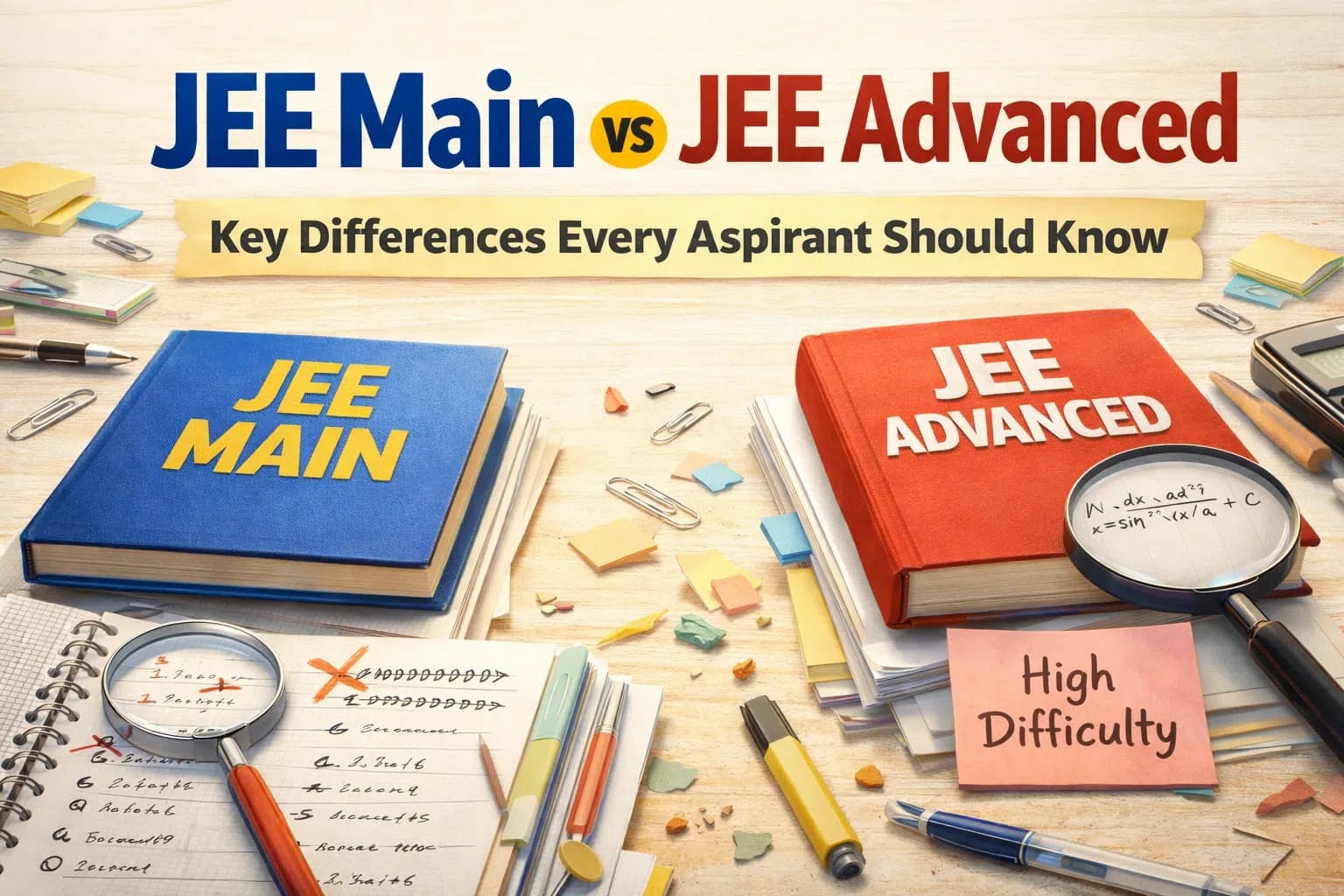
For engineering aspirants in India, understanding the distinction between JEE Main and JEE Advanced is crucial for strategic preparation and realistic goal‑setting. While both exams share the common thread of testing Physics, Chemistry, and Mathematics, they differ dramatically in purpose, difficulty, question patterns, and what they unlock for your engineering career.
This comprehensive guide demystifies both examinations, helping you understand exactly what each demands and how to approach them differently for maximum success.
Ready to Ace Your Exam?
Practice with our comprehensive test series designed by experts. Get detailed solutions, performance analytics, and boost your preparation.
Explore Test SeriesThe Fundamental Purpose: What Each Exam Actually Tests
JEE Main: The Gateway Exam
JEE Main serves as the primary engineering entrance examination in India, functioning as a qualifier for multiple pathways. Conducted by the National Testing Agency (NTA), it opens doors to:
- National Institutes of Technology (NITs) across India
- Indian Institutes of Information Technology (IIITs)
- Government Funded Technical Institutes (GFTIs)
- Numerous state government engineering colleges
- Many private engineering institutions
- Qualification for JEE Advanced
Think of JEE Main as the broad filter that separates students ready for quality engineering education from those who need more preparation. With over 12 lakh candidates appearing annually, it's designed to test fundamental understanding across a wide syllabus rather than deep problem‑solving prowess.
JEE Advanced: The Elite Selection
JEE Advanced, conducted by one of the IITs on rotation, has a singular prestigious purpose: selecting students for the 23 Indian Institutes of Technology (IITs) and a few other premier institutions like ISM Dhanbad.
Only the top 2.5 lakh JEE Main qualifiers (approximately top 20% performers) can attempt JEE Advanced. This exam separates good students from exceptional ones through extraordinarily challenging questions that test not just knowledge, but analytical thinking, creativity, and problem‑solving under pressure.
Where JEE Main asks "Do you know the concept?" JEE Advanced asks "Can you apply this concept in completely unfamiliar situations combining multiple topics?"
Exam Pattern and Structure: How They're Organized
JEE Main Pattern:
- Total Duration: 3 hours (180 minutes)
- Total Questions: 90 (30 per subject)
- Compulsory Questions: 20 MCQs per subject
- Optional Questions: 10 numerical questions per subject (attempt any 5)
- Total Marks: 300 (100 per subject)
- Question Types: Multiple Choice Questions (MCQs) and Numerical Value Answer Questions
- Negative Marking: -1 for wrong MCQ, -1 for wrong numerical
- Mode: Computer‑Based Test (CBT)
- Sessions: Conducted twice a year (January and April)
- Attempts per Session: Unlimited attempts within 3 consecutive years after Class 12
JEE Advanced Pattern:
- Total Duration: 6 hours (two papers of 3 hours each)
- Paper 1 & Paper 2: Both compulsory with separate question distribution
- Total Questions: Varies by year (typically 48‑54 per paper)
- Question Types:Multiple Choice Questions (Single Correct)
- Multiple Correct Answer Type
- Numerical Value Type
- Matrix Match Type
- Paragraph‑based Questions
- Assertion‑Reasoning Type
- Marking Scheme: Complex, varies by question type
- Single correct: +3 for correct, -1 for wrong
- Multiple correct: +4 for completely correct, partial marking possible, -2 for completely wrong
- Numerical: +4 for correct, 0 for wrong (usually no negative)
- Mode: Computer‑Based Test
- Sessions: Once a year (usually May)
- Attempts: Maximum 2 attempts in 2 consecutive years
- Age Limit: Must be below 25 years (relaxed by 5 years for reserved categories)
Difficulty Level: The Gap Is Enormous
JEE Main Difficulty Characteristics:
JEE Main questions test your grasp of concepts at a fundamental to intermediate level. Here's what makes a typical JEE Main question:
- Straightforward application of formulas and concepts
- Usually single‑concept based (occasionally two concepts)
- Moderate calculation requirements
- Pattern repetition from previous years is common
- Questions can be solved using standard approaches taught in coaching
- Time per question: About 2 minutes average (very achievable)
Example JEE Main Style: A projectile is thrown with velocity 'v' at an angle θ. Find the maximum height reached. [Direct formula application of h = (v²sin²θ)/2g]
JEE Advanced Difficulty Characteristics:
JEE Advanced questions operate on a completely different level:
- Multi‑concept integration (3‑4 concepts combined in one question)
- Requires deep conceptual clarity and creative thinking
- Heavy computation with complex mathematics
- Unique questions rarely seen before
- Standard approaches often don't work you need to think
- Requires building solution approaches from scratch
- Time per question: Can range from 3 minutes to 10+ minutes
Example JEE Advanced Style: A charged particle moves in a magnetic field while experiencing a variable electric field that depends on position. Simultaneously, it collides elastically with a wall at an angle. Find the trajectory considering all forces and energy considerations. [Combines electromagnetism, mechanics, collision theory, and calculus]
The difficulty gap is not incremental it's exponential. A student comfortable with JEE Main difficulty needs 6‑8 months of additional focused preparation for JEE Advanced.
Syllabus Coverage: Similar Topics, Different Depth
Syllabus Scope:
Both exams technically cover the same syllabus drawn from Class 11 and Class 12 Physics, Chemistry, and Mathematics. However, the depth of coverage differs dramatically.
JEE Main Syllabus Approach:
- Covers most topics at surface to moderate depth
- Focuses on standard applications of concepts
- Theoretical understanding sufficient for most questions
- Chapter‑wise weightage is relatively predictable
- Skipping 1‑2 low‑weightage topics doesn't severely impact score
JEE Advanced Syllabus Approach:
- Covers fewer topics but with exceptional depth
- Expects mastery‑level understanding of every included topic
- Theoretical knowledge alone is insufficient application skills critical
- Weightage is unpredictable any topic can dominate any year
- Even low‑weightage topics can appear in complex multi‑concept questions
- Cannot afford to skip any topic completely
Depth Comparison by Subject:
Physics:
- JEE Main: Formula‑based with moderate conceptual questions
- JEE Advanced: Requires derivation understanding and unusual application scenarios
Chemistry:
- JEE Main: NCERT‑centric with straightforward questions
- JEE Advanced: Goes beyond NCERT, requires deep mechanism understanding and complex problem‑solving
Mathematics:
- JEE Main: Standard problem types with moderate calculation
- JEE Advanced: Olympiad‑style problems requiring creative mathematical thinking
Time Management: Different Beasts Entirely
JEE Main Time Dynamics:
With 180 minutes for 90 questions (choosing 75 effectively), you have about 2.4 minutes per question. This is generally comfortable for well‑prepared students.
Successful JEE Main Time Strategy:
- First round (90 minutes): Attempt all easy and moderate questions across all subjects
- Second round (60 minutes): Attempt borderline difficult questions
- Final round (30 minutes): Review, selective tough attempts, and double‑checking
Most students can attempt 65‑70 questions comfortably with good accuracy. Time pressure exists but is manageable with practice.
JEE Advanced Time Dynamics:
With 180 minutes per paper for 48‑54 complex questions, you need 3‑4 minutes per question on average. However, question difficulty varies wildly some take 30 seconds, others need 8‑10 minutes.
JEE Advanced Time Reality:
- Some questions are designed to be time sinks identifying and skipping these is crucial
- You'll likely leave 10‑15 questions unattempted in each paper
- Even toppers rarely attempt more than 70‑75% of total questions
- Time management is about question selection, not speed
The mental fatigue in JEE Advanced is enormous. Managing two 3‑hour papers on the same day, with lunch break in between, requires exceptional stamina and concentration.
Preparation Strategy: When and How to Shift Focus
The Timeline Dilemma:
Most aspirants face the question: When should I start preparing specifically for JEE Advanced?
Recommended Approach:
Phase 1 (Class 11 - Class 12 Early): Focus primarily on JEE Main level preparation:
- Build strong NCERT foundation
- Master all topics at fundamental level
- Practice standard question types
- Develop speed and accuracy
Phase 2 (After Class 12 Boards Until JEE Main Session 1): Continue JEE Main focus with gradual difficulty increase:
- Complete full syllabus at JEE Main difficulty
- Attempt previous year JEE Main questions extensively
- Take regular mock tests
- Work on weak areas
Phase 3 (Between JEE Main Sessions or After Qualifying): Shift to JEE Advanced preparation:
- Start solving JEE Advanced previous year questions
- Study advanced concepts beyond NCERT
- Practice multi‑concept integration
- Build problem‑solving creativity
- Attempt JEE Advanced mock tests
Phase 4 (Final 2‑3 Months Before JEE Advanced): Intensive JEE Advanced mode:
- Focus entirely on JEE Advanced difficulty
- Solve challenging problem sets
- Analyze previous year papers deeply
- Develop question selection strategy
- Build physical and mental stamina
Key Insight: Don't make the mistake of preparing for JEE Advanced before mastering JEE Main. The foundation built during JEE Main preparation is essential skipping it to directly tackle Advanced‑level problems creates conceptual gaps that hurt both exams.
Percentile vs Rank: Understanding Your Standing
JEE Main Scoring System:
JEE Main uses a percentile‑based system. Your percentile indicates what percentage of candidates you've outperformed. Key percentile benchmarks:
- 99+ percentile: Top NITs in competitive branches
- 97‑99 percentile: Good NITs in core engineering branches
- 95‑97 percentile: Newer NITs, top IIITs
- 90‑95 percentile: IIITs, GFTIs, state colleges
- 85‑90 percentile: State engineering colleges, private institutes
JEE Advanced Ranking System:
JEE Advanced directly gives you an All India Rank (AIR). Ranks determine IIT admission:
- Rank 1‑500: Any IIT, any branch (including CSE at top IITs)
- Rank 500‑2000: Top IITs in most branches, any IIT in non‑CS branches
- Rank 2000‑5000: Good IITs in available branches
- Rank 5000‑10000: Newer IITs, less competitive branches
- Rank 10000‑20000: Newer IITs in remaining seats
Unlike JEE Main's percentile normalization, JEE Advanced uses direct ranks, making competition more transparent but also more intense.
College Opportunities: What Each Exam Unlocks
Through JEE Main Only:
Strong JEE Main performance without qualifying/attempting Advanced opens these opportunities:
- NITs: 31 institutes across India with high‑quality engineering education
- IIITs: 25 institutes focused on information technology and related fields
- GFTIs: Government‑funded technical institutes with good placement records
- State Colleges: Many excellent state engineering colleges use JEE Main scores
- Private Colleges: Top private institutes like VIT, BITS (through separate exams but JEE Main aids counseling)
A 97+ percentile in JEE Main, even without JEE Advanced, provides excellent engineering education opportunities with strong placement records.
Through JEE Advanced:
Qualifying and performing well in JEE Advanced unlocks:
- 23 IITs: The most prestigious engineering institutes in India
- ISM Dhanbad: Indian Institute of Technology (Indian School of Mines)
- IIT Bombay, IIT Delhi, IIT Madras CSE: With ranks under 100
- Top IIT branches: With ranks under 1000
- Any IIT seat: With ranks under 10,000 (approximately)
The IIT tag carries exceptional weight in placements, higher education opportunities, and career trajectory.
Resource Requirements: What You Need for Each
For JEE Main:
Essential resources:
- NCERT textbooks (11th and 12th) for all three subjects
- One good reference book per subject (HC Verma for Physics, NCERT Exemplar, etc.)
- Previous year question papers (last 10 years, all shifts)
- Quality mock test series
- Online doubt‑clearing platform or coaching support
Nice‑to‑have resources:
- Subject‑specific advanced books for deeper understanding
- Video lectures for difficult concepts
- Study group for peer learning
For JEE Advanced:
Essential resources (in addition to JEE Main resources):
- Advanced problem books (I.E. Irodov for Physics, MS Chauhan for Chemistry, Balaji for Mathematics)
- JEE Advanced previous year papers (last 15‑20 years with solutions)
- Specialized JEE Advanced mock test series
- Advanced concept books beyond NCERT
- Discussion forums for complex problem approaches
Nice‑to‑have resources:
- Olympiad‑level problem sets
- Research papers for deep conceptual clarity
- One‑on‑one mentoring for Advanced‑specific strategy
The investment (time, money, mental energy) required for JEE Advanced preparation is significantly higher than JEE Main.
Common Myths Debunked
Myth 1: "If I can crack JEE Main, JEE Advanced will be easy"
Reality: The difficulty jump is massive. Many 99+ percentile students in JEE Main struggle to get ranks under 10,000 in Advanced without specific preparation.
Myth 2: "I should prepare for JEE Advanced from Class 11 itself"
Reality: Build a strong JEE Main foundation first. Attempting Advanced‑level problems too early creates confusion and inefficiency.
Myth 3: "Only IIT is worth it; NITs are inferior"
Reality: Many NIT graduates excel in placements, higher education, and careers. The institute matters less than your own efforts and interests.
Myth 4: "JEE Main is just board‑level, anyone can score well"
Reality: JEE Main is competitive and requires dedicated preparation. 95+ percentile is achieved by only top 5% of over 12 lakh aspirants.
Myth 5: "Not clearing JEE Advanced means failure"
Reality: Out of 12+ lakh JEE Main takers, only about 2.5 lakh qualify for Advanced, and only about 40,000 get IIT seats. Getting a good NIT or IIIT is a significant achievement.
Final Thoughts: Your Personal Journey
Understanding the difference between JEE Main and JEE Advanced isn't just about exam patterns and difficulty it's about knowing yourself, your goals, and what trade‑offs you're willing to make.
Questions to Ask Yourself:
- What are my realistic career goals?
- Am I prepared to put in the extra effort for JEE Advanced?
- How will I handle the pressure of both exams?
- What's my backup plan if JEE Advanced doesn't go well?
- Is an IIT seat essential for my career path, or will a good NIT suffice?
There's no single "right" answer. Some students are deeply passionate about attending an IIT and willing to give multiple attempts. Others are perfectly content with excellent NIT branches and start their engineering journey sooner.
Both paths lead to successful engineering careers. The difference isn't in the destination, but in the journey and what suits your individual circumstances, capabilities, and aspirations.
Whatever you choose, give it your honest best effort, prepare smartly, and remember that these exams are important steps in your journey not the final destination of your capabilities or potential.
Related Articles:
- JEE Main 2026 January 22 Analysis: Complete Paper Review
- JEE Main 2026 Percentile Calculator: Marks Conversion Guide
- Top 10 Preparation Mistakes to Avoid Before JEE Main
- NIT Admission Strategy: Choosing the Right Institute
- JEE Main Session 1 vs Session 2: Strategic Planning
Stay informed about JEE Main and Advanced with accurate analysis and guidance at AspirantMitraa!
Ready to Ace Your Exam?
Practice with our comprehensive test series designed by experts. Get detailed solutions, performance analytics, and boost your preparation.
Explore Test Series