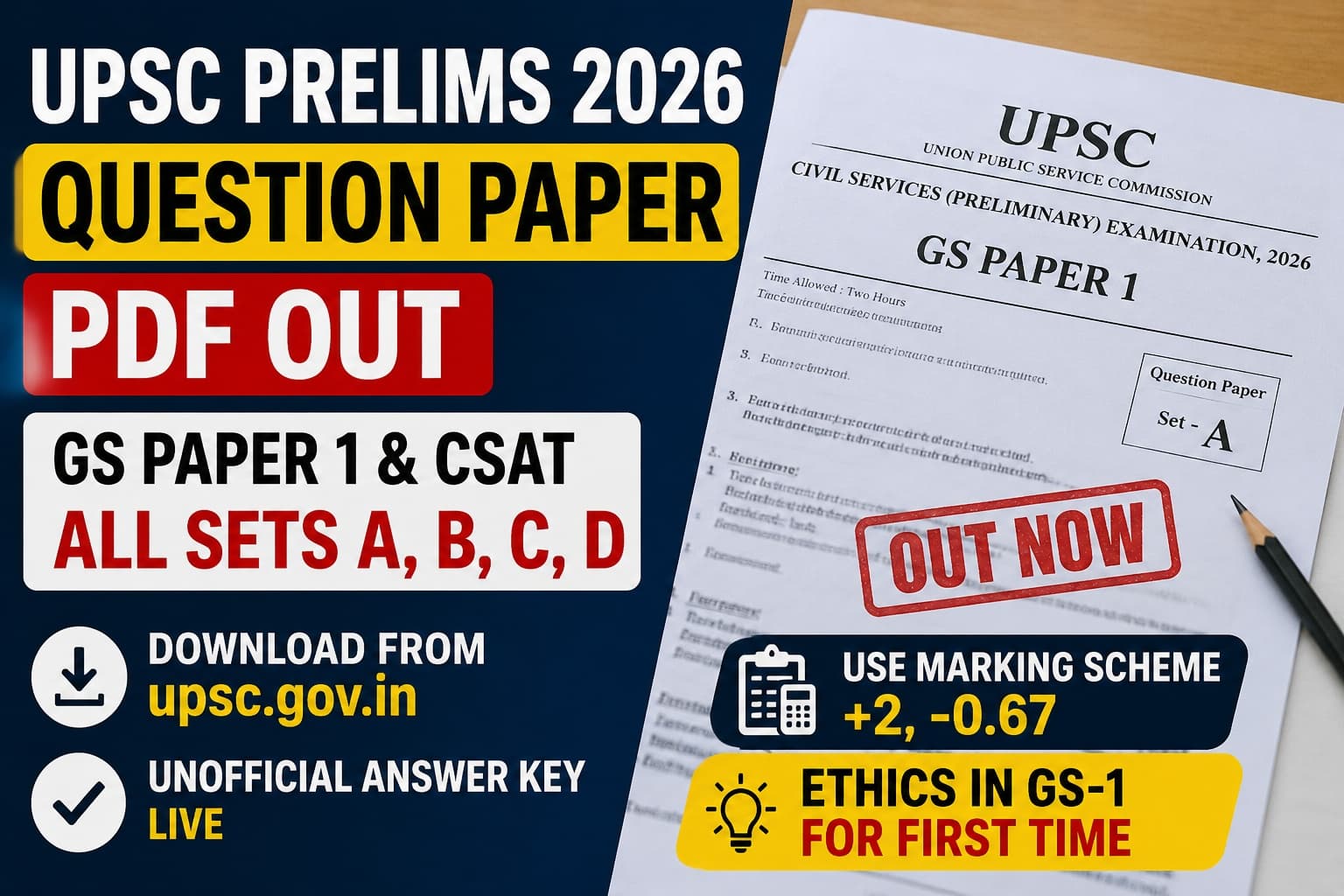
UPSC Prelims 2026 Complete Exam Analysis Subject‑Wise Review, Good Attempts and Expected Cutoff
 aspirantmitraa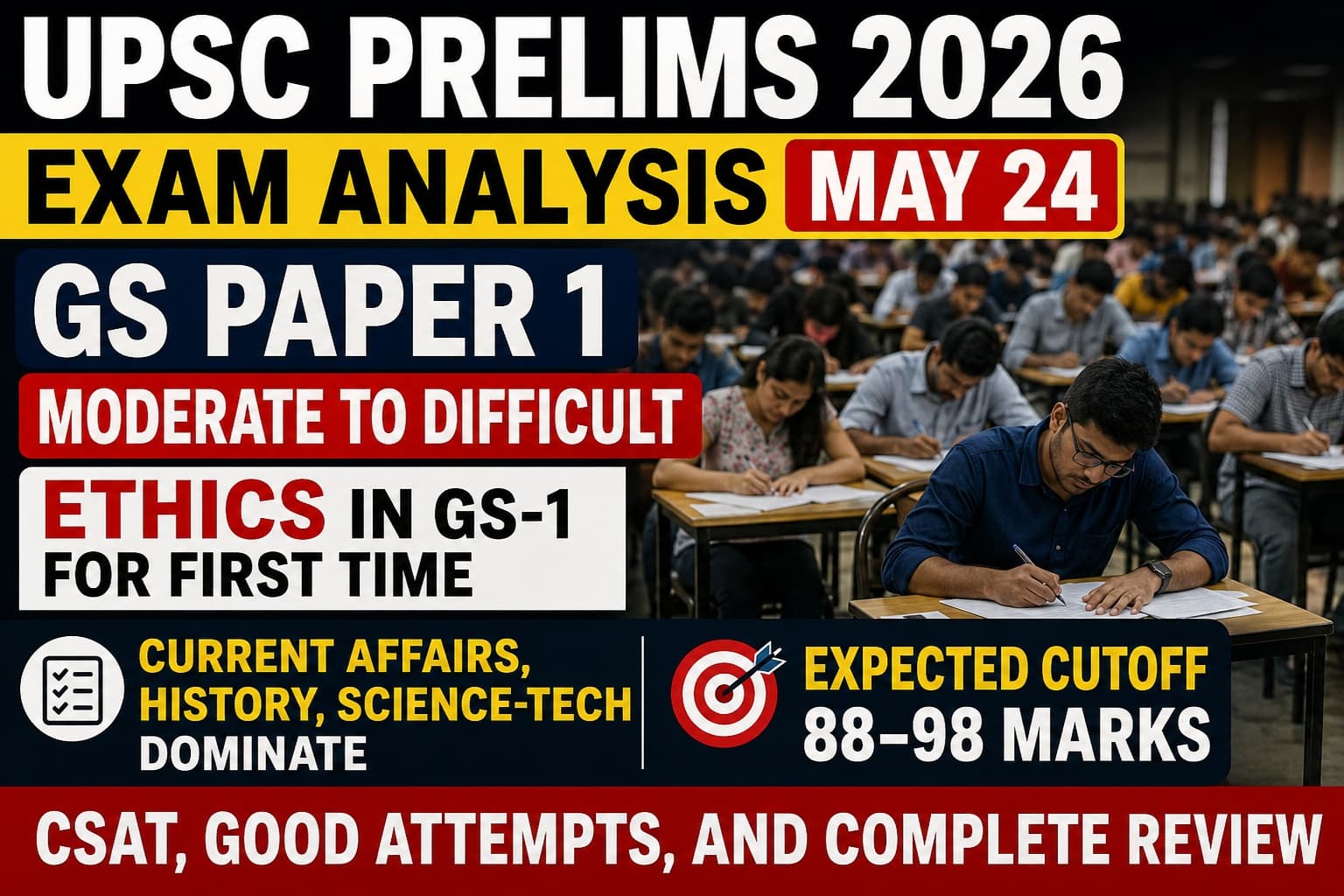
The UPSC Civil Services Preliminary Examination 2026 has concluded today, Sunday May 24, 2026, across hundreds of exam centres in India. The Union Public Service Commission conducted GS Paper 1 (General Studies) in the morning shift from 9:30 AM to 11:30 AM and GS Paper 2 (CSAT) in the afternoon shift from 2:30 PM to 4:30 PM. As candidates exit centres across the country and coaching institutes release their memory‑based analysis, a clear picture of today's paper is emerging.
The verdict from expert faculty at leading UPSC coaching institutes: the UPSC Prelims 2026 GS Paper 1 was Moderate to Difficult, with strong emphasis on History‑Culture, Environment‑Geography, Economy, Science‑Tech, Polity‑Governance, and International Relations. The most historic development of today's paper: this year GS 1 also saw some Ethics and Integrity questions for the first time in GS‑1. This is a landmark shift in UPSC's approach that will fundamentally alter how future aspirants prepare.
Ready to Ace Your Exam?
Practice with our comprehensive test series designed by experts. Get detailed solutions, performance analytics, and boost your preparation.
Explore Test SeriesUPSC Prelims 2026 Exam at a Glance
| Detail Information | |
| Exam Date | May 24, 2026 (Sunday) |
| Conducting Body | Union Public Service Commission (UPSC) |
| GS Paper 1 Timing | 9:30 AM to 11:30 AM |
| CSAT Paper 2 Timing | 2:30 PM to 4:30 PM |
| Duration Per Paper | 2 hours |
| Total Questions GS Paper 1 | 100 MCQs |
| Total Marks GS Paper 1 | 200 marks |
| CSAT Qualifying Marks | 33% (66 marks out of 200) |
| Negative Marking | One‑third of marks for each wrong answer |
| Official Website | upsc.gov.in |
| Provisional Answer Key | Released by coaching institutes (unofficial) |
| Official Answer Key | To be released a few months before Mains |
| UPSC Mains 2026 Date | August 21, 2026 |
UPSC Prelims 2026 GS Paper 1: Overall Difficulty Level
The UPSC Prelims GS Paper 1 2026 was tough and very difficult as per students' reactions compared to previous UPSC GS papers. However, expert faculty at institutes like Vajiram and Ravi, Vision IAS, StudyIQ, and PW IAS have classified the paper more precisely as moderate to difficult, acknowledging that the difficulty varied significantly by section.
One of the biggest takeaways from GS Paper 1 was the sharp rise in current affairs integration. From AI governance to geoparks, fintech, ports, and global developments, UPSC heavily tested candidates on linking contemporary issues with static concepts. Aspirants relying only on NCERTs and standard books may have found this paper difficult.
The overall difficulty breakdown by section is as follows:
| Section Difficulty Level Key Trend | ||
| History and Culture | Moderate | Modern History dominant, Art and Culture mixed |
| Geography | Moderate to Difficult | Conceptual physical geography, geoparks |
| Polity and Governance | Easy to Moderate | Beyond standard Articles, BNSS, disability law |
| Economy | Moderate to Difficult | CBDC, RWA tokenisation, current events |
| Environment | Moderate | Linked with geography and current events |
| Science and Technology | Difficult | Quantum, AI, GenomeIndia, Deep Ocean Mission |
| Current Affairs | Difficult | Heavily integrated across all subjects |
| Ethics and Integrity | New Trend | Appeared in GS‑1 for the first time ever |
| International Relations | Moderate | Appeared with current affairs integration |
UPSC Prelims 2026 GS Paper 1: Subject‑Wise Detailed Analysis
1. History and Culture
Modern History and Culture had a significant presence in today's GS Paper 1. Modern History and Culture had a significant presence in UPSC Prelims 2026. Questions from Ancient and Medieval History were fewer compared to Modern History, reflecting UPSC's continuing shift toward contemporary relevance.
Key topics from History in UPSC Prelims 2026:
- Freedom movement leaders, events, and associated organisations
- Art and architecture of different periods
- Ancient texts and their significance
- Colonial administrative reforms and their institutional impact
- Cultural heritage sites and their UNESCO recognition status
- Folk traditions, performing arts, and classical music forms
The trend of integrating historical facts with current government schemes (like protection of heritage sites) continued in 2026.
2. Geography
Geography questions emphasized conceptual understanding. Several environment‑based geography questions were also observed.
Key topics from Geography in UPSC Prelims 2026:
- Physical geography: tectonic activity, types of rocks, river systems
- Geoparks and UNESCO Global Geopark designations
- Climate patterns and rainfall distribution in India
- Ocean currents and their impact on Indian weather
- Economic geography: ports, corridors, and infrastructure linkage
- Sagarmala and Vizhinjam port‑related questions appeared
3. Polity and Governance
The Polity section in UPSC Prelims 2026 was considered easy to moderate by most candidates, with several questions based on conceptual understanding.
Polity and governance questions moved beyond standard Articles and tested disability law, parliamentary committees, Zero FIR, BNSS, and governance ethics caselets.
Key topics from Polity in UPSC Prelims 2026:
- Parliamentary procedures and committees
- Constitutional provisions and landmark amendments
- Zero FIR provisions under BNSS (Bharatiya Nagarik Suraksha Sanhita)
- Rights of persons with disabilities
- Federalism and Governor's role
- Panchayati Raj and 73rd and 74th Amendment provisions
- Fundamental Rights and DPSP interplay
The appearance of governance ethics caselets in GS Paper 1 alongside the first‑ever Ethics and Integrity questions confirms UPSC's move toward integrating GS‑4 type thinking into the Prelims stage.
4. Economy
Economy mixed basic concepts with current financial developments such as CBDC, real‑world asset tokenisation, M1xchange, Financial Inclusion Index, sustainability bonds, and rare earth elements.
Key topics from Economy in UPSC Prelims 2026:
- Central Bank Digital Currency (CBDC) implementation
- Real‑World Asset (RWA) tokenisation on blockchain
- M1xchange Trade Receivables Discounting System
- Financial Inclusion Index and its components
- Sustainability and green bonds
- Rare earth elements and their strategic importance
- Budget‑related fiscal concepts
- Inflation metrics and RBI monetary policy
The Economy section this year had a notably high current affairs component. Pure theoretical economics concepts were fewer, while applied and contextual economic developments dominated. Candidates who followed Economic Survey 2025‑26 and Union Budget 2026 had a clear advantage.
5. Environment and Ecology
Environment once again proved to be a scoring section for well‑prepared candidates. Questions were linked to both standard environment topics and current conservation developments.
Key topics from Environment in UPSC Prelims 2026:
- Protected areas, national parks, and biosphere reserves
- Wetlands and Ramsar Convention sites
- Climate change and international agreements
- Biodiversity conservation mechanisms
- Ocean and marine ecosystem protection
- Green hydrogen mission and energy transition
- Geoparks as a unique overlap between environment and geography
6. Science and Technology
Science and Technology was current‑heavy: blockchain, LLMs, quantum mission, GenomeIndia, stealth technology, green hydrogen, drone swarms, and Deep Ocean Mission.
Key topics from Science and Technology in UPSC Prelims 2026:
- National Quantum Mission objectives and targets
- GenomeIndia project on human genomic diversity
- Large Language Models (LLMs) and AI governance
- Blockchain technology and financial applications
- Deep Ocean Mission: objectives and infrastructure
- DHRUV64 (DRDO development)
- BIS bomb disposal standards
- Stealth technology and drone swarm applications
- Bharat Forecast System for weather prediction
- NIRANTAR (Ministry of Education literacy initiative)
The Science and Technology section was rated the most difficult within GS Paper 1, reflecting UPSC's increasingly technology‑forward approach to testing.
7. Current Affairs
Around 15 to 20 questions in UPSC Prelims 2026 were linked directly or indirectly to current affairs topics. However, this figure understates the actual current affairs dependency since almost every section — Economy, S&T, Geography, and Polity — had embedded current affairs linkage.
UPSC did not merely ask headline‑based current affairs. Many questions required knowledge of the background, institutional framework, and conceptual significance of recent developments. Examples include Sagarmala, Vizhinjam, NIRANTAR, Bharat Forecast System, DHRUV64, BIS bomb disposal standard, GenomeIndia, National Quantum Mission, AI Impact Summit, and Revamped Rashtriya Gram Swaraj Abhiyan.
8. Ethics and Integrity — Historic First in GS Paper 1
This year GS 1 also saw some Ethics and Integrity questions for the first time in GS‑1. This is arguably the most significant development in UPSC Prelims 2026. Ethics has traditionally been tested only in GS Paper 4 of UPSC Mains, and the occasional appearance of governance ethics was limited to the Polity section.
For future UPSC aspirants, this signals a possible structural shift in UPSC's approach: ethical dimensions of governance, public administration, and decision‑making may increasingly appear in the Prelims examination. Candidates should incorporate basic Ethics readings from GS‑4 Mains syllabus into their Prelims preparation going forward.
UPSC Prelims 2026 CSAT GS Paper 2 Analysis
The UPSC CSAT 2026 analysis highlights question trends across aptitude, reasoning, numerical ability, and comprehension sections. Recent trends indicate a growing emphasis on lengthy comprehension passages, logical reasoning, and speed‑based problem solving.
CSAT (General Studies Paper 2) is qualifying in nature. Candidates must score at least 33% marks in CSAT to qualify. This means candidates need 66 marks out of 200 to avoid disqualification.
Key features of CSAT Paper 2 in UPSC Prelims 2026:
- Comprehension passages were lengthy and required careful reading
- Logical reasoning questions required multi‑step analysis
- Mathematical aptitude questions were moderate in difficulty
- Data interpretation and data sufficiency appeared
- Decision making questions were scenario‑based and contextual
In 2023, the UPSC witnessed the lowest cutoff in recent history (75.41 for General) due to an exceptionally difficult GS Paper 1 and a highly challenging CSAT paper that knocked out many high‑scoring candidates. The 2026 CSAT was rated moderate in difficulty compared to 2023, reducing the risk of mass disqualification.
UPSC Prelims 2026 Good Attempts: How Many Questions Should You Attempt?
Based on today's paper difficulty and expert guidance, here is the recommended good attempt range for GS Paper 1 2026:
| Category Good Attempt Range Score Range (Expected) | ||
| Very good performance | 85 to 95 questions attempted, 70 to 80 correct | 120 to 145 marks |
| Good performance | 75 to 85 attempted, 60 to 70 correct | 100 to 125 marks |
| Average performance | 65 to 75 attempted, 50 to 60 correct | 80 to 105 marks |
| Below average | Below 65 attempted | Below 80 marks |
The key formula for UPSC Prelims marks calculation is:
Total Score = (Number of Correct Answers × 2) minus (Number of Wrong Answers × 0.67)
Each GS Paper 1 question carries 2 marks. Wrong answers carry a negative marking of two‑thirds of the question's marks, which equals 0.67 marks per wrong answer. Unattempted questions carry no marks and no penalty.
A candidate who attempts 80 questions with 65 correct answers and 15 wrong answers scores: (65 × 2) minus (15 × 0.67) = 130 minus 10.05 = approximately 119.95 marks.
UPSC Prelims 2026 Expected Cutoff: Category‑Wise Prediction
The UPSC Prelims cutoff is declared only for GS Paper 1 marks, subject to qualifying CSAT. The cutoff is released officially by UPSC typically only after Mains examination is over (not immediately after Prelims). Coaching institutes release unofficial expected cutoffs based on difficulty analysis.
| Year General Category Cutoff OBC SC ST | ||||
| 2025‑26 | To be declared | — | — | — |
| 2024‑25 | 113.88 marks | 110.66 | 102.00 | 100.00 |
| 2023‑24 (tough year) | 75.41 marks | 74.41 | 72.41 | 68.41 |
| 2022‑23 | 95.26 marks | 88.89 | 84.89 | 83.11 |
| 2021‑22 | 87.54 marks | 85.09 | 77.02 | 71.35 |
| 2020‑21 | 92.51 marks | 90.01 | 85.01 | 81.34 |
Expected UPSC Prelims 2026 Cutoff (Based on Today's Moderate to Difficult Paper):
| Category Expected Cutoff | |
| General (CRL) | 88 to 98 marks |
| OBC | 85 to 93 marks |
| SC | 78 to 86 marks |
| ST | 72 to 81 marks |
| EWS | 87 to 96 marks |
| PwBD | 60 to 72 marks |
These are projected estimates from coaching institute expert panels and will be refined once the unofficial answer key analysis is complete by 5:00 PM today at institutes including Vajiram and Ravi, Vision IAS, and StudyIQ.
UPSC Prelims 2026 Paper Trend vs Previous Years
| Feature 2026 2025 2024 2023 | ||||
| Overall Difficulty | Moderate to Difficult | Moderate to Difficult | Moderate | Very Difficult |
| History Weightage | High | High | High | Very High |
| Current Affairs Integration | Very High | High | Moderate | Moderate |
| Science and Technology | Very High | High | High | Moderate |
| Ethics in GS‑1 | YES (First Time) | No | No | No |
| CSAT Difficulty | Moderate | Moderate | Easy | Very Difficult |
| Good Attempts (GS‑1) | 75 to 85 | 75 to 85 | 80 to 90 | 65 to 75 |
What to Do After UPSC Prelims 2026
If you think you scored above the expected cutoff:
- Begin UPSC Mains 2026 preparation immediately. UPSC Mains is scheduled for August 21, 2026
- Cover all nine GS Mains papers: GS‑1, GS‑2, GS‑3, GS‑4, Essay, optional Subject Paper 1, optional Subject Paper 2, and two qualifying language papers
- Start with Answer Writing Practice from today. The gap between Prelims and Mains is approximately 90 days, which is less than people assume
If you are unsure about your score:
- Download the unofficial answer key from coaching institutes (links available on upsc.gov.in after result or from major coaching platforms)
- Calculate your score using the formula: (Correct × 2) minus (Wrong × 0.67)
- Compare with the expected cutoff range of 88 to 98 for General category
- Do not wait for the official result. Begin Mains preparation now if you are anywhere near the cutoff range
For UPSC 2027 aspirants:
- The 2026 paper confirms that NCERT alone is insufficient. Current Affairs integration across all subjects must be deep and contextual, not just headline‑based
- Ethics readings from GS‑4 Mains material must now be incorporated into Prelims preparation
- Science and Technology section requires regular follow‑up of PIB, DST, Ministry of Science, ISRO, and DRDO developments
Frequently Asked Questions on UPSC Prelims 2026
Q. When was UPSC Prelims 2026 conducted? The UPSC Civil Services Preliminary Examination 2026 was conducted on May 24, 2026, with GS Paper 1 from 9:30 AM to 11:30 AM and CSAT from 2:30 PM to 4:30 PM.
Q. What was the overall difficulty level of UPSC Prelims 2026? GS Paper 1 was rated Moderate to Difficult. CSAT was rated Moderate.
Q. Which section was toughest in UPSC Prelims 2026? Science and Technology was rated the most difficult section, followed by Economy with its high current affairs dependency.
Q. Did Ethics appear in UPSC Prelims GS Paper 1 for the first time in 2026? Yes. Ethics and Integrity questions appeared in GS Paper 1 for the first time in 2026, marking a historic shift in UPSC's examination approach.
Q. What is the expected cutoff for UPSC Prelims 2026 General category? Based on today's paper difficulty analysis, the expected General category cutoff is 88 to 98 marks out of 200.
Q. How many questions were there in UPSC Prelims 2026 GS Paper 1? There were 100 objective‑type questions carrying a total of 200 marks, with negative marking of 0.67 marks per wrong answer.
Q. When is UPSC Mains 2026? UPSC Mains 2026 is scheduled for August 21, 2026.
Q. Is CSAT qualifying or merit‑based? CSAT (GS Paper 2) is qualifying in nature. Candidates must score at least 33% (66 marks out of 200) to qualify. GS Paper 1 marks determine the merit list.
For the official UPSC Prelims 2026 answer key and result notification, keep visiting the official UPSC portal at upsc.gov.in. The official answer key is typically released months after the examination, before UPSC announces the Prelims result.
Ready to Ace Your Exam?
Practice with our comprehensive test series designed by experts. Get detailed solutions, performance analytics, and boost your preparation.
Explore Test Series