IBPS PO Exam Dates 2026 Announced: Prelims and Mains Schedule
 aspirantmitraa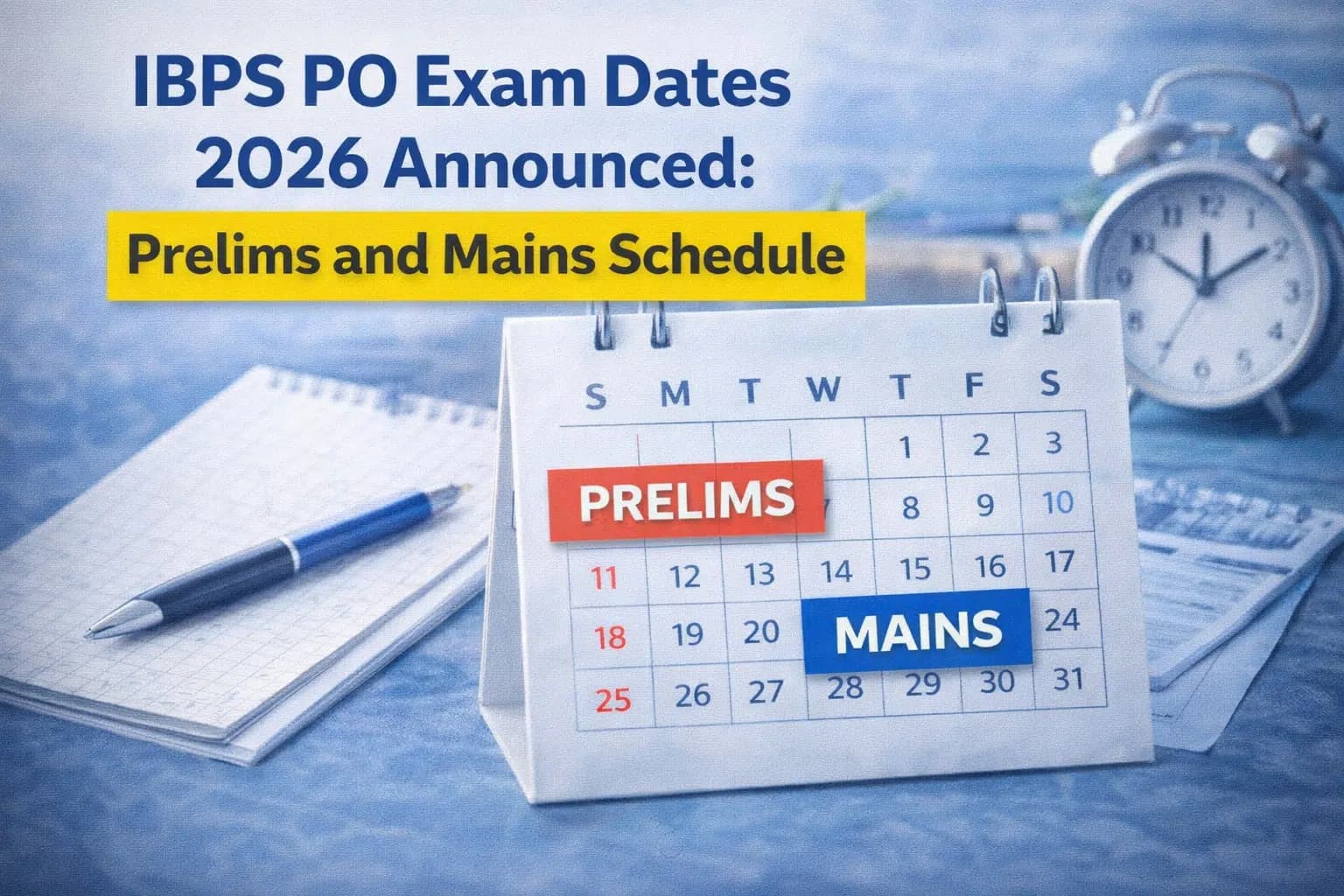
The Institute of Banking Personnel Selection has officially released the IBPS Exam Calendar 2026 on January 16, 2026, announcing the much‑awaited IBPS PO exam dates for CRP PO/MT‑XVI recruitment cycle. Banking aspirants across India can now plan their preparation with clarity as the IBPS PO Prelims exam is scheduled for August 22‑23, 2026, and the Mains exam on October 4, 2026. This announcement provides a comprehensive roadmap for candidates targeting Probationary Officer positions in 11 participating public sector banks.
Ready to Ace Your Exam?
Practice with our comprehensive test series designed by experts. Get detailed solutions, performance analytics, and boost your preparation.
Explore Test SeriesIBPS PO 2026 Important Dates
The official IBPS Calendar 2026 released on the portal www.ibps.in outlines the complete timeline for the recruitment process.
Notification Release: Expected in June 2026 (tentatively first week)
Online Registration Start: Expected in June 2026 (same day as notification)
Online Registration Close: Expected in late June or early July 2026 (approximately 20‑25 days window)
Last Date for Fee Payment: Usually 1‑2 days after registration closes
Admit Card for Prelims: Expected in August 2026 (7‑10 days before exam)
IBPS PO Prelims Exam: August 22 and 23, 2026 (Saturday and Sunday)
Prelims Result: Expected in late August or early September 2026
Admit Card for Mains: Expected in late September 2026
IBPS PO Mains Exam: October 4, 2026 (Sunday)
Mains Result: Expected in November 2026
Interview Call Letter: Expected in December 2026
Interview Dates: Expected between December 2026 and January 2027
Final Result: Expected in February or March 2027
These dates are tentative based on the official exam schedule and previous year patterns. Candidates should regularly check the official IBPS website for confirmed dates and any updates.
What is IBPS PO Examination?
The Institute of Banking Personnel Selection conducts the Probationary Officer examination annually to recruit officers for participating public sector banks across India. The CRP PO/MT‑XVI recruitment will be the 16th edition of this prestigious examination since its inception in 2011.
Participating Banks
The IBPS PO recruitment process involves 11 major public sector banks that hire Probationary Officers through this common recruitment process.
List of Participating Banks:
Bank of Baroda operates as one of India's largest public sector banks with pan‑India presence and international operations.
Bank of India has an extensive network serving millions of customers across urban and rural areas.
Bank of Maharashtra focuses on serving Maharashtra state along with national presence in other states.
Canara Bank operates one of the largest banking networks with strong southern and western regional presence.
Central Bank of India has heritage banking operations with widespread branch network.
Indian Bank serves primarily southern states with growing presence across India.
Indian Overseas Bank has international and domestic banking operations.
Punjab and Sind Bank operates primarily in northern regions with branches across country.
Punjab National Bank is one of the largest public sector banks with comprehensive banking services.
UCO Bank provides universal banking services with focus on eastern and northern regions.
Union Bank of India resulted from merger of three banks creating one of India's largest banks.
These banks conduct final interviews and hire selected candidates based on their preferences, merit ranking, and vacancy availability.
Expected Vacancies
While the exact number of vacancies for IBPS PO 2026 will be announced with the official notification, based on recent trends, candidates can expect approximately 5,000 to 6,000 vacancies.
Recent Vacancy Trends:
IBPS PO 2025 recruitment announced 5,208 vacancies across 11 participating banks. This represented a healthy number of opportunities for banking aspirants.
IBPS PO 2024 offered around 5,800 vacancies providing substantial recruitment opportunities.
IBPS PO 2023 had approximately 6,400 vacancies showing variations based on banks' requirements.
The vacancy distribution varies across banks depending on their expansion plans, retirement projections, and business growth requirements. Category‑wise reservation follows government norms with seats allocated for General, OBC, SC, ST, EWS, and PwBD categories.
Understanding the complete IBPS PO exam pattern and syllabus 2026 helps candidates prepare strategically for each stage of this competitive examination. For comprehensive syllabus coverage in an interactive gamified format, explore AspirantMitraa's IBPS PO 2026 syllabus platform designed to make learning engaging and effective.
IBPS PO Selection Process 2026
The recruitment process consists of three stages designed to comprehensively evaluate candidates' aptitude, knowledge, and personality suitability for banking careers.
Stage 1: Preliminary Examination
The Prelims serves as a screening test conducted online in computer‑based mode. This exam qualifies candidates for the Main examination but marks obtained here do not count toward final selection.
Prelims Exam Structure:
Mode: Computer Based Test (CBT) conducted online at designated centers
Total Questions: 100 Multiple Choice Questions distributed across three sections
Total Marks: 100 marks with each question carrying 1 mark
Duration: 60 minutes total time with sectional timing for each part
Language: Exam available in both English and Hindi languages (except English section)
Negative Marking: 0.25 marks deducted for each wrong answer
Sections Covered:
English Language tests grammar, vocabulary, reading comprehension, and language proficiency through 30 questions for 30 marks with 20 minutes allocated.
Quantitative Aptitude evaluates numerical ability, mathematical concepts, data interpretation, and calculation speed through 35 questions for 35 marks with 20 minutes time.
Reasoning Ability assesses logical thinking, analytical reasoning, puzzle solving, and pattern recognition through 35 questions for 35 marks with 20 minutes duration.
Candidates must clear sectional cutoffs in all three sections along with overall cutoff to qualify for Mains examination. The cutoffs vary based on difficulty level, number of candidates, and vacancies.
Stage 2: Main Examination
Candidates qualifying Prelims appear for the more comprehensive Main examination. Performance in Mains determines merit ranking and contributes 80% weightage to final selection.
Mains Exam Structure:
Mode: Computer Based Test conducted online
Total Marks: 200 marks for objective section plus 25 marks for descriptive section
Duration: 3 hours total (2 hours for objective, 30 minutes for descriptive)
Sections: Four objective sections plus one descriptive section
Negative Marking: 0.25 marks deducted for each wrong answer in objective section
Objective Section Details:
Reasoning and Computer Aptitude combined section tests logical reasoning, puzzles, seating arrangements, and basic computer knowledge through 45 questions for 60 marks with 60 minutes allocated.
English Language assesses advanced grammar, vocabulary, reading comprehension, and language skills through 35 questions for 40 marks with 40 minutes time.
Data Analysis and Interpretation evaluates ability to read charts, graphs, tables, and perform calculations through 35 questions for 60 marks with 45 minutes duration.
General Economy and Banking Awareness tests knowledge of current affairs, banking sector, economic developments, and financial awareness through 40 questions for 40 marks with 35 minutes allocated.
Descriptive Section:
This section tests writing skills through essay writing on given topics and letter writing for 25 marks with 30 minutes duration. The descriptive paper is evaluated only if candidates clear the objective section cutoffs. Both objective and descriptive marks are considered for final merit.
Stage 3: Interview Process
Candidates shortlisted based on Mains performance are called for personal interviews conducted by participating banks. The interview carries 100 marks contributing 20% weightage to final selection.
Interview Components:
Personality Test: This non‑qualifying component assesses candidates' personality traits, temperament, and behavioral characteristics before the actual interview.
Personal Interview: The panel evaluates communication skills, banking knowledge, current affairs awareness, decision‑making ability, leadership qualities, and overall suitability for banking career.
The final merit list combines Mains marks (80% weightage) and Interview marks (20% weightage). Candidates are allocated to banks based on merit rank, preferences submitted, vacancy availability, and category reservation.
For detailed preparation guidance specific to each stage, refer to our comprehensive article on IBPS PO preparation strategy 2026. Additionally, practicing with quality mock tests is essential for exam success. The IBPS PO 2026 Prelims Test Series offers comprehensive practice with detailed performance analysis to help you ace the examination.
IBPS PO Eligibility Criteria 2026
Before applying, candidates must ensure they meet all eligibility requirements that will be detailed in the official notification.
Educational Qualification
Minimum Requirement: Bachelor's degree in any discipline from a recognized university or equivalent qualification recognized by the Government of India.
Candidates appearing in final year examinations or awaiting results can also apply provisionally. However, they must produce the degree certificate before joining, failing which their provisional selection will be cancelled.
Professional qualifications like CA, ICWA, or engineering degrees from recognized institutions also qualify candidates for IBPS PO examination.
Age Limit
The age criteria for IBPS PO 2026 is calculated as of a specific cut‑off date mentioned in the notification, typically August 1, 2026.
Age Range:
Minimum Age: 20 years as on the cut‑off date
Maximum Age: 30 years as on the cut‑off date for General category candidates
Age Relaxations:
OBC candidates receive 3 years relaxation, making maximum age 33 years
SC and ST candidates get 5 years relaxation, extending maximum age to 35 years
PwBD candidates in General category receive 10 years relaxation (maximum age 40 years)
PwBD candidates in OBC category get 13 years relaxation (maximum age 43 years)
PwBD candidates in SC or ST category receive 15 years relaxation (maximum age 45 years)
Ex‑Servicemen and certain other special categories receive relaxations as per government norms
Additional Requirements
Computer Literacy: Candidates must have knowledge of computer operations as computer knowledge is tested in the examination and is essential for banking operations.
Language Proficiency: Candidates should have proficiency in the official language of the state or union territory they apply for, as local language knowledge helps in customer interaction.
Nationality: Candidates must be citizens of India, subjects of Nepal or Bhutan, or Tibetan refugees who came to India before January 1, 1962, with intention of permanent settlement.
Complete details about all eligibility parameters are covered in our dedicated guide on IBPS PO eligibility criteria 2026. Once eligibility is confirmed, start your preparation journey with structured learning through AspirantMitraa's gamified syllabus platform for comprehensive topic coverage.
IBPS PO Salary and Benefits
Selected candidates enjoy attractive compensation packages along with numerous perks and benefits that make banking careers highly desirable.
Basic Salary Structure
Initial Basic Pay: Rs. 48,480 per month as per JMGS‑I scale (Junior Management Grade Scale‑I)
In‑hand Salary: Approximately Rs. 60,000 to Rs. 75,000 per month depending on posting location and allowances
Components of Salary:
Basic Pay forms the foundation calculated according to 11th Bipartite Settlement pay scales.
Dearness Allowance (DA) is calculated as percentage of basic pay and revised quarterly based on inflation.
House Rent Allowance (HRA) varies from 7% to 9% of basic pay depending on city classification (Metro, Semi‑Urban, Rural).
City Compensatory Allowance (CCA) applies for employees posted in metropolitan cities.
Special Allowance provides additional compensation based on posting and role.
Additional Benefits and Perks
Medical Benefits: Comprehensive medical insurance for self and family members with cashless hospitalization facilities.
Leave Travel Concession: Annual entitlement for travel to hometown or any place in India with family.
Pension Benefits: Contributory pension scheme ensuring financial security post‑retirement.
Provident Fund: Employer and employee contributions building retirement corpus.
Housing Facilities: Bank‑provided accommodation or HRA for arranging own housing.
Educational Support: Children education allowance and hostel subsidy for school‑going children.
Vehicle Loans: Subsidized interest rates on car and two‑wheeler loans.
Home Loans: Concessional interest rates on housing loans for bank employees.
Insurance Coverage: Group insurance and personal accident insurance coverage.
Career Growth and Promotion
Probationary Officers undergo two years of training across different departments learning various banking operations. After successful completion, they are confirmed as Assistant Managers.
Promotion Hierarchy:
Assistant Manager (JMGS‑I) is the entry level after probation completion with basic pay Rs. 48,480.
Manager (MMGS‑II) promotion happens typically after 2‑3 years with substantial pay increment.
Senior Manager (MMGS‑III) represents middle management role with greater responsibilities.
Chief Manager (SMGS‑IV) heads important departments or large branches.
Assistant General Manager (SMGS‑V) handles strategic roles and regional operations.
Deputy General Manager and General Manager represent top management positions with comprehensive bank‑wide responsibilities.
The career progression provides opportunities to reach top management positions through merit, performance, and competitive internal exams.
How to Prepare for IBPS PO 2026
With Prelims scheduled for August 22‑23, 2026, candidates have approximately 6‑7 months for comprehensive preparation if starting in February 2026.
Subject‑wise Preparation Strategy
Quantitative Aptitude:
Focus on building strong fundamentals in arithmetic, algebra, and data interpretation. Practice speed mathematics and shortcut techniques for faster calculations.
Important topics include number systems, simplification, percentage, ratio and proportion, average, profit and loss, simple and compound interest, time and work, time speed and distance, and data interpretation.
Solve previous year questions to understand pattern and difficulty level. Take sectional tests regularly to improve speed and accuracy.
English Language:
Build vocabulary through word lists, reading newspapers, and learning root words. Master grammar rules covering tenses, voice, narration, articles, prepositions, and sentence correction.
Practice reading comprehension passages daily to improve speed and understanding. Work on error detection, sentence improvement, para jumbles, and cloze tests.
Reading quality English content regularly improves overall language proficiency naturally over time.
Reasoning Ability:
Practice puzzles, seating arrangements, blood relations, direction sense, and coding‑decoding questions extensively.
Learn shortcuts for series, analogy, and classification questions. Develop logical thinking through regular practice of diverse question types.
Syllogism using Venn diagrams, inequality questions, and input‑output problems require specific techniques that come with practice.
General Awareness:
Read daily newspapers focusing on banking and economic news, government schemes, appointments, national and international events.
Study banking terminology, RBI functions, monetary policy, fiscal policy, financial institutions, and banking regulations.
Current affairs from last 6 months before exam carry maximum weightage. Make monthly notes of important events and revise regularly.
Static GK covering important days, capitals, currencies, headquarters of organizations, and awards should be prepared systematically.
Mock Tests and Practice
Taking regular full‑length mock tests simulating actual exam conditions is crucial for success. Mock tests help build exam temperament, improve time management, and identify weak areas.
Start with sectional tests initially, then progress to full‑length tests. Analyze each test thoroughly, understanding mistakes and learning correct approaches.
Maintain a wrong question journal and revisit difficult questions periodically. Track improvement through successive tests.
Practicing with quality test series designed specifically for IBPS PO pattern is essential. The IBPS PO 2026 Prelims Test Series provides comprehensive mock tests with detailed solutions, performance analytics, and comparative rankings to help you assess your preparation level accurately.
Application Process for IBPS PO 2026
The application will be conducted entirely online through the official IBPS website once the notification is released in June 2026.
Registration Steps
Visit the official website www.ibps.in and click on the IBPS PO 2026 notification link under CRP PO/MT‑XVI.
New candidates must first register with basic details like name, date of birth, email ID, and mobile number receiving a registration number.
Login using registration credentials and fill the complete application form with personal, educational, and contact details.
Upload scanned photograph and signature in specified format and size. Upload category certificate if applicable.
Select exam center preferences from available cities. Choose post preferences if multiple positions are available.
Pay application fee online through net banking, debit card, credit card, or UPI. Exempted categories can proceed without payment.
Application Fee:
General, OBC, and EWS category candidates pay Rs. 850 as application fee
SC, ST, and PwBD category candidates pay Rs. 175 as intimation charges
The fee once paid is non‑refundable and cannot be held in reserve for any other examination.
Submit the application and download confirmation page for future reference. Take multiple printouts and save PDF digitally.
For detailed step‑by‑step instructions on filling the application form, refer to our complete guide on how to apply for IBPS PO 2026 online. After completing your application, start preparing immediately using the comprehensive IBPS PO syllabus platform for structured learning.
Important Instructions for Candidates
Before the Exam
Download admit card from official website 7‑10 days before exam date. Verify all details on admit card carefully.
Carry original photo ID proof along with admit card to examination center. Without these, entry will not be permitted.
Reach exam center at least 30‑45 minutes before reporting time mentioned on admit card.
During the Exam
Electronic devices including mobile phones, calculators, smartwatches, or any communication devices are strictly prohibited.
Rough work should be done on paper provided at center or on computer screen itself depending on facility available.
Follow all instructions given by invigilator and maintain exam hall discipline.
After the Exam
Results will be published on the official website. Candidates can check results using registration number and password.
Qualified candidates will receive information about next stages through email and SMS on registered contact details.
Keep checking official website regularly for updates, result announcements, and admit card releases.
Frequently Asked Questions
Q: When will IBPS PO 2026 notification be released?
The IBPS PO 2026 notification is expected to be released in June 2026, likely in the first week based on previous year patterns.
Q: What is the exam date for IBPS PO Prelims 2026?
IBPS PO Prelims exam will be conducted on August 22 and 23, 2026, as per the official IBPS Calendar 2026.
Q: When is IBPS PO Mains exam 2026 scheduled?
The IBPS PO Mains examination is scheduled for October 4, 2026, according to the official calendar.
Q: How many vacancies are expected in IBPS PO 2026?
Based on recent trends, approximately 5,000 to 6,000 vacancies are expected, though exact numbers will be announced with the notification.
Q: What is the age limit for IBPS PO 2026?
The age should be between 20 to 30 years for general category with relaxations for reserved categories as per government norms.
Q: Is IBPS PO exam conducted in Hindi language?
Yes, except for the English section, all other sections are available in both English and Hindi languages.
Q: What is the application fee for IBPS PO 2026?
General, OBC, and EWS candidates pay Rs. 850 while SC, ST, and PwBD candidates pay Rs. 175 as intimation charges.
Q: Are Prelims marks counted in final selection?
No, Prelims is only qualifying. Final selection is based on Mains exam marks (80%) and Interview marks (20%).
The announcement of IBPS PO exam dates 2026 provides a clear roadmap for banking aspirants to plan their preparation strategically. With Prelims scheduled for August 22‑23, 2026, and Mains on October 4, 2026, candidates have sufficient time to prepare comprehensively if they start now.
The IBPS PO examination offers an excellent opportunity to begin a rewarding career in India's public sector banking with attractive salary, comprehensive benefits, and clear promotion hierarchy. The recruitment process through Prelims, Mains, and Interview ensures selection of capable candidates suited for banking roles.
Understanding the complete exam pattern, eligibility requirements, and selection process covered in our detailed guides on IBPS PO exam pattern and syllabus 2026 and eligibility criteria helps candidates prepare more effectively.
With the notification expected in June 2026, candidates should utilize the coming months for thorough preparation covering all subjects, regular mock test practice, and current affairs reading. Strategic preparation following proven preparation strategies significantly improves chances of success.
Master the complete syllabus through AspirantMitraa's gamified learning platform and test your preparation with the IBPS PO 2026 Prelims Test Series for comprehensive exam readiness.
Stay connected with the official IBPS website for notification release, application dates, and all important updates. Plan your preparation timeline, gather study resources, and begin your journey toward becoming a Probationary Officer in India's leading public sector banks.
Your banking career awaits - start preparing today!
Note: All dates mentioned are as per official IBPS Calendar 2026 and may be subject to change. Candidates should refer to the official notification for confirmed details.