IBPS PO Exam Pattern and Syllabus 2026: Complete Guide
 aspirantmitraa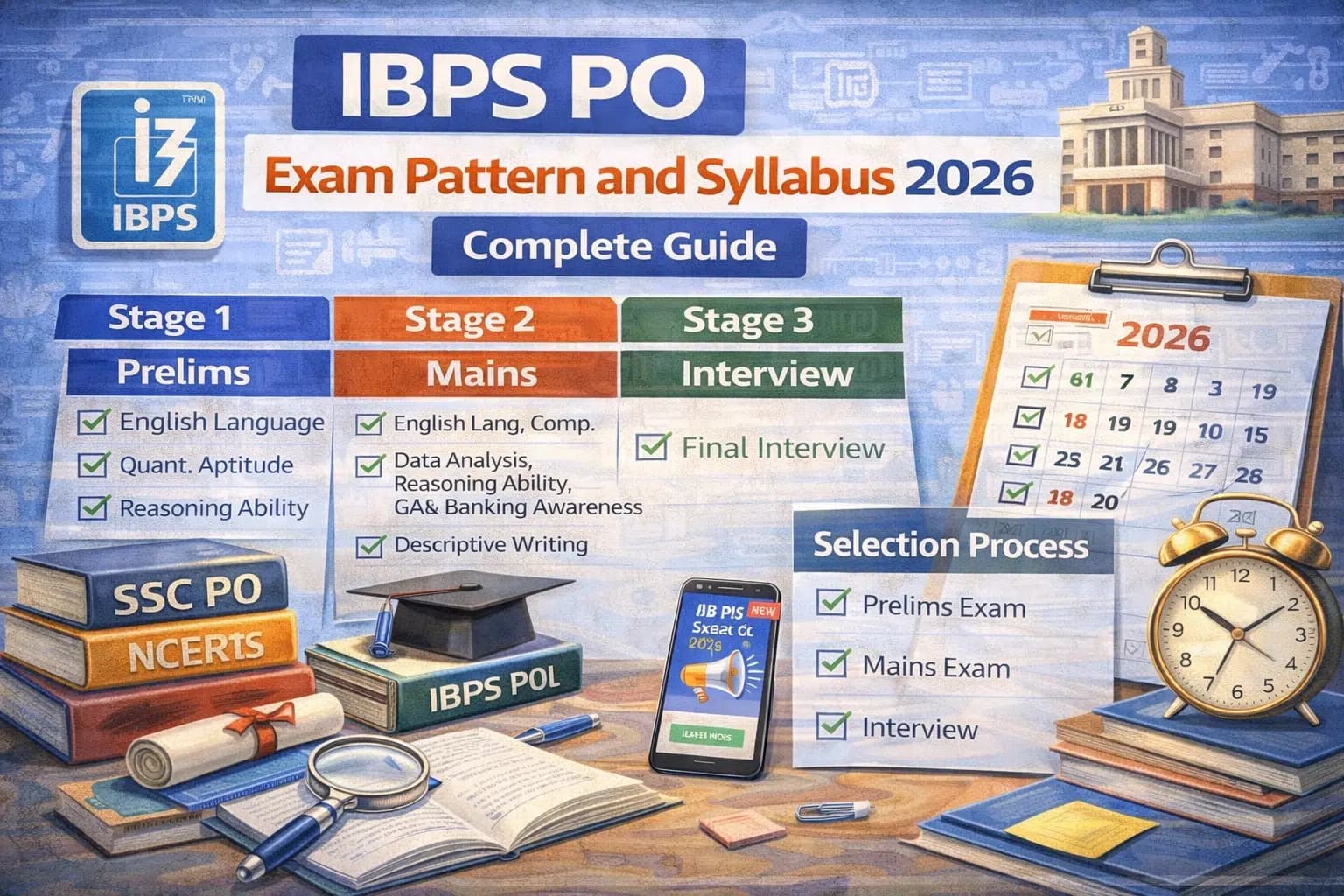
Understanding the IBPS PO exam pattern and syllabus is fundamental for strategic preparation to crack this prestigious banking examination. The Institute of Banking Personnel Selection has designed a comprehensive three‑stage selection process to recruit Probationary Officers for 11 participating public sector banks. With the IBPS PO exam dates announced for August 22‑23, 2026 (Prelims) and October 4, 2026 (Mains), aspirants must thoroughly understand the examination structure and curriculum to optimize their preparation strategy.
Ready to Ace Your Exam?
Practice with our comprehensive test series designed by experts. Get detailed solutions, performance analytics, and boost your preparation.
Explore Test SeriesIBPS PO Examination Structure Overview
The IBPS PO recruitment process follows a rigorous three‑stage evaluation designed to assess candidates' aptitude, knowledge, and personality suitability for banking careers.
Stage 1: Preliminary Examination serves as the screening test qualifying candidates for the Main examination. This computer‑based test evaluates basic proficiency across English Language, Quantitative Aptitude, and Reasoning Ability. The marks obtained in Prelims do not count toward final merit but clearing sectional and overall cutoffs is mandatory to proceed further.
Stage 2: Main Examination represents the comprehensive assessment determining merit ranking for final selection. This extensive computer‑based test covers Reasoning and Computer Aptitude, English Language, Data Analysis and Interpretation, and General Economy and Banking Awareness along with a descriptive writing section. Performance in Mains contributes 80% weightage to the final selection score.
Stage 3: Personal Interview evaluates candidates' personality traits, communication skills, and banking aptitude through face‑to‑face interaction with expert panels. The interview carries 100 marks contributing 20% weightage to final selection. The combined score from Mains and Interview determines final merit ranking and bank allocation.
For a complete overview of dates and process, refer to our detailed article on IBPS PO exam dates 2026.
IBPS PO Prelims Exam Pattern 2026
The Preliminary Examination acts as the first hurdle in the selection process, designed to shortlist candidates based on their fundamental banking aptitude.
Examination Mode and Duration
The Prelims is conducted entirely in Computer Based Test mode at designated examination centers across India. Candidates appear for the exam in multiple shifts over two days, August 22 and 23, 2026.
Total Duration: 60 minutes divided into three sections with sectional timing
Language Medium: Available in English and Hindi (except English Language section)
Normalization: Since the exam is conducted across multiple shifts on different days, normalization of marks is applied to ensure fairness across all candidates regardless of their shift or exam day.
The normalization process accounts for difficulty variations across different exam sessions, ensuring no candidate is advantaged or disadvantaged due to their particular shift allocation.
Section‑wise Pattern Details
English Language Section:
Number of Questions: 30 questions
Maximum Marks: 30 marks with each question carrying 1 mark
Time Allocated: 20 minutes for this section only
Topics Covered: Reading Comprehension passages testing understanding and inference ability, grammar rules including error detection and sentence improvement, vocabulary questions testing synonyms, antonyms, and word meanings, para jumbles requiring logical sequencing of sentences, cloze test filling appropriate words in passage blanks, and sentence completion exercises.
Quantitative Aptitude Section:
Number of Questions: 35 questions
Maximum Marks: 35 marks with each question worth 1 mark
Time Allocated: 20 minutes dedicated time
Topics Covered: Number systems and simplification testing calculation accuracy, percentage and ratio proportion solving practical problems, average and mixtures with application‑based questions, profit and loss including discount and marked price concepts, simple and compound interest calculations, time and work problems including pipe and cistern variations, time speed and distance with train and boat questions, data interpretation from charts, graphs, and tables, and basic geometry and mensuration concepts.
Reasoning Ability Section:
Number of Questions: 35 questions
Maximum Marks: 35 marks with 1 mark per question
Time Allocated: 20 minutes for completing this section
Topics Covered: Puzzles and seating arrangements testing logical deduction, blood relations establishing family relationships, direction sense and distance calculations, coding and decoding pattern recognition, series completion including number, letter, and mixed series, inequality and comparison questions, syllogism using logical statements, input‑output problems following specific rules, alphanumeric series patterns, and ranking and ordering questions.
Marking Scheme and Cutoffs
Positive Marking: Each correct answer awards 1 mark to the candidate
Negative Marking: Each incorrect answer results in deduction of 0.25 marks (one‑fourth penalty)
Unattempted Questions: No marks are deducted for questions left unattempted
Sectional Cutoffs: Candidates must score minimum qualifying marks in each individual section to clear Prelims
Overall Cutoff: In addition to sectional cutoffs, an overall cutoff combining all three sections must also be achieved
The cutoff marks vary each year based on factors like overall difficulty level of the exam, number of candidates appearing, total vacancies available, and performance distribution across candidates. Generally, scoring 60‑70 marks out of 100 ensures comfortable qualification though cutoffs fluctuate.
Category‑wise Cutoff Variation:
General category candidates typically need higher scores compared to reserved categories. OBC candidates receive some relaxation in cutoffs while SC and ST categories have further reduced qualifying criteria. The exact cutoffs are announced after exam completion based on normalization and merit distribution.
For comprehensive topic‑wise coverage of all Prelims sections, explore AspirantMitraa's IBPS PO 2026 syllabus platform offering gamified learning for better retention and understanding
.
IBPS PO Mains Exam Pattern 2026
The Main Examination represents the most critical stage as performance here determines final merit ranking and selection outcome.
Examination Structure
Mode of Examination: Computer Based Test conducted online at designated centers
Total Duration: 3 hours including time for objective and descriptive sections
Total Marks: 225 marks combining 200 marks for objective section and 25 marks for descriptive paper
Language Medium: English and Hindi available for objective section (except English Language), descriptive section only in English
Sectional Timing: Each section has pre‑defined time allocation and candidates cannot switch between sections before allocated time expires
Objective Section Pattern
Section 1: Reasoning and Computer Aptitude
Number of Questions: 45 questions testing both reasoning ability and basic computer knowledge
Maximum Marks: 60 marks making this the highest weighted section
Time Allocated: 60 minutes for attempting this section
Topics Covered: Advanced puzzles requiring multi‑level logical deduction, complex seating arrangements in circular, linear, and rectangular patterns, data sufficiency determining adequacy of given information, input‑output following complex algorithmic patterns, coded relationships and blood relations, computer fundamentals including hardware and software basics, computer memory and storage concepts, operating systems and their functions, MS Office applications usage, internet and networking fundamentals, computer abbreviations and terminology, and cybersecurity basics.
Section 2: English Language
Number of Questions: 35 questions assessing comprehensive language proficiency
Maximum Marks: 40 marks
Time Allocated: 40 minutes
Topics Covered: Reading comprehension with multiple passages testing deep understanding, grammar covering tenses, voice, narration, subject‑verb agreement, error detection identifying grammatical mistakes in sentences, sentence improvement suggesting better alternatives, vocabulary including synonyms, antonyms, idioms, and phrases, para jumbles arranging sentences logically, cloze test filling blanks appropriately, sentence connectors using appropriate linking words, and column‑based match questions.
Section 3: Data Analysis and Interpretation
Number of Questions: 35 questions focused on numerical and analytical skills
Maximum Marks: 60 marks making it equally important as reasoning section
Time Allocated: 45 minutes
Topics Covered: Data interpretation from bar graphs, pie charts, line graphs, and mixed charts, tabular data analysis requiring multiple calculations, case studies with comprehensive data sets, approximation and calculation shortcuts, advanced arithmetic including percentage, ratio, average applications, profit and loss with complex scenarios, simple and compound interest calculations, time and work problems, partnerships and mixture‑alligation, and probability and permutation‑combination basics.
Section 4: General Economy and Banking Awareness
Number of Questions: 40 questions testing banking and economic knowledge
Maximum Marks: 40 marks
Time Allocated: 35 minutes
Topics Covered: Current banking and economic affairs from last 6 months, RBI policies including monetary policy, repo rate, CRR, SLR, and recent decisions, banking terminology and definitions, financial institutions like NABARD, SIDBI, EXIM Bank, stock markets and SEBI regulations, budget and economic survey highlights, government schemes especially financial inclusion programs, important appointments in banking and finance sector, awards and honors in economic field, international economic organizations like IMF, World Bank, ADB, Indian economy structure and sectors, inflation and its types, GDP, GNP, and economic indicators, insurance sector developments, and taxation basics.
Descriptive Section Pattern
Paper Type: English Descriptive Writing assessed separately after objective section
Total Marks: 25 marks evaluating writing skills
Time Allocated: 30 minutes immediately following objective section
Medium of Exam: Only English language for descriptive paper
Question Types:
Essay Writing: Candidates write essays on given topics related to banking, economy, social issues, or current affairs. Word limit typically ranges from 200‑250 words. Essays are evaluated based on content relevance, coherent structure, grammatically correct language, and clarity of expression.
Letter Writing: Formal or business letters addressing specific situations or problems. Types include complaint letters, request letters, inquiry letters, or official correspondence. Word limit usually 150‑200 words. Assessment criteria include appropriate format, tone, content accuracy, and language quality.
Precis Writing: Summarizing given passages in one‑third of original length maintaining core meaning. This tests comprehension and concise expression abilities.
Important Note: The descriptive section is evaluated only for candidates who clear the cutoffs in the objective section. Both objective and descriptive marks are combined for final merit ranking. Poor performance in descriptive can significantly impact overall Mains score even with good objective section performance.
IBPS PO Syllabus 2026 Detailed Breakdown
Understanding what to study is as important as knowing the exam pattern. The syllabus remains consistent across years with minor variations in current affairs scope.
Quantitative Aptitude Syllabus
Arithmetic Topics:
Number Systems covering divisibility rules, HCF and LCM, prime numbers, rational and irrational numbers, and decimal fractions form the foundation.
Simplification and Approximation test quick calculation ability using BODMAS rules and estimation techniques.
Percentage applications in various real‑life scenarios including population increase, price changes, and election results.
Profit and Loss including concepts of cost price, selling price, discount, marked price, and successive transactions.
Simple Interest and Compound Interest with variations like installments, different compounding periods, and difference between SI and CI.
Ratio and Proportion problems including direct and inverse proportion, continued ratios, and partnership variations.
Average problems with missing numbers, weighted averages, and average speed calculations.
Time and Work covering individual efficiency, group work, wages based on work, and pipe and cistern problems.
Time, Speed and Distance with variations involving trains, boats, streams, and relative speed concepts.
Mixtures and Alligations dealing with mixing liquids, replacing mixtures, and finding proportions.
Data Interpretation:
Bar Graphs presenting data comparison across categories or time periods requiring calculation and analysis.
Line Graphs showing trends and patterns over time needing interpretation skills.
Pie Charts representing proportional distribution requiring percentage and angle calculations.
Tables presenting comprehensive data in rows and columns demanding multi‑step calculations.
Caselet‑based DI providing scenario‑based data requiring careful reading and analysis.
Mixed Charts combining multiple graph types testing integrated understanding.
Algebra and Others:
Linear Equations and basic algebraic expressions solving for unknown variables.
Quadratic Equations finding roots using factorization or formula method.
Sequence and Series including arithmetic progression, geometric progression, and special series.
Geometry and Mensuration:
Basic geometrical properties of triangles, quadrilaterals, and circles.
Area and perimeter of 2D shapes like triangles, rectangles, circles, and composite figures.
Volume and surface area of 3D objects like cubes, cuboids, cylinders, cones, and spheres.
English Language Syllabus
Reading Comprehension:
Passages of varying lengths from 300‑500 words on diverse topics like economics, banking, social issues, technology, environment, and current affairs.
Question types include factual questions, inference‑based questions, vocabulary in context, tone identification, and main idea recognition.
Grammar and Usage:
Parts of Speech understanding nouns, pronouns, verbs, adjectives, adverbs, and their usage.
Tenses covering all twelve tenses with correct formation and application.
Voice transformation between active and passive voice following grammatical rules.
Narration converting direct speech to indirect speech and vice versa.
Subject‑Verb Agreement ensuring grammatical concord in sentences.
Articles usage of a, an, and the in appropriate contexts.
Prepositions correct usage in different situations.
Vocabulary:
Synonyms identifying words with similar meanings.
Antonyms finding words with opposite meanings.
One Word Substitution replacing phrases with single appropriate words.
Idioms and Phrases understanding common expressions and their meanings.
Phrasal Verbs combinations of verbs with prepositions or adverbs.
Sentence‑based Questions:
Error Spotting identifying grammatical, vocabulary, or structural errors in sentences.
Sentence Improvement suggesting better alternatives maintaining original meaning.
Sentence Rearrangement arranging jumbled sentences in logical order.
Fill in the Blanks completing sentences with appropriate words.
Cloze Test filling multiple blanks in a passage contextually.
Reasoning Ability Syllabus
Verbal Reasoning:
Coding‑Decoding recognizing patterns in coded language and decoding accordingly.
Blood Relations establishing family relationships through given information.
Direction Sense determining positions and distances based on directional movements.
Alphabet and Number Series identifying patterns and finding missing terms.
Ranking and Ordering arranging objects or persons based on given criteria.
Syllogism deriving logical conclusions from given premises using Venn diagrams.
Statement and Assumptions identifying underlying assumptions in statements.
Statement and Conclusions determining valid conclusions from given statements.
Cause and Effect establishing relationships between events.
Analytical Reasoning:
Puzzles solving complex logic puzzles with multiple variables and conditions.
Seating Arrangements determining positions in circular, linear, rectangular, or complex patterns.
Scheduling arranging activities, meetings, or events based on given constraints.
Grouping and Selection choosing subsets based on multiple conditions.
Data Sufficiency determining whether given information is adequate to answer questions.
Non‑Verbal Reasoning (Primarily in Prelims):
Figure Series identifying patterns in geometric figures and completing sequences.
Analogy and Classification grouping similar figures or finding odd one out.
Mirror and Water Images visualizing reflections of figures.
Paper Cutting and Folding predicting patterns after cutting folded paper.
Embedded Figures identifying smaller figures within complex designs.
Computer Awareness Syllabus
Computer Basics:
History and generations of computers understanding evolution and development.
Input and output devices including keyboard, mouse, monitor, printer, and their types.
Central Processing Unit functioning and components like ALU, Control Unit, and Registers.
Memory types including RAM, ROM, Cache, and storage devices like HDD, SSD.
Software:
Operating Systems functions, types, and popular OS like Windows, Linux, MacOS.
MS Office applications including Word for document creation, Excel for spreadsheets, PowerPoint for presentations, and their basic features.
Software types including system software, application software, and utility software.
Networking and Internet:
Networking fundamentals including LAN, WAN, MAN, and network topologies.
Internet basics covering WWW, browsers, search engines, and internet protocols.
Email usage and netiquette following proper online communication etiquette.
Security:
Computer viruses, malware, trojans, and their protection mechanisms.
Firewall functioning and importance in network security.
Data encryption and cybersecurity basics.
Phishing, hacking, and online fraud awareness.
Banking Technology:
Core Banking Solutions enabling centralized banking operations.
ATMs, POS terminals, and electronic payment systems.
Internet Banking and Mobile Banking applications.
NEFT, RTGS, IMPS, UPI, and other digital payment methods.
For mastering the complete IBPS PO syllabus through structured, engaging learning, explore AspirantMitraa's gamified syllabus platform designed specifically for banking exam preparation.
General Awareness Syllabus
Current Affairs Coverage (Last 6 Months):
National news covering government policies, schemes, and major developments.
International events including summits, agreements, and global issues.
Banking and economic news including RBI policy changes, bank mergers, financial sector reforms.
Important appointments in banking, finance, government, and international organizations.
Awards and honors in various fields including banking, sports, literature, peace.
Sports events and tournaments with winners and important records.
Books and authors especially in economic and social fields.
Science and technology developments including space missions and innovations.
Important days and dates celebrated nationally and internationally.
Static GK:
Indian financial system structure including RBI, commercial banks, cooperative banks.
Important abbreviations used in banking and finance.
Headquarters of banks, financial institutions, and international organizations.
Currencies of major countries and their symbols.
Capitals of Indian states and union territories.
National and international organizations and their functions.
Banking and Economic Awareness:
Banking regulations and RBI functions as central bank.
Monetary policy tools including repo rate, reverse repo rate, CRR, SLR, MSF.
Fiscal policy and its components.
Types of banks and their functions.
Financial inclusion initiatives and Jan Dhan Yojana.
Insurance sector overview and important companies.
Stock markets, SEBI, and securities trading basics.
NPA, bad loans, and asset quality concerns.
Digital banking and fintech developments.
Government budgets and economic surveys.
Preparation Strategy Based on Pattern
Understanding the pattern helps develop focused preparation approach for maximum efficiency.
For Prelims Preparation
Time Management: With only 20 minutes per section, speed is crucial. Practice solving questions quickly without compromising accuracy.
Accuracy First: Given negative marking, attempting questions correctly matters more than attempting all questions. Develop elimination techniques to improve accuracy.
Sectional Balance: Don't neglect any section thinking you'll compensate in others. Sectional cutoffs require minimum performance in each section independently.
Mock Test Practice: Regular full‑length Prelims mock tests build exam temperament and help optimize attempting strategy. The IBPS PO 2026 Prelims Test Series provides comprehensive practice with performance analytics for continuous improvement.
Section‑wise Focus: Identify your strong and weak sections. Start mock tests with weaker sections when you're fresh, then move to stronger ones.
For Mains Preparation
Descriptive Writing: Practice essay and letter writing regularly from day one. Typing practice on computer improves speed for online descriptive test.
Current Affairs Integration: Link current affairs with banking awareness. Read banking and economic news with analysis, not just facts.
Computer Awareness: Don't underestimate this part of reasoning section. Dedicate specific time weekly for computer topics.
Data Interpretation: DI requires calculation speed and accuracy. Practice mental math and approximation techniques extensively.
Time Allocation: In 60‑minute sections, reserve 50 minutes for attempting and 10 minutes for review and difficult questions.
General Preparation Tips
Standard Books: Stick to a few standard books per subject rather than reading multiple books creating confusion.
Notes Making: Create concise notes for quick revision. Formula sheets for Quant, grammar rules for English, and monthly current affairs compilations are essential.
Regular Revision: Schedule weekly and monthly revisions to retain what you learned. Without revision, forgetting is natural.
Newspaper Reading: Daily newspaper reading for current affairs is non‑negotiable. Focus on banking and economic pages particularly.
Previous Year Analysis: Solve and analyze IBPS PO papers from last 5‑10 years to understand pattern evolution and important topics.
Common Mistakes to Avoid
Pattern‑Related Errors:
Attempting all questions without considering negative marking significantly reduces overall score.
Ignoring sectional cutoffs by focusing only on overall performance leads to disqualification despite good total marks.
Not practicing in computer‑based mode causes adaptation issues during actual online examination.
Preparation Mistakes:
Starting preparation too late leaves insufficient time for complete syllabus coverage and revision.
Ignoring descriptive section preparation assuming objective section alone determines selection.
Relying only on shortcuts without understanding fundamentals creates problems when questions are twisted.
Not taking mock tests regularly results in poor time management and exam temperament during actual test.
Exam Day Errors:
Not reading questions carefully leads to silly mistakes in known questions.
Poor section sequence planning results in exhaustion before reaching strong sections.
Getting stuck on difficult questions wastes time that could secure easy marks elsewhere.
For comprehensive preparation guidance avoiding these pitfalls, refer to IBPS PO preparation strategy 2026.
Frequently Asked Questions
Q: Is IBPS PO Prelims score counted in final merit?
No, Prelims is only qualifying. Final merit is based entirely on Mains score (80%) and Interview score (20%).
Q: What is the qualifying percentage for IBPS PO Prelims?
There is no fixed percentage. Cutoffs vary annually based on difficulty, vacancies, and candidate performance. Generally, 60‑70% ensures qualification.
Q: How many sections are there in IBPS PO Mains?
There are four objective sections plus one descriptive section totaling five parts in Mains examination.
Q: Is negative marking applicable in descriptive section?
No, there is no negative marking in the descriptive section. However, the objective section has standard negative marking.
Q: Which section carries maximum marks in Mains?
Both Reasoning and Computer Aptitude (60 marks) and Data Analysis and Interpretation (60 marks) carry highest weightage.
Q: Can I use a calculator in IBPS PO exam?
No, calculators are not allowed. A basic on‑screen calculator is provided for numerical calculations.
Q: Is computer knowledge tested separately?
Computer Aptitude is combined with Reasoning Ability in Mains as one section carrying 60 marks.
Q: What topics should I focus on for Data Interpretation?
Focus on bar graphs, line charts, pie charts, tables, and caselet‑based DI with emphasis on calculation speed and accuracy.
Understanding the IBPS PO exam pattern and syllabus thoroughly is fundamental to developing an effective preparation strategy for this competitive banking examination. The two‑stage written examination followed by interview tests diverse skills from quantitative ability to personality traits ensuring comprehensive candidate evaluation.
The Prelims examination serves as the gateway requiring speed and accuracy across English, Quantitative Aptitude, and Reasoning. The Mains examination demands depth of knowledge, analytical ability, and writing skills through its extensive objective and descriptive sections. The interview assesses personality and suitability for banking roles.
With Prelims scheduled for August 22‑23, 2026, and Mains on October 4, 2026, as announced in the official IBPS calendar, candidates have a clear timeline for preparation. Starting early provides sufficient time for thorough syllabus coverage, multiple revision cycles, and extensive mock test practice.
Master the complete syllabus through AspirantMitraa's interactive learning platform offering gamified content for better engagement and retention. Complement your preparation with regular practice using the IBPS PO 2026 Prelims Test Series for comprehensive exam readiness.
Understanding eligibility requirements and following a structured preparation strategy aligned with the exam pattern significantly enhances success probability in IBPS PO 2026.
Start your preparation today with complete pattern understanding and strategic planning!
Note: Exam pattern details are based on current IBPS PO format. Always verify from official notification for any changes.
Ready to Ace Your Exam?
Practice with our comprehensive test series designed by experts. Get detailed solutions, performance analytics, and boost your preparation.
Explore Test Series