
Loading...
Loading...
The SBI PO syllabus is the single most important document a candidate must internalise before building a preparation plan. Without a clear understanding of what is tested, aspirants risk spending weeks on irrelevant topics while neglecting areas that determine selection. The State Bank of India does not publish an exhaustive topic list in its official notification but specifies broad subject areas from which questions are drawn. This page provides the most complete and accurate topic-level breakdown of the SBI PO Prelims and Mains syllabus based on official notification guidelines and question paper analysis from recent years.
For the complete examination overview, visit the SBI PO main page. To track which topics you have completed, use the SBI PO Syllabus Tracker.
The SBI PO examination has two written stages with distinct syllabi.
Phase I (Prelims) covers English Language, Quantitative Aptitude, and Reasoning Ability. It is qualifying in nature and runs for 60 minutes with a 20-minute sectional time limit for each section.
Phase II (Mains) covers Reasoning and Computer Aptitude, Data Analysis and Interpretation, General/Economy/Banking Awareness, and English Language in the Objective Test, plus an English Descriptive Test. Mains marks determine the final merit at a 75% weightage.
English Language in SBI PO Prelims tests reading comprehension, grammar, and vocabulary. In the revised 2025 pattern, this section saw the question count increase significantly. Candidates have only 20 minutes to navigate what is widely considered the most reading-intensive section of the paper.
Reading Comprehension is the anchor topic of English Language. Questions in this subsection test the ability to understand the central theme of a passage, identify the author's tone and intent, draw inferences, and answer vocabulary-in-context questions. SBI PO passages are drawn from economic and financial subjects, current events, and social commentary. The passages are typically 400 to 600 words in length with 5 to 8 questions each.
Key focus areas within Reading Comprehension:
Cloze Test presents a passage with blanks that must be filled with the most appropriate word or phrase from the options. Recent years have seen a shift from simple grammar-based cloze tests to context-sensitive ones where the filler must match both the grammatical structure and the logical flow of the paragraph.
Error Detection requires identifying the grammatically incorrect part of a sentence. Common error types include subject-verb agreement, pronoun usage, tense consistency, article usage, and preposition errors.
Sentence Improvement presents a sentence with an underlined portion and asks which replacement makes it grammatically and contextually correct.
Para Jumbles present 5 to 6 sentences in scrambled order that must be rearranged into a coherent paragraph. This tests logical sequencing and the understanding of connective language (conjunctions, pronouns, discourse markers).
Fill in the Blanks with one or two blanks per sentence tests vocabulary and contextual understanding simultaneously.
Vocabulary-based questions include synonyms, antonyms, idiom and phrase meanings, and word usage questions.
New Pattern Questions introduced in recent years include:
Quantitative Aptitude is simultaneously the most time-consuming and the most critical section for score differentiation. With 35 questions in 20 minutes, candidates must average approximately 34 seconds per question - a pace that requires both conceptual clarity and calculation speed.
Data Interpretation (DI) consistently accounts for 15 to 20 questions in SBI PO Prelims. Multiple DI sets based on different graph types appear in each paper. The most common formats are:
For DI, the skill is not advanced mathematics. It is the ability to extract the right data point quickly, set up the calculation efficiently, and compute accurately under time pressure. Aspirants who practice mental approximation techniques (rounding, percentage estimation) handle DI significantly faster than those who compute precisely every time.
Arithmetic topics that SBI PO regularly tests include:
Number Series questions present a series of numbers with a pattern that the candidate must identify to find the missing or wrong term. Common patterns include difference series, ratio series, square and cube series, and alternating two-series combinations.
Simplification and Approximation tests the ability to quickly compute complex arithmetic expressions using BODMAS rules or approximation techniques. These questions are the fastest marks in the QA section if the candidate has practiced sufficiently.
Quadratic Equations present two quadratic equations whose roots must be found and compared (greater than, less than, equal to, or cannot be determined).
Reasoning Ability is the section where SBI PO papers are most known for their complexity. The variety of puzzle types and the length of some reasoning sets mean that time management within this 20-minute window is as critical as the conceptual knowledge itself.
Puzzles and Seating Arrangements are the dominant topic in SBI PO Reasoning. They typically account for 60% or more of the questions. The types include:
The key skill for puzzles is systematic deduction - drawing a grid, eliminating impossibilities step by step, and committing to one interpretation when conditions permit multiple readings.
Syllogisms present two or more statements followed by conclusions. Candidates must determine which conclusions logically follow, using the Venn diagram approach or the rule-based approach.
Inequalities (Coded and Direct) present either direct mathematical inequalities or coded symbols that translate to mathematical relationships. Candidates must determine whether given conclusions hold.
Coding-Decoding in recent SBI PO papers uses a two-step or three-step rule-based coding system rather than simple letter-substitution codes.
Blood Relations tests the ability to determine the relationship between two individuals based on a sequence of relational statements, sometimes given in coded or indirect form.
Direction and Distance requires the candidate to track a path described in a series of movements and determine the final direction or distance from the starting point.
Input-Output presents a machine that rearranges words and numbers through multiple steps. Candidates must identify the rule and predict a given step's arrangement.
Data Sufficiency presents a question followed by two statements. Candidates must determine whether the statements individually, together, or in combination are sufficient to answer the question.
Alphanumeric Series presents a mixed series of letters, numbers, and symbols from which questions about position, count, or pattern are asked.
Mains Reasoning follows the same types as Prelims but at a significantly higher complexity level. Multi-variable complex puzzles with 6 to 8 conditions, double-sided seating arrangements with multiple attributes, and logic-heavy decision-making questions are typical.
Computer Aptitude topics added in Mains that are not in Prelims include:
Computer Aptitude questions are typically straightforward for candidates with basic computer familiarity. They should not be underestimated, however, as 5 to 8 marks from this section with minimal preparation time is a very efficient return.
Data Analysis and Interpretation at the Mains level demands a significantly higher level of calculation accuracy and multi-step reasoning compared to Prelims DI.
The additional DI types that appear at Mains but rarely in Prelims include:
Arithmetic accuracy and calculation speed under time pressure are critical at Mains DI level.
This section is the biggest differentiator between candidates who prepare generically and those who prepare specifically for SBI PO. The 2025 revision increased this section from 50 to 60 questions, reinforcing its importance.
Current Affairs (Last 6 Months) covers:
Banking and Financial Awareness is the most important sub-topic and where serious preparation is required:
Static Banking and Economy topics:
The Mains English section goes beyond Prelims in complexity and demands a higher level of language proficiency. Reading Comprehension passages are longer and more abstract. Error correction questions test nuanced grammar. Paragraph completion and coherent paragraph writing test both comprehension and composition skills.
The Descriptive Test is evaluated only for candidates who clear the Objective Test sectional cutoffs. It carries 50 marks and runs for exactly 30 minutes.
From the 2025 cycle onwards, the Descriptive Test includes:
The emphasis on Email and Report Writing reflects SBI's expectation that Probationary Officers must be proficient in professional written communication from the start of their career.
For practice, write at least three descriptive pieces per week. Focus on:
Based on consistent question distribution across recent SBI PO papers, the following prioritisation is recommended:
Highest priority for Prelims:
Highest priority for Mains:
The SBI PO Prelims Test Series on Aspirant Mitraa is structured around the topics outlined in this syllabus. Topic-wise tests for individual topics like DI, Puzzles, RC, and Error Detection allow aspirants to test their conceptual command before moving to section-wise and full-length mocks. This phased approach - topic first, then section, then full paper - mirrors the most effective preparation methodology for SBI PO.
Is the SBI PO Prelims syllabus the same as IBPS PO Prelims? The broad subject areas are similar - English Language, Quantitative Aptitude, and Reasoning Ability - but the question types, difficulty level, and sectional time constraints differ. SBI PO Prelims is generally considered slightly more demanding than IBPS PO Prelims, with more complex puzzle types and a higher pace requirement.
Does the SBI PO Mains syllabus change every year? The broad subjects remain consistent, but the specific question types and weightage within sections can shift. The 2025 notification introduced changes to both the question count across sections and the Descriptive Test format. Always verify the current year's notification for any updates.
Is Computer Aptitude important for SBI PO? Yes. Computer Aptitude is part of the Mains Reasoning and Computer Aptitude section and contributes a meaningful number of marks. While the topics are not advanced, candidates who ignore this area lose marks that are relatively easy to secure with basic preparation.
How many months of current affairs should be covered for Mains Banking Awareness? The General/Economy/Banking Awareness section covers current events from approximately the last 6 months before the Mains date. For a Mains scheduled in September 2026, this means covering events from approximately March to September 2026.
What is the best source for Banking Awareness preparation? Regular reading of RBI press releases, SBI's official financial results, and financial newspapers such as The Economic Times and Business Standard, combined with a dedicated Banking Awareness study book, covers the static and current components comprehensively.
The SBI PO syllabus is demanding but well-defined. Candidates who understand the topic hierarchy, prioritise high-weightage areas, and practice consistently using the right resources significantly improve their chances in every stage of this competitive examination.
Stay updated with the latest news and notifications about SBI PO Syllabus 2026 - Complete Prelims and Mains Topic-wise Breakdown and other exams.
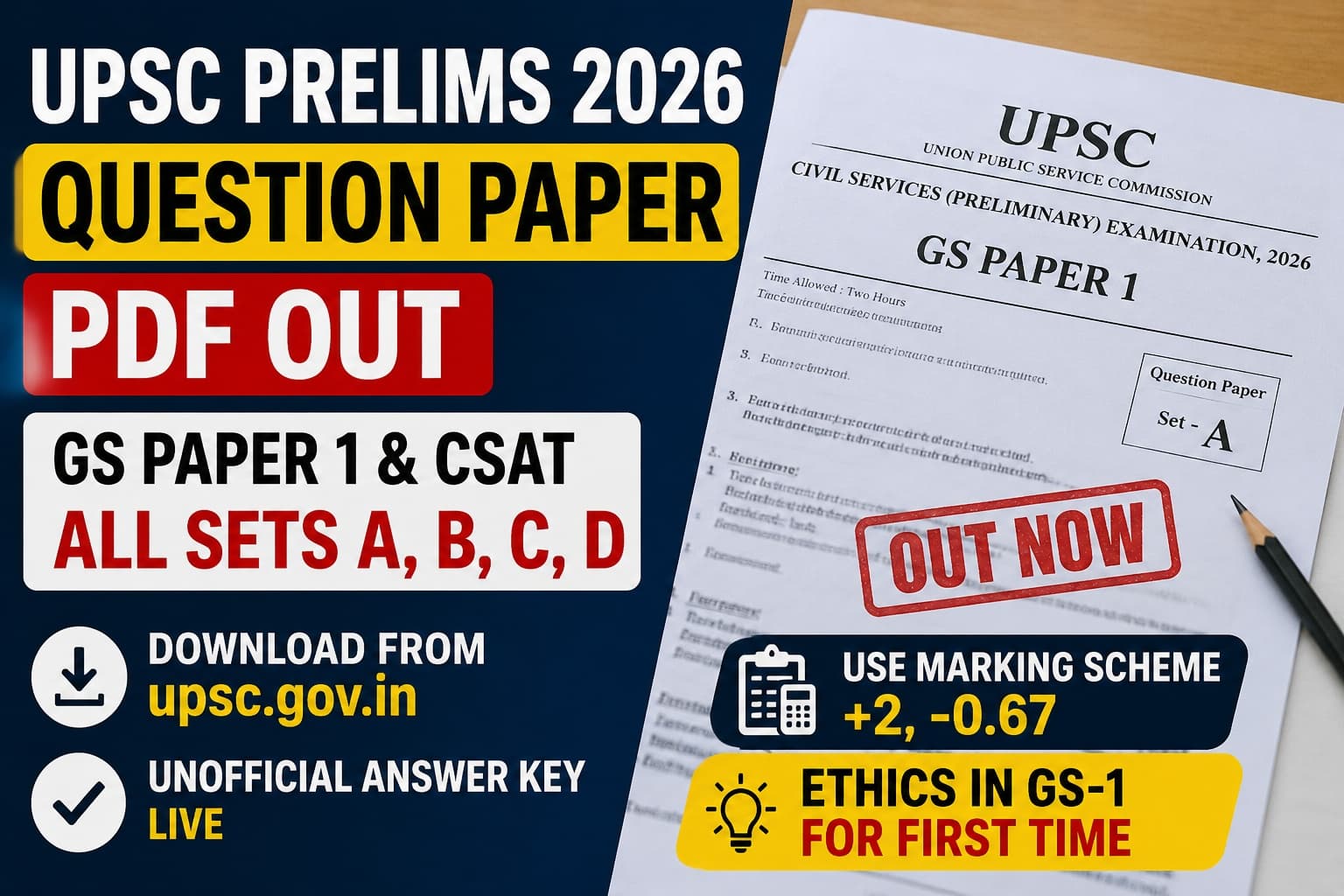 ExamUpdate
AspirantMitraa
24 May 2026
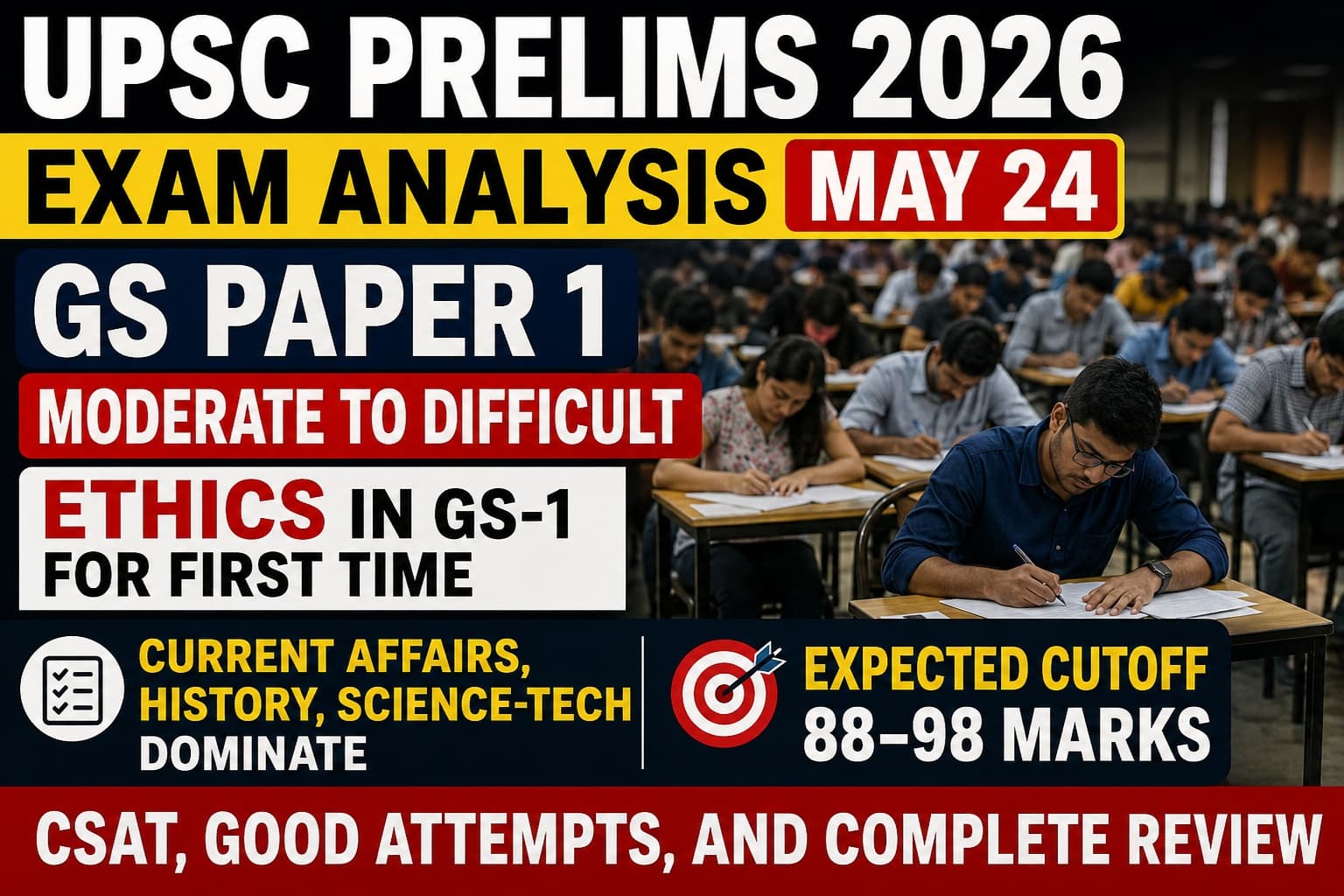 ExamAnalysis
AspirantMitraa
24 May 2026