
Loading...
Loading...
Every year, thousands of candidates who have studied comprehensively for the SBI Probationary Officer examination fail to convert their preparation into a qualifying score. They know the concepts. They have covered the syllabus. Yet they miss the cutoff by 3 to 6 marks. The reason is almost always the same: studying builds knowledge, but it does not build the speed, accuracy, and examination temperament that the SBI PO format demands. Those three qualities are built only through structured, repeated practice under conditions that replicate the actual examination as closely as possible.
The SBI PO Prelims Test Series on Aspirant Mitraa is designed to close exactly this gap. This page explains why mock testing is not optional for SBI PO, how the test series should be integrated into your preparation, what each test type builds, and how to use post-test analysis to drive improvement in each cycle of practice.
For the complete examination guide, visit the SBI PO main page. For the syllabus topics aligned with the test series, visit the SBI PO Syllabus page.
The SBI PO Prelims has a unique structural pressure that is rarely appreciated until a candidate faces it for the first time: three sections in 60 minutes with a strict 20-minute sectional lock. Once the 20 minutes for English Language are up, the system moves automatically to Quantitative Aptitude regardless of how many questions remain. There is no borrowing time from one section to another. There is no going back.
This creates a category of problems that reading and concept-building cannot solve:
Time allocation under pressure. Knowing how to solve a puzzle set does not tell you which sets to attempt and which to skip when 8 minutes remain and two incomplete sets are open on screen. Candidates need to have developed this judgment through practice, not theory.
Accuracy under speed. At 30 seconds per question in English Language (40 questions, 20 minutes), calculation errors and reading misses increase dramatically compared to relaxed practice. Only timed repetition builds the concentration required to maintain accuracy at this pace.
Negative marking discipline. Every competitive examination taker knows intellectually that guessing is risky under negative marking. But in the actual examination, with 5 minutes remaining and 8 unattempted questions, the instinct to attempt everything overrides the rule. Candidates who have practiced the discipline of leaving uncertain questions through multiple mock tests enter the actual exam with that discipline internalised rather than just understood.
Recovery from a bad start. A candidate who encounters a difficult puzzle set as the first question in Reasoning and spends 4 minutes on it before moving on has already consumed 20% of their time. In a real examination, this can create panic. A candidate who has practised this scenario in mock tests knows exactly how to recalibrate and move forward efficiently.
None of these skills can be built by reading about them. They require repetition in realistic conditions.
The SBI PO Prelims Test Series on Aspirant Mitraa is structured to cover the full preparation arc from foundation to examination readiness:
Topic-wise tests cover individual topics within each section. For example:
Topic-wise tests are the starting point. They are attempted immediately after studying a specific topic from standard sources, confirming whether conceptual understanding has been absorbed before moving forward.
Section-wise tests simulate the actual sectional experience with 20-minute windows for each section independently. These reveal performance at the section level without the full cognitive load of a complete paper.
Full-length mock tests replicate the complete Prelims experience: all three sections in sequence with strict 20-minute sectional timers, real difficulty calibration, and the same interface structure as the actual CBT. These are the most important tests in the series and should be attempted repeatedly in the final 4 to 6 weeks before Prelims.
Each test comes with:
A common mistake is beginning mock tests too early, before conceptual foundations are built. Attempting full-length Prelims mocks in the first month of preparation - when half the topics are not yet covered - produces scores that demoralise without being informative. The score is low not because of performance gaps but because of preparation gaps, which are different problems requiring different solutions.
The recommended sequence is:
Month 1 to 3 (Foundation Phase): Cover topics from standard sources. After completing each topic, immediately attempt the relevant topic-wise test. This embeds concepts actively rather than passively. At this stage, topic-wise tests are the primary test-series activity.
Month 3 to 5 (Section Practice Phase): Begin attempting section-wise timed tests daily. One 20-minute section per day alongside ongoing study provides realistic time pressure without the full examination load. Track accuracy and speed per topic within each section.
Month 5 to 6 and Final Weeks (Mock Test Phase): Begin full-length Prelims mocks. Aim for a minimum of 3 mocks per week in the final 4 weeks before the examination. Each mock should be followed by a 30 to 45-minute analysis session - more on this below.
Attempting a mock test is the visible part of the process. Analysing it is where the actual improvement happens. Most candidates score their mock, feel satisfied or disappointed, and move to the next mock without extracting the learning that makes improvement possible.
The correct post-test analysis process takes 30 to 45 minutes for every full-length mock:
Step 1 - Section-wise accuracy check. For each of the three sections, calculate: questions attempted, questions correct, questions wrong, and net score. Compare with the section-wise good attempt benchmarks (20-25 for Reasoning/QA, 28-35 for English in a typical Prelims).
Step 2 - Topic-wise error identification. Within each section, identify which specific topics generated errors. If 4 out of 5 wrong answers in Reasoning came from Blood Relations, that is a specific gap requiring targeted topic-wise test practice, not general Reasoning practice.
Step 3 - Question type analysis. Identify whether errors are conceptual (wrong approach to the problem), careless (correct approach but computation error), or strategic (spending too long on a question that should have been skipped). Each type requires a different response.
Step 4 - Time allocation review. The test analytics show time spent per question and per section. A candidate who spent 8 minutes on a single puzzle set and then rushed the remaining 10 questions in 12 minutes has a time management problem. A candidate who finished the section in 16 minutes with high accuracy may have the opposite problem of moving too quickly through questions without checking.
Step 5 - Score trend across mocks. Track your net score on each full-length mock in a simple log. The trend line - improving, plateauing, or declining - tells you whether the preparation is working. A plateau after 5 to 6 mocks in a narrow score band typically indicates that the same errors are being repeated. This is a signal to return to topic-wise tests for the specific failing areas rather than continuing to attempt more full-length mocks.
The Aspirant Mitraa SBI PO Prelims Test Series is calibrated at UPSC-equivalent difficulty levels, meaning the questions reflect the actual complexity of SBI PO papers rather than artificially easy mock questions. Consistent scores on this test series provide meaningful readiness signals.
| Consistent Mock Test Score (out of 100) Readiness Assessment Recommended Action | ||
| Below 50 | Significant preparation gaps remain | Return to topic-wise tests; increase daily study hours |
| 50 to 62 | Below safe zone; approaching but not at cutoff level | Focus intensively on highest-weightage topics; daily timed sectional practice |
| 62 to 72 | At cutoff range; manageable but not comfortable | Refine time management; reduce errors in strong topics; strengthen weak topics |
| 72 to 80 | Comfortable preparation level | Maintain consistency; focus on CSAT equivalents (DI and Puzzles accuracy) |
| Above 80 | Well-prepared; strong buffer above cutoff | Focus on maintaining accuracy; begin Mains preparation in parallel |
These benchmarks are for General/EWS category aspirants. SC/ST candidates can adjust the comfortable zone to approximately 58 to 68 based on historical cutoff patterns.
The 2025 General category Prelims cutoff was 66.75 and the 2021 cutoff was 71.00 - the highest in recent years. Targeting 72+ consistently on calibrated mocks provides a meaningful buffer in any scenario.
Puzzles dominate the section at 60% to 70% of questions in most Prelims papers. Within the test series, begin with individual puzzle types - practice linear arrangements until they are reliable, then circular, then floor-based, then multi-variable combinations. Only move to mixed Reasoning section tests once each puzzle type produces consistent accuracy.
A useful rule for Puzzles in the actual examination: if a puzzle set is not solved within 3 minutes of starting it, move on. Mark it for review and come back with remaining time. Spending 7 minutes on a single set to get 5 questions correct - when those same 7 minutes could have secured 8 to 10 marks from other question types - is a time management failure regardless of whether the puzzle was eventually solved.
DI practice must go beyond just attempting sets. In mock tests, track: which DI formats take the longest, which calculation types produce errors, and whether errors come from data misreading or arithmetic mistakes. DI from tables and simple bar graphs should be the fastest; Caselet and mixed-data DI should be allocated more time per set.
Arithmetic topics (Percentage, SI/CI, TSD) typically need the least time once fundamentals are clear. In a Prelims paper where DI is difficult, strong arithmetic performance acts as a stabiliser for the overall QA score.
With 40 questions in 20 minutes, the Reading Comprehension sets (approximately 10 questions) should be attempted first if the passage topic is familiar and the questions appear answerable. Para Jumbles are typically high-accuracy for well-prepared candidates. Vocabulary-based questions are the most variable - skip them if uncertain rather than guessing.
Error Detection in recent papers has focused on subtle grammar errors (subject-verb agreement in complex sentences, misused conjunctions). Topic-wise tests for Error Detection specifically train the eye for these patterns.
The most effective preparation combines two tools: the test series for active assessment and the SBI PO Syllabus Tracker for coverage tracking. The Tracker provides a visual map of which topics have been studied and tested, preventing the common problem where certain topics are practised repeatedly because they are comfortable while harder topics are avoided.
After each topic-wise test, update the Tracker to mark the topic as tested. This creates an audit trail of preparation that reveals genuine gaps rather than allowing comfort bias to dictate which areas get most practice time.
If you qualify Prelims, the Mains preparation phase requires a different kind of practice than Prelims. The key differences:
The sectional time limits in Mains are longer per section (up to 60 minutes for Reasoning), but the questions are significantly harder. Full-length Mains mocks must include the Descriptive Test in the same sitting - typing the essay, letter, or email immediately after 3 hours of objective questions builds the stamina required for the actual examination.
Banking Awareness and Current Affairs preparation for Mains is ongoing and cannot be compressed into the final weeks. Begin this coverage during the Prelims preparation phase so it is already underway when Mains practice begins.
Data Analysis at Mains level requires Caselet DI and Missing Data DI practice specifically - formats that do not appear in Prelims. Transitioning immediately to Mains-level DI practice after the Prelims exam day (without waiting for the result) gives candidates who qualify a 4 to 6 week head start on this critical area.
How many mock tests should I attempt before SBI PO Prelims? A minimum of 15 to 20 full-length Prelims mocks in the 4 to 6 weeks before the examination is the recommended baseline. Additional topic-wise and section-wise tests throughout the preparation period should supplement the full-length mocks, not replace them.
Should I attempt mocks before completing the full syllabus? Topic-wise tests should be attempted as you complete each topic. Full-length mocks should begin only after approximately 70 to 80% of the syllabus has been covered. Beginning full-length mocks before sufficient coverage produces uniformly low scores that indicate preparation gaps rather than performance gaps.
What if my mock test scores are consistently below 60? Consistently scoring below 60 on calibrated mocks indicates that foundational topics need stronger coverage before more mocks will produce improvement. Return to topic-wise tests and standard sources for the weakest sections, then reintroduce section-wise tests before full-length mocks.
How long should the post-test analysis take? 30 to 45 minutes per full-length mock is the recommended analysis window. Rushing the analysis to move quickly to the next mock defeats the purpose. Each mock is most valuable for what the analysis reveals about which topics and skills need more work.
Is the test series updated for the 2025 revised pattern (40 English questions, 30 QA, 30 Reasoning)? The Aspirant Mitraa SBI PO Prelims Test Series is updated to reflect the current examination pattern. Full-length mocks replicate the revised question distribution and the strict 20-minute sectional time limits that apply to each section.
The gap between knowing and performing is bridged only by structured, analytical practice. The SBI PO Prelims is an examination where preparation and performance can diverge significantly for unprepared test-takers. The candidates who consistently qualify are those who have done the preparation and validated it through realistic mock testing. Start early, analyse every test thoroughly, and let the data from your performance drive every revision decision.
Stay updated with the latest news and notifications about SBI PO Test Series 2026 - Why Mock Tests Are Non-Negotiable and How to Use Them Right and other exams.
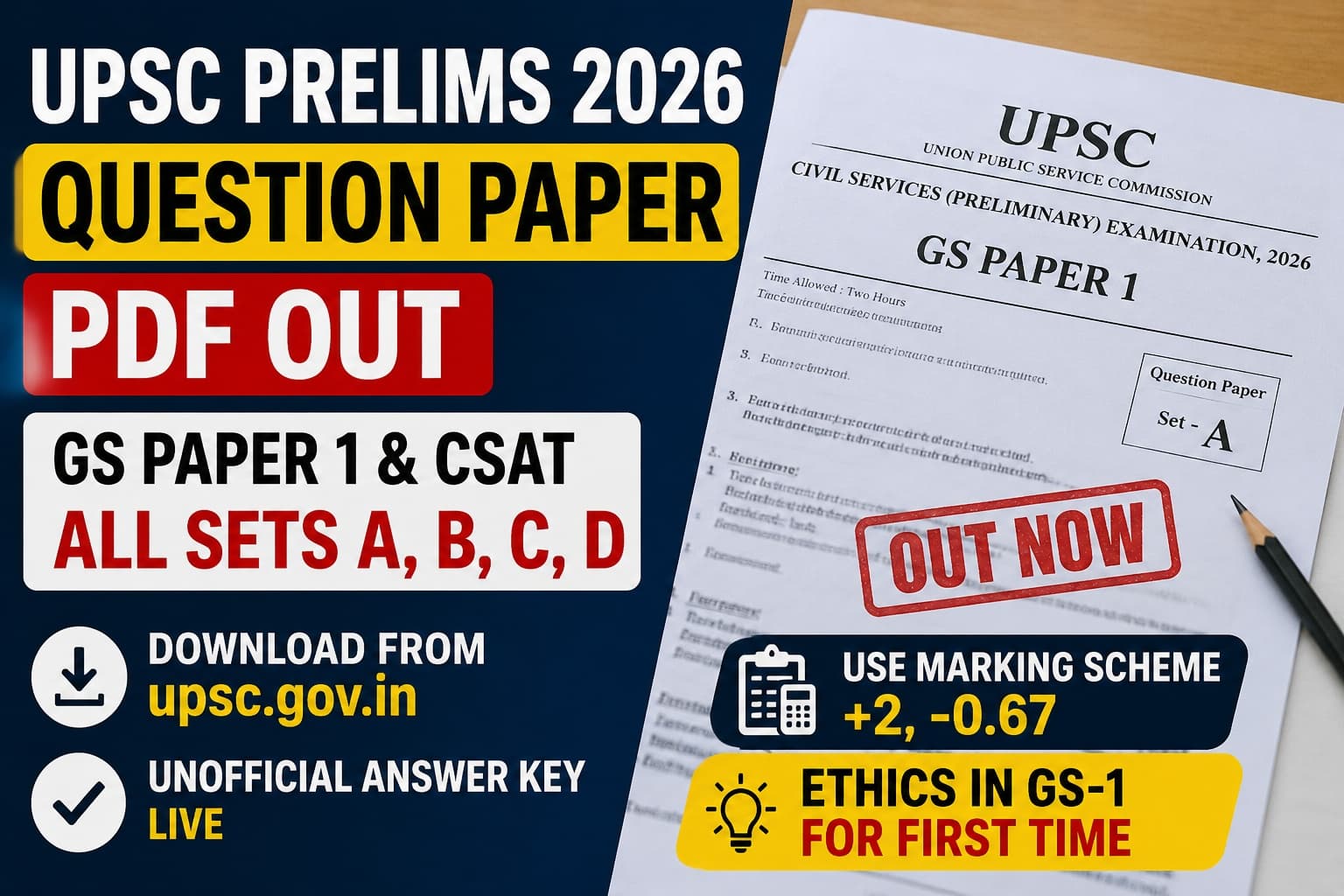 ExamUpdate
AspirantMitraa
24 May 2026
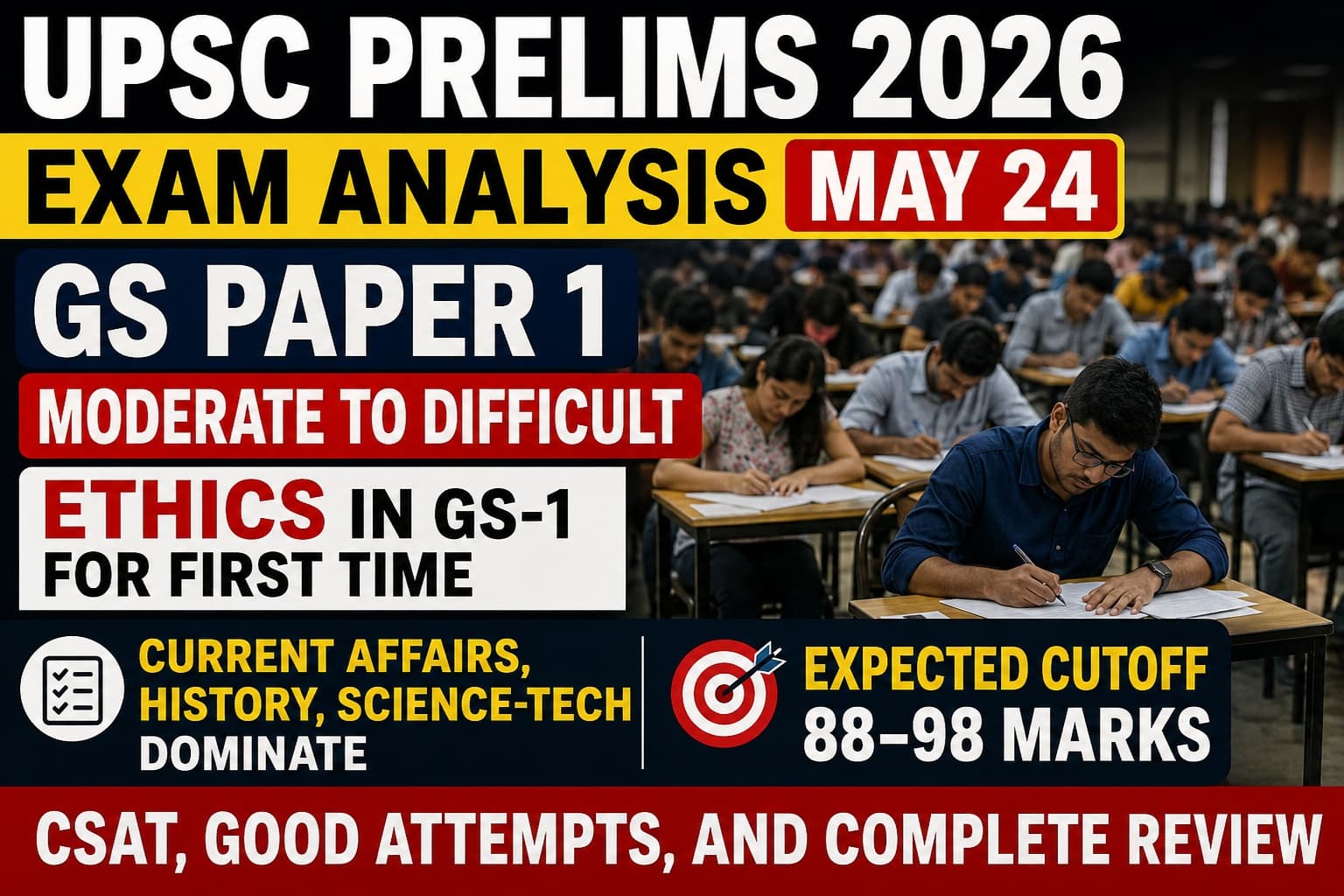 ExamAnalysis
AspirantMitraa
24 May 2026